Helmet Cleaning Machine Maintenance Checklist
Preventive maintenance checklist for commercial helmet cleaning machines: 1.7 MHz piezo descaling, 253.7 nm UV-C quartz wiping, carbon filters, and LOTO interlocks.
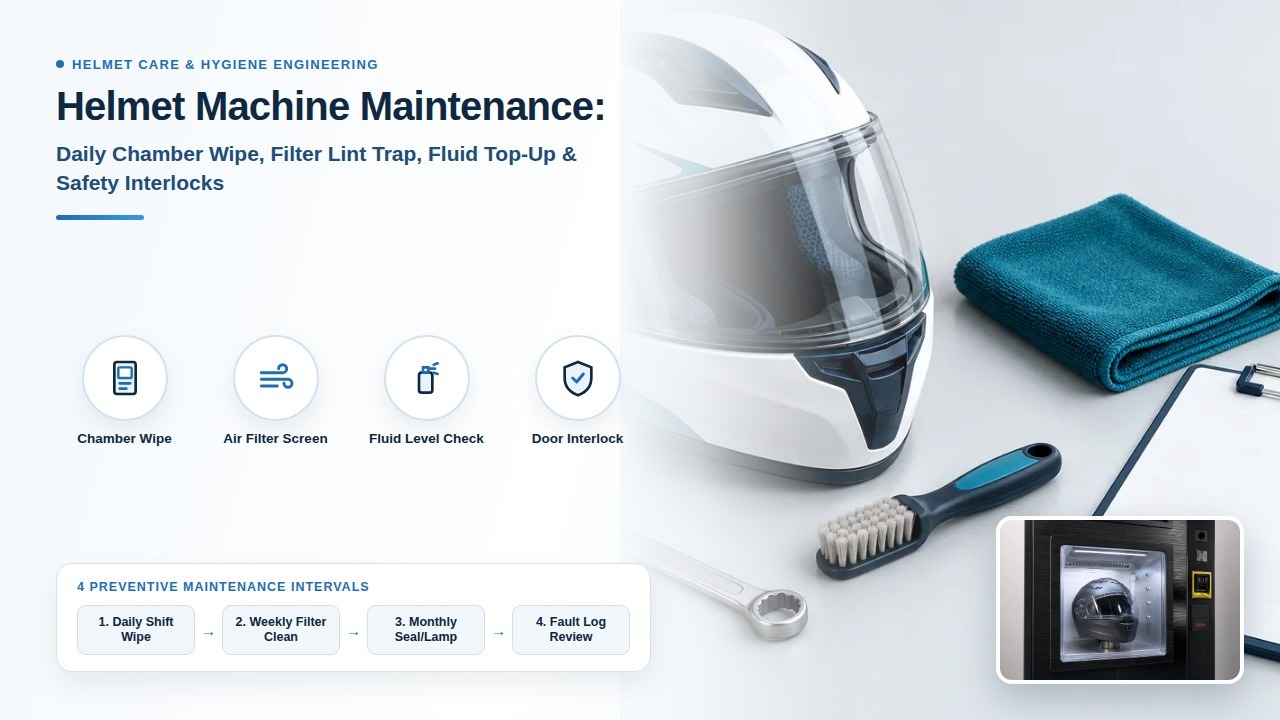
Operating a commercial helmet cleaning machine without a cycle-tracked preventive maintenance (PM) checklist causes calcium carbonate scaling on $1.7\text{ MHz}$ ultrasonic piezoelectric discs within $200\text{–}400\text{ cycles}$, invisible $35%\text{–}50%$ germicidal $253.7\text{ nm}$ UV-C attenuation from fouled quartz sleeves, clogged PTC blower lint screens that leave comfort liners damp, and fugitive ozone exhaust exceeding the $0.05\text{ ppm}$ FDA 21 CFR 801.415 limit. Fleet managers, vending route operators, and service technicians must tie every maintenance interval to cumulative cycle counts, operating hours, and OSHA 29 CFR 1910.147 hazardous-energy isolation rules rather than waiting for a hard component failure.
A complete commercial helmet cleaning machine maintenance checklist governs four engineered subsystems across four trigger intervals: (1) Daily / Per-Shift Operator Readiness (Every 20–50 Cycles) covering chamber platen wipe-down, biocide reservoir level check (8 L HCE-S1, 16 L HCE-D2, 25 L HCE-K2), silicone door gasket inspection, and MDB payment bezel readiness; (2) Weekly / 100–300 Cycle Subsystem Care covering removable PTC blower intake lint screen washing (every 50–100 cycles), cold 70%–99% isopropyl alcohol (IPA) wiping of $253.7\text{ nm}$ fused-quartz UV-C sleeves (every 250–300 cycles), and MDB cashless card-reader slot cleaning; (3) Monthly / 500 Cycle Authorized Technician PM covering 1.5%–2.0% food-grade citric acid descaling of the $1.7\text{ MHz} / 2.4\text{ MHz}$ ultrasonic atomizer basin, < 0.2 s door safety interlock cut-off verification (ISO 15858 and IEC 60335-2-75), low-liquid float-switch cutout testing, and MDB 6-pin Molex harness inspection (NFPA 70B); and (4) Semi-Annual / Cumulative Hour Overhaul (1,500–9,000 Hours) covering catalytic activated-carbon ozone destruct filter replacement every 6–12 months (3,000–4,500 cycles to keep ambient $\text{O}_3 < 0.05\text{–}0.10\text{ ppm}$ per OSHA 29 CFR 1910.1000), piezo ceramic disc replacement every 1,500–3,000 operating hours, and UV-C lamp replacement at 8,000–9,000 lamp-hours.
Download the blank maintenance record CSV to log equipment serial configurations, manual revisions, VMC/PLC cycle counters, and return-to-service sign-offs alongside your delivered equipment manual.
| Maintenance Tier & Trigger | Assigned Role & Safety Boundary | Core Subsystem Tasks & Verification Threshold | Primary Standard / Catalog Baseline |
|---|---|---|---|
Tier 1: Daily / Shift Readiness (Every shift or 20–50 cycles) | Operator / Attendant (Power ON, non-invasive external & chamber access only) | Wipe perforated helmet platen & glass window; verify biocide reservoir above 1.5 L reserve; inspect door bulb gasket; verify 0 active fault codes & MDB cashless “Ready” prompt | Helmet cleaning SOP & HCE Catalog (HCE-S1 / HCE-D2 / HCE-K2) |
Tier 2: Weekly / Cycle Cleaning (Every 50–300 cycles) | Trained Operator / Route Tech (Chamber OFF & cooled; nitrile gloves required) | Vacuum/wash PTC intake lint filter (every 50–100 cycles); wipe cold 253.7 nm UV-C quartz sleeve & touchscreen with 70%–99% IPA (every 250–300 cycles); swipe MDB cleaning card | ISO 15858 (UV-C optical transmission) & Commercial machine catalog |
Tier 3: Monthly Functional PM (Every 500 cycles or 30 days) | Authorized Service Technician (OSHA 1910.147 LOTO for internal panel access) | Soak 1.7 MHz piezo atomizer well in 1.5%–2.0% citric acid (20–30 min); test < 0.2 s door-crack UV-C/ozone interlock shutoff; verify PTC exhaust $\le 50\text{ }^\circ\text{C}$; check MDB Molex harness & 4G RSSI | IEC 60335-2-75, NFPA 70B & Snell M2020/M2025 ($\le 50\text{ }^\circ\text{C}$ EPS ceiling) |
Tier 4: Scheduled Wear-Part Overhaul (1,500–9,000 operating hours) | Authorized Service Technician (LOTO + post-repair validation log required) | Replace catalytic carbon O3 destruct cartridge (6–12 mo / 3,000–4,500 cycles); replace piezo ceramic disc (1,500–3,000 hrs); replace UV-C lamp (8,000–9,000 lamp-hrs or $< 75%$ $E_0$) | OSHA 29 CFR 1910.1000 ($\le 0.10\text{ ppm}$ $\text{O}_3$), FDA 21 CFR 801.415 ($\le 0.05\text{ ppm}$) & IES LM-85 |
What are the dominant failure modes across the four subsystems of a commercial helmet cleaning machine?
Every commercial dry-mist, UV-C, ozone, and forced-air helmet cleaning machine (HCE-S1, HCE-D2, and HCE-K2) relies on four interdependent electro-mechanical subsystems whose dominant field failure modes—piezoelectric mineral scaling, quartz optical fouling, PTC airflow starvation, and door interlock or MDB payment drift—must be prevented through scheduled physical interventions.
When a commercial helmet cleaning machine suffers unscheduled downtime or recurring odor complaints, the root cause is rarely a mainboard failure. Instead, field failures follow predictable physical degradation curves governed by feed-water mineral chemistry, ultraviolet quartz transmission, open-cell foam lint accumulation, and mechanical switch wear. Before establishing site-specific intervals, record your machine’s exact serial number, VMC/PLC firmware version, payment terminal model, and manual revision in the downloadable maintenance log so technicians never apply a single-chamber countertop checklist to a dual-slot 24/7 vending kiosk (see our equipment architecture comparison).
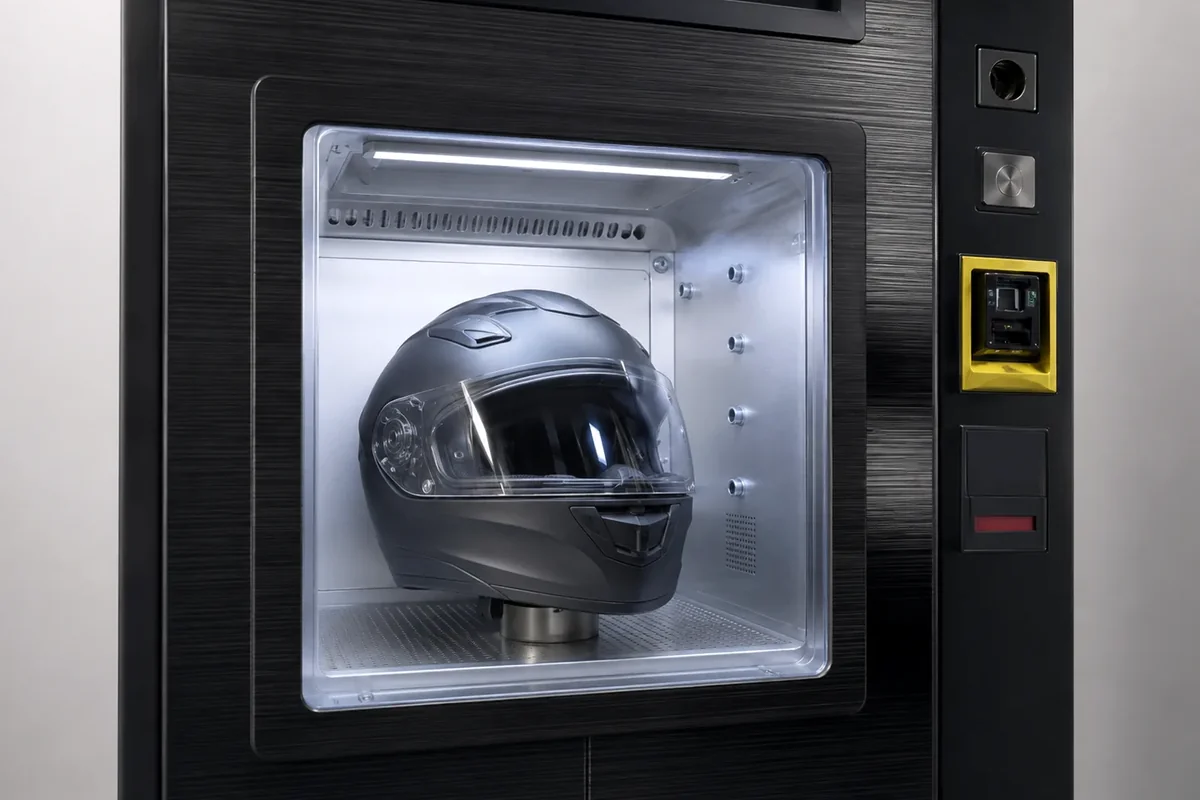
4-Subsystem Engineering Failure Mode, Inspection & Prevention Matrix
The table below defines the Standard Engineering Baseline under Reference Conditions across all four machine subsystems, detailing the component hardware, inspection method, replacement threshold, and the Dominant Failure Mode & Prevention:
| Machine Subsystem & Core Components | Routine Inspection & Measurement Method | Scheduled PM & Replacement Baseline | Applicable Standard / Safety Limit | Dominant Failure Mode & Prevention |
|---|---|---|---|---|
1. Ultrasonic Dry-Mist Atomizer & Liquid Feed Subsystem (1.7 MHz / 2.4 MHz Piezo Ceramic Disc, Peristaltic/Metering Pump, Silicone Tubing & Dual-Level Float Sensor) | Inspect mist plume density during Stage 4 (3–5 mL/cycle dose, $\le 5\text{–}10\text{ }\mu\text{m}$ droplet size); check float-switch movement and tubing for air bubbles or salt crust | Flush tubing & soak atomizer well in warm 1.5%–2.0% citric acid (15–20 g/L) for 20–30 min every 500 cycles (monthly); replace piezo ceramic disc & silicone pump tube every 1,500–3,000 operating hours | IEC 60335-2-75 liquid dispensing control & disinfectant spray label approval (pH 6.0–7.5, TDS < 30 ppm) | CaCO3 mineral & quaternary-ammonium salt crystallization on the piezo disc + float-switch bridging: Hard tap water (> 120 ppm CaCO3) or dried biocide salts coat the nickel/titanium transducer face within 200–400 cycles, cutting mist output by > 60%, trapping acoustic heat, and burning out the MOSFET driver board. Prevention: Use only RO/distilled-water-based OEM solution, perform monthly citric acid soaks (never scrape with metal tools), and verify float-switch low-liquid cutout at < 1.5 L reserve |
2. UV-C 254 nm Germicidal Lamp & Quartz Sleeve Subsystem (Low-Pressure Mercury-Vapor 253.7 nm Quartz Tube, Electronic Ballast & Specular Aluminum Reflector) | Inspect cold quartz sleeve for white mist film, dust, or fingerprints; measure 253.7 nm irradiance ($\mu\text{W/cm}^2$) at the helmet platen semi-annually with a calibrated UV-C radiometer | Wipe cold quartz tube & reflector with lint-free cloth and 70%–99% isopropyl alcohol (IPA) every 250–300 cycles; replace UV-C lamp every 8,000–9,000 cumulative lamp-hours (or when irradiance drops $< 70%\text{–}80%$ of $E_0$) | ISO 15858 (UV-C device safety) & IES LM-85 / manufacturer solarization decay curves | Optical sleeve fouling (35%–50% UV-C loss) & unmonitored quartz solarization (> 9,000 hrs): A 0.1 mm dried biocide or sebum film blocks nearly half of 253.7 nm photons while the bulb still glows visible blue (405–436 nm), resulting in silent under-dosage ($< 15\text{ mJ/cm}^2$). Prevention: Mandate 250-cycle cold 70%–99% IPA wipes wearing nitrile gloves and enforce cycle-counter lamp replacement at 8,000–9,000 hours |
3. PTC Forced-Air Heater, Centrifugal Blower & Catalytic Carbon Exhaust Filter (1200 W–2650 W Self-Regulating PTC Heater, Squirrel-Cage Blower, Intake Lint Screen & Honeycomb Carbon Bed) | Check removable intake mesh for hair/textile lint; log chamber drying temperature ($\le 45\text{ }^\circ\text{C–}50\text{ }^\circ\text{C}$) and 65 °C bimetallic cutout; check exhaust port with portable O3 sensor | Vacuum/wash primary intake lint screen every 50–100 cycles (weekly); blow out blower wheel dust quarterly; replace catalytic activated-carbon ozone destruct cartridge every 6–12 months (3,000–4,500 cycles) | Snell M2020/M2025 & ECE 22.06 ($\le 50\text{ }^\circ\text{C}$ EPS limit); OSHA 29 CFR 1910.1000 ($\le 0.10\text{ ppm}$ $\text{O}_3$ PEL) & FDA 21 CFR 801.415 ($\le 0.05\text{ ppm}$) | Lint-starved blower airflow (> 40% CFM drop) & saturated carbon filter ozone breakthrough: Hair and pad fibers choke the intake mesh, leaving cheek pads damp (> 15% moisture) and tripping the 65 °C thermal cutout, while spent carbon leaks > 0.10 ppm ozone into indoor rooms. Prevention: Clean intake lint screens weekly and swap catalytic carbon cartridges every 3,000–4,500 cycles |
4. Cabinet Door Interlock, Silicone Gasket & MDB Cashless Terminal (Dual-Channel Reed/Micro-Switch Interlock, Perimeter Silicone/EPDM Bulb Gasket, Electromagnetic Lock & Nayax/PAX MDB Reader) | Perform paper-strip gasket pinch test around all 4 door edges; crack door 3–5 mm during test cycle to verify < 0.2 s UV-C shutoff; inspect 6-pin MDB Molex harness & 4G signal (RSSI > -85 dBm) | Wipe door gasket & NFC/touchscreen bezel weekly (70%–99% IPA on microfiber, never direct spray); run MDB card-reader cleaning card every 250 cycles; replace compressed gaskets (> 25% set) every 12–18 months | ISO 15858 & IEC 60335-2-75 interlock rules; OSHA 29 CFR 1910.147 LOTO & NFPA 70B electrical maintenance | Delayed interlock cutoff (> 0.2 s), gasket compression ozone leaks & "Cashless Reader Offline" lockouts: Misaligned door switches expose users to 253.7 nm UV-C, flattened gaskets leak mist/ozone, and grimed chip pins or loose MDB plugs halt kiosk revenue. Prevention: Test < 0.2 s interlock trip monthly, never spray liquids onto payment bezels, and reseat MDB Molex connectors during monthly PM |
Scope Note: The intervals and thresholds above represent Standard Engineering Baselines under Reference Conditions for commercial enclosed dry-mist + UV-C + ozone + PTC cabinets (HCE-S1, HCE-D2, and HCE-K2). Always cross-check order-specific part numbers, fuse ratings, and wiring diagrams during Factory Acceptance Testing (FAT) and Part-Number & Serial Fitment Verification.
Takeaway: Treat the ultrasonic piezo transducer, UV-C quartz sleeve, PTC intake lint screen, and catalytic carbon exhaust bed as metered wear systems whose output degrades long before the machine fails to power on.
How do you divide maintenance responsibilities between daily operators and authorized LOTO technicians?
Separate daily non-invasive operator readiness checks (chamber wiping, intake lint screen washing, approved fluid top-ups, and fault logging) from authorized technician maintenance (citric acid transducer descaling, UV-C lamp and ballast replacement, door interlock calibration, and electrical troubleshooting) under OSHA 29 CFR 1910.147 Lockout/Tagout (LOTO) and NFPA 70B boundaries.
A common cause of secondary equipment damage—and workplace safety violations—is allowing untrained counter staff or route attendants to open rear service panels, scrape ultrasonic transducers with metal tools, or bypass a sticking door micro-switch to clear a queue. As documented in OSHA’s Control of Hazardous Energy (Lockout/Tagout) standard (29 CFR 1910.147) (fetched October 18, 2026), any service task that requires removing a fixed guard, accessing 110V–240V AC primary wiring, servicing high-frequency ultrasonic driver boards, or working near unshielded 253.7 nm UV-C lamps requires complete de-energization and physical lockout (or exclusive technician plug control on cord-and-plug units).
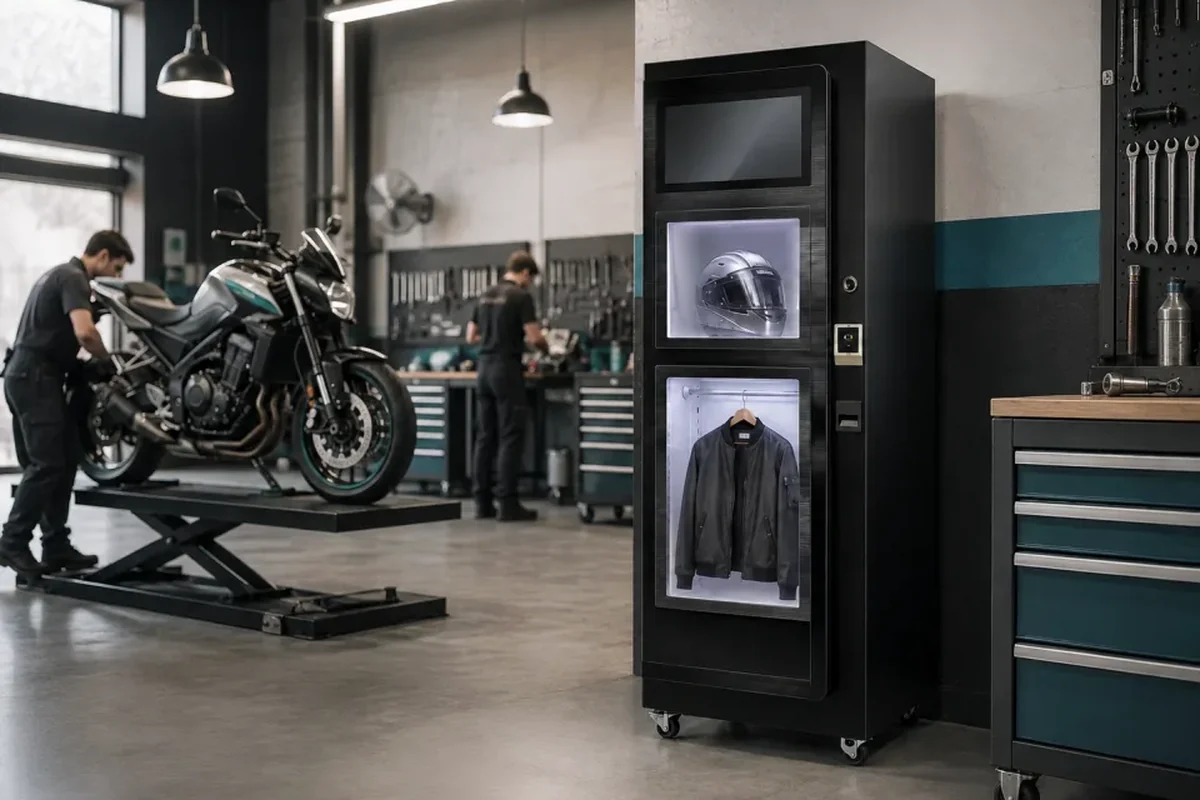
Daily Pre-Shift Operator Readiness Checklist (Every Shift or 20–50 Cycles)
Before accepting helmets at a staffed rental counter (HCE-S1 / HCE-D2) or clearing an unattended self-service helmet cleaning vending machine (HCE-K2) for daily operation, the assigned operator must complete and initial these six non-invasive checks:
| Shift Check Area | Physical Inspection & Acceptance Threshold | Mandatory Operator Action When Out of Spec |
|---|---|---|
| 1. Chamber Platen, Walls & Viewing Window | Perforated stainless helmet post/platen and Fuyao tempered glass free of mud, hair, visor stickers, or pooled moisture | Wipe interior surfaces with a lint-free microfiber cloth dampened with water or neutral cleaner; remove loose debris before loading |
2. Disinfectant & Deodorizer Reservoir (8 L / 16 L / 25 L) | Liquid level strictly above the 1.5 L low-level float switch (>= 10% tank height); batch label and expiry date valid | Top up only with the approved pre-mixed pH-neutral (6.0–7.5), low-TDS (< 30 ppm) OEM formulation; record batch lot in log |
| 3. Primary PTC Blower Intake Lint Screen | Snap-out mesh screen at chamber return air vent free of visible fiber matting or dust blanket | Pull out snap-fit lint screen, vacuum or rinse under clean water, dry completely, and reseat flush before starting shift |
| 4. Perimeter Door Gasket & Electromagnetic Latch | Silicone/EPDM bulb seal continuous, clean, and free of tears; electromagnetic lock engages smoothly without binding | Wipe gasket lip with damp microfiber cloth; if torn or failing to latch, place cabinet on Hold and escalate to authorized tech |
| 5. Power Cord, GFCI/RCD Breaker & Floor Perimeter | Supply cable jacket intact, plug cool to touch, GFCI/RCD test indicator normal, and zero liquid drips beneath cabinet | Immediately unplug or trip breaker and suspend machine if cord damage, liquid leak, or acrid electrical smell is present |
| 6. VMC/PLC Display, Cycle Counter & MDB Payment Bezel | Touchscreen shows "Ready", cumulative cycle count logged, zero unresolved fault codes, and Nayax/PAX cashless LED green | Record any active error code (E01–E08), wipe NFC/screen with dry microfiber, and follow fault suspension sequence if unresolved |
Keep unprocessed intake helmets and sanitized ready-rack helmets physically separated while completing shift preparation, following the workflow in our helmet cleaning standard operating procedure (SOP). When calculating daily station capacity, deduct 10–15 minutes per shift for readiness checks and filter cleaning as detailed in our helmet cleaning throughput calculation guide.
Takeaway: Empower operators to clean accessible lint screens, wipe chamber surfaces, and halt unsafe machines immediately—but restrict internal descaling, electrical panels, and interlock adjustments strictly to LOTO-authorized technicians.
What physical-threshold rules prevent ultrasonic transducer burnout, UV-C under-dosage, and interlock failures?
Four non-negotiable physical-threshold rules govern commercial helmet cleaning equipment longevity: never introducing hard tap water (> 120 ppm CaCO3) into 1.7 MHz ultrasonic basins, wiping UV-C quartz sleeves with 70%–99% IPA every 250–300 cycles, verifying < 0.2 s door safety interlock shutoff monthly, and scheduling wear-part replacements by the VMC/PLC cycle counter rather than calendar months.
In our cleaning, sanitizing, and disinfection evidence guide, we demonstrated why a component’s mere presence inside a cabinet does not guarantee microbial log reduction. The four engineering rules-of-thumb below translate component physics into concrete maintenance thresholds for your service team:
Rule-of-Thumb 1 — Never Filling or Diluting the Ultrasonic Fogger Reservoir with Hard Tap Water (
> 120 ppm CaCO3): If feed water or diluted disinfectant exceeds30–50 ppm TDS(or hard municipal tap water> 120 ppm CaCO3is poured into the8 L / 16 L / 25 Lreservoir) $\rightarrow$ calcium carbonate and quaternary-ammonium salt crystals plate directly onto the nickel/titanium electrode of the1.7 MHz / 2.4 MHzpiezoelectric ceramic transducer within200–400 cycles, cutting micronized (<= 5–10 µm) mist output by> 60%, trapping acoustic heat on the ceramic face, and burning out the24V/48VMOSFET driver board. Always replenish with pre-mixed RO/distilled-water-based OEM solution and soak the transducer basin in warm1.5%–2.0%food-grade citric acid (15–20 g/L) for20–30 minutesevery500 cycles—never scraping the ceramic disc with screwdrivers or abrasive pads.
Rule-of-Thumb 2 — Wiping UV-C Quartz Sleeves with
70%–99% IPAEvery250–300 CyclesRather Than Trusting Visible Blue Glow: If the253.7 nmlow-pressure mercury lamp still glows visible blue-violet (405–436 nmspectral lines) inside the chamber $\rightarrow$ do not assume germicidal fluence is intact because a0.1 mmfilm of dried disinfectant mist, aerosolized fragrance oil, or skin sebum on the fused-quartz tube absorbs35%–50%of253.7 nmUV-C photons while internal quartz solarization degrades output by20%–30%over8,000–9,000 lamp-hours. Wipe cold quartz sleeves with a lint-free cloth dampened with70%–99% isopropyl alcohol (IPA)every250–300 cycleswhile wearing nitrile gloves to prevent baked-on fingerprint carbonization.
Rule-of-Thumb 3 — Verifying
< 0.2 sDoor Safety Interlock Cut-Off at Every Monthly PM Check (ISO 15858&IEC 60335-2-75): If the chamber door is cracked open by> 3–5 mmduring an active UV-C or ozone stage $\rightarrow$ the dual-channel magnetic reed or mechanical micro-switch interlock must extinguish the253.7 nmUV-C ballast and ozone generator within< 0.2 secondsand log an interrupted-cycle fault code; if shutoff lags or the switch sticks, immediately lock out the cabinet (OSHA 29 CFR 1910.147) to prevent acute eye photokeratitis/skin erythema (ISO 158586.0 mJ/cm²8-hour actinic ceiling) and fugitive ozone exposure (> 0.10 ppmOSHA 29 CFR 1910.1000PEL).
Rule-of-Thumb 4 — Tracking Cumulative Lamp and Atomizer Hours via VMC/PLC Cycle Counter Rather Than Calendar Months: If an unattended vending kiosk (
HCE-K2) at a commuter fuel station runs60 cycles/day(21,900 cycles/year) while a seasonal rental counter unit (HCE-S1) runs12 cycles/day(4,380 cycles/year) $\rightarrow$ trigger piezo ceramic disc replacement (1,500–3,000 operating hours), catalytic carbon filter replacement (3,000–4,500 cycles), and UV-C lamp replacement (8,000–9,000 lamp-hours) from the VMC/PLC non-volatile cycle and hour counter rather than fixed calendar months so high-turnaround machines never operate past component exhaustion.
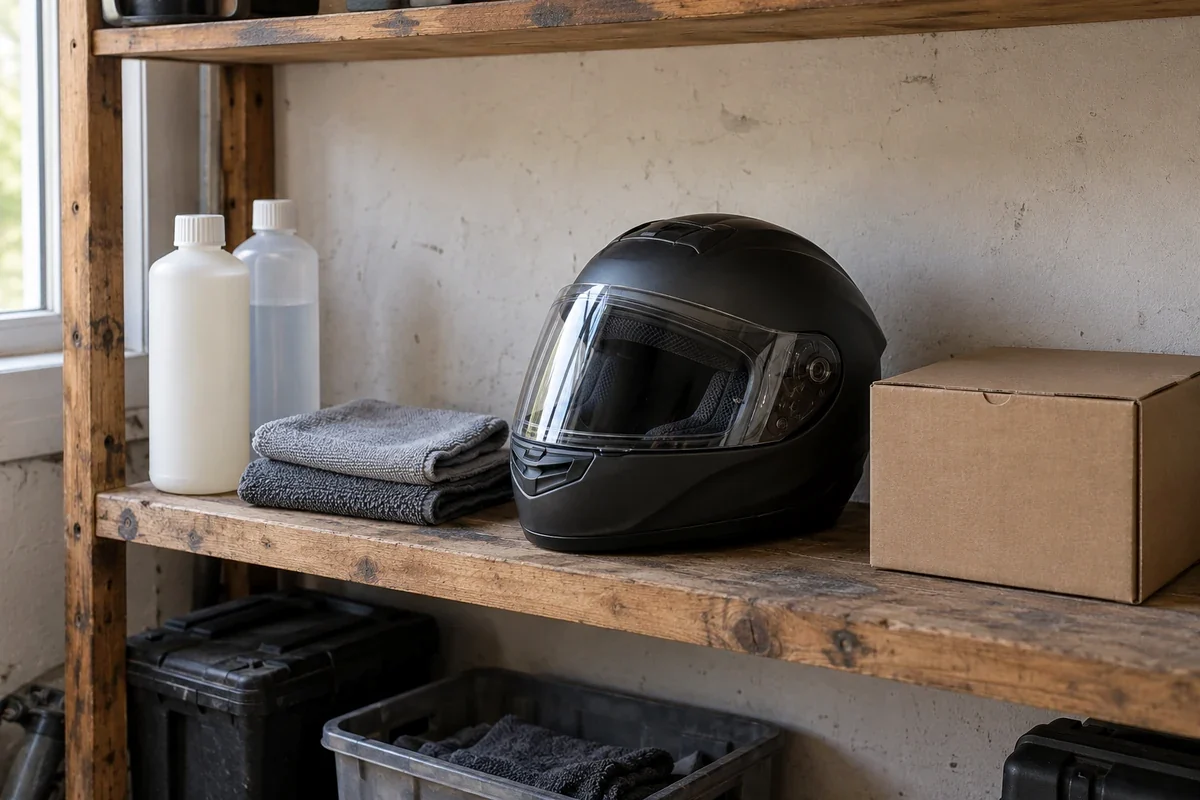
Takeaway: Never judge ultrasonic misting, UV-C germicidal dose, or ozone catalytic destruction by eye—enforce 500-cycle citric acid descaling, 250-cycle IPA quartz wiping, and cycle-counter part replacements.
How do you calculate consumable tank refill intervals ($T_{\text{refill,days}}$) and UV-C effective dose depreciation ($H_{\text{eff}}(t)$)?
Calculate your exact liquid reservoir refill interval from usable tank volume above the float-switch reserve and daily metered dosing ($T_{\text{refill,days}} = [V_{\text{tank,mL}} \cdot (1 - f_{\text{reserve}})] / [n_{\text{cycles/day}} \cdot v_{\text{dose,mL}}]$), and model delivered UV-C germicidal fluence across lamp operating hours and sleeve fouling ($H_{\text{eff}}(t) = E_0 \cdot \eta_{\text{fouling}} \cdot e^{-k_{\text{aging}} t_{\text{hr}}} \cdot t_{\text{cycle}}$).
Route operators running a multi-site helmet cleaning machine business and financial planners modeling operating expenses in the HCE ROI Calculator need deterministic formulas to schedule route van refills and verify when a fouled or aging UV-C lamp falls below its microbial target.
Equation 1: Consumable Tank Refill Interval ($T_{\text{refill,days}}$)
To prevent an unattended HCE-K2 vending kiosk (25 L tank) or staffed HCE-S1 / HCE-D2 cabinet (8 L / 16 L tank) from hitting its low-liquid float-switch lockout during a busy weekend, calculate the maximum days between refills as:
$$T_{\text{refill,days}} = \frac{V_{\text{tank,mL}} \cdot \left(1 - f_{\text{reserve}}\right)}{n_{\text{cycles/day}} \cdot v_{\text{dose,mL}}}$$
Where:
- $T_{\text{refill,days}}$ = Maximum operating days before the low-liquid float sensor trips ($\text{days}$).
- $V_{\text{tank,mL}}$ = Total nominal disinfectant reservoir capacity ($8,000\text{ mL}$ on
HCE-S1, $16,000\text{ mL}$ onHCE-D2, or $25,000\text{ mL}$ onHCE-K2). - $f_{\text{reserve}}$ = Dead-volume float-switch safety reserve fraction required to keep the ultrasonic piezo transducer and pump pickup submerged (typically $0.06\text{ to }0.10$, or $1,500\text{ mL}$ on a $25,000\text{ mL}$ tank).
- $n_{\text{cycles/day}}$ = Average daily cleaning cycles completed across all chambers fed by the reservoir ($\text{cycles/day}$).
- $v_{\text{dose,mL}}$ = Metered ultrasonic dry-mist volume atomized per cycle ($3.0\text{ to }5.0\text{ mL/cycle}$ baseline).
Worked Example (HCE-K2 25 L Vending Kiosk vs. HCE-S1 8 L Counter Unit): For an HCE-K2 kiosk with $V_{\text{tank,mL}} = 25,000\text{ mL}$ and a $1,500\text{ mL}$ float-switch cutout reserve ($f_{\text{reserve}} = 0.06$), operating at $n_{\text{cycles/day}} = 40\text{ cycles/day}$ with a metered dose of $v_{\text{dose,mL}} = 4.0\text{ mL/cycle}$, the maximum refill interval is $T_{\text{refill,days}} = [25,000 \times (1 - 0.06)] / (40 \times 4.0) = 23,500 / 160 = 146.9\text{ days}$ ($\approx 5,875\text{ cycles}$)—whereas a compact HCE-S1 counter cabinet ($V_{\text{tank,mL}} = 8,000\text{ mL}$, $f_{\text{reserve}} = 0.10$) processing $30\text{ cycles/day}$ at $4.0\text{ mL/cycle}$ reaches its float cutout in $T_{\text{refill,days}} = (8,000 \times 0.90) / (30 \times 4.0) = 7,200 / 120 = 60.0\text{ days}$ ($\approx 1,800\text{ cycles}$).
Equation 2: UV-C Effective Germicidal Dose Depreciation ($H_{\text{eff}}(t)$)
During Stage 3 irradiation, the effective 253.7 nm germicidal fluence delivered to the exposed helmet shell and visor surface at cumulative lamp operating hour $t_{\text{hr}}$ is governed by both external quartz sleeve fouling ($\eta_{\text{fouling}}$) and internal mercury-lamp solarization decay ($e^{-k_{\text{aging}} t_{\text{hr}}}$):
$$H_{\text{eff}}(t) = E_0 \cdot \eta_{\text{fouling}} \cdot e^{-k_{\text{aging}} \cdot t_{\text{hr}}} \cdot t_{\text{cycle}}$$
Where:
- $H_{\text{eff}}(t)$ = Effective
253.7 nmgermicidal UV-C dose delivered per cycle at lamp age $t_{\text{hr}}$ ($\text{mJ/cm}^2$). - $E_0$ = New-lamp clean-sleeve baseline irradiance measured at the helmet surface reference plane ($\text{mW/cm}^2$).
- $\eta_{\text{fouling}}$ = Optical quartz sleeve transmission factor ($0.95\text{ to }1.00$ when wiped every $250\text{ cycles}$ with
70%–99% IPA; drops to $0.50\text{–}0.65$ when coated with a $0.1\text{ mm}$ dried biocide/sebum film). - $k_{\text{aging}}$ = Low-pressure mercury quartz solarization decay constant (typically $3.0 \times 10^{-5}\text{ to }3.8 \times 10^{-5}\text{ hr}^{-1}$, corresponding to $\approx 25%$ decay at $8,000\text{–}9,000\text{ hr}$).
- $t_{\text{hr}}$ = Cumulative energized lamp operating hours recorded by the PLC/VMC counter ($\text{hours}$).
- $t_{\text{cycle}}$ = UV-C stage irradiation duration per cleaning cycle ($\text{seconds}$).
Worked Example (Maintained vs. Unwiped Quartz Sleeve at 6,000 Lamp-Hours): Assume a cabinet delivers $E_0 = 0.20\text{ mW/cm}^2$ at the helmet surface over a $t_{\text{cycle}} = 180\text{ s}$ irradiation stage ($36.0\text{ mJ/cm}^2$ initial baseline against a $\ge 20.0\text{ mJ/cm}^2$ validation target), with $k_{\text{aging}} = 3.5 \times 10^{-5}\text{ hr}^{-1}$ at $t_{\text{hr}} = 6,000\text{ lamp-hours}$ ($e^{-0.21} = 0.811$). On a machine whose quartz sleeve is wiped with 70%–99% IPA every $250\text{ cycles}$ ($\eta_{\text{fouling}} = 0.95$), the delivered fluence is $H_{\text{eff}} = 0.20 \times 0.95 \times 0.811 \times 180 = 27.7\text{ mJ/cm}^2$ (passing validation with a $38.5%$ safety margin). On an unmaintained machine with a $0.1\text{ mm}$ dried mist residue on the sleeve ($\eta_{\text{fouling}} = 0.52$), delivered fluence collapses to $H_{\text{eff}} = 0.20 \times 0.52 \times 0.811 \times 180 = 15.2\text{ mJ/cm}^2$—failing the $20.0\text{ mJ/cm}^2$ disinfection threshold by $24%$ even though the lamp has $3,000\text{ hours}$ of rated life remaining.
Takeaway: Log both cumulative cycle counts and solution batch top-ups so refills happen $10\text{–}14\text{ days}$ before float-switch lockout and UV-C sleeves never lose half their germicidal fluence to surface film.
How should staff execute fault suspension, LOTO isolation, and return-to-service verification?
When a machine exhibits an error code, ozone smell, liquid leak, or incomplete drying cycle, staff must immediately suspend payment acceptance, quarantine any helmet inside the chamber, isolate electrical energy under OSHA 29 CFR 1910.147 before internal troubleshooting, and complete a documented return-to-service verification before reopening.
Never allow attendants to clear an active fault by cycling the main breaker off and on repeatedly. Unresolved restarts erase volatile diagnostic states, risk energizing a shorted heater or ultrasonic driver board, and leave held helmets in an unknown hygiene state. Follow this strict 5-step fault-response and return-to-service sequence:
- Immediate Service Suspension & Payment Lockout: If an abnormal odor, strange blower noise, liquid drip, door-latch failure, or display fault code (
E01low fluid,E02door interlock open,E03PTC over-temp cutout,E04UV-C ballast fault, orMDB Offline) occurs, place the unit out of service immediately. On unattendedHCE-K2kiosks, disable vending acceptance remotely via the 4G telemetry dashboard (Nayax MoMa / VMC cloud) so riders are not charged for an unavailable machine. - Quarantine of Interrupted Helmets: Unlock the chamber using the manual release procedure, place any helmet that was mid-cycle into a labeled quarantine tote, and evaluate its liner moisture, visor condition, and odor using the helmet cleaning SOP, visor chemical check guide, padding washability intake guide, and five-year rule service-intake register.
- Diagnostic Evidence Capture (External & Display Only): Before powering down for service, record the exact error code, cumulative cycle count, active stage at fault (
Preheat,Ozone,UV-C,Dry-Mist, orDrying), and manual revision in the maintenance log. Take clear photographs of the display screen and accessible chamber condition without opening restricted electrical enclosures. - LOTO Energy Isolation & Authorized Repair: Before opening rear access doors to service the
110V/220Vmainboard, PTC heater, ultrasonic driver, or ozone generator, the authorized technician must disconnect power and apply a physical lock and tag (OSHA 29 CFR 1910.147 and NFPA 70B). Replace failed components only with part-number-verified OEM spares confirmed against your supplier document verification file. - Return-to-Service Acceptance Gate: Power-on alone never authorizes reopening. Before releasing the machine for customer helmets, the authorized person must verify and sign off four checks in the log:
- All fixed guards, rear service panels, and ground bonding straps are reinstalled and torqued.
- Door safety interlock cuts power to the
253.7 nmUV-C lamp and ozone module in< 0.2 swhen cracked (ISO 15858&IEC 60335-2-75). - One complete empty test cycle (
3–5 min) runs to completion with verified mist plume, chamber air temperature $\le 50\text{ }^\circ\text{C}$, and zero exhaust ozone odor (see our recurring odor troubleshooting checks). - Held helmets from Step 2 have been re-processed in a verified cycle or returned under documented customer resolution.
Common mistake: Repeatedly power-cycling a cabinet to clear a thermal cutout (
> 65 °C) or low-liquid float fault (< 1.5 L) instead of cleaning the clogged PTC lint screen or descaling the bridged float sensor—which rapidly burns out the PTC blower motor or ultrasonic MOSFET driver board.
Takeaway: A fault remains open until LOTO repair, guard reinstallation, < 0.2 s interlock verification, and an empty test cycle are signed off by the authorized person in the maintenance log.
What does a 5-year TCO ledger reveal about unmaintained hard-water transducer burnout vs. a scheduled PM kit program?
Over a 5-year commercial lifecycle (75,000 cycles at 15,000 cycles/year), running a helmet cleaning machine on reactive “fix-it-when-it-breaks” practices with hard tap water and unwiped filters costs $3.4\times\text{ to }4.9\times$ more than executing a scheduled PM checklist with an annual $140–$260 OEM wear-parts kit.
When evaluating commercial equipment on our helmet cleaning machine price page or scoping a rental deployment, buyers often overlook how inexpensive preventive consumables are compared to emergency truck rolls, burnt-out ultrasonic driver boards, and lost weekend vending revenue.
5-Year Maintenance TCO Ledger: Unmaintained Run-to-Failure vs. Scheduled Cycle-Tracked PM Program (Assumed Baseline: 15,000 Cycles/Year, 75,000 Cycles over 5 Years)
Note: The comparative engineering ledger below models a commercial dual-chamber cabinet or self-service kiosk (HCE-D2 / HCE-K2) completing $15,000\text{ cycles/year}$ ($75,000\text{ cycles}$ over 5 years) under stated reference assumptions:
| 5-Year Cost / Loss Category | Unmaintained / Reactive Run-to-Failure (Hard Tap Water, Unwiped UV-C & Clogged Lint Mesh) | Scheduled Cycle-Tracked PM Checklist + Annual OEM Wear-Parts Kit (HCE-D2 / HCE-K2) | Engineering Root Cause & Prevention Reference |
|---|---|---|---|
| Ultrasonic Atomizer Discs, Pumps & Driver Boards | $8\text{–}12$ scaled piezo discs + $3\text{–}4$ burnt-out MOSFET driver boards & clogged pumps ($\approx $1,450\text{–}$2,600$) | $3\text{–}4$ scheduled piezo ceramic discs (1,500–3,000 hrs) + monthly 1.5% citric acid soak ($\approx $180\text{–}$320$) | Hard water (> 120 ppm CaCO3) plates ceramic discs in 200–400 cycles; RO/distilled OEM fluid + citric acid soak prevents thermal burnout |
| UV-C Germicidal Lamps, Sleeves & Ballasts | Fouled sleeves (35%–50% dose loss) + lamp cathode failure spiking electronic ballasts ($\approx $650\text{–}$1,200$) | 250-cycle cold 70%–99% IPA wipes + scheduled lamp swap at 8,000–9,000 lamp-hrs ($\approx $160\text{–}$280$) | Nitrile-gloved IPA wiping preserves $\eta_{\text{fouling}} \ge 0.95$ (ISO 15858) and protects electronic ballasts |
| PTC Heater, Centrifugal Blower & Carbon Exhaust | Lint-choked blower burnout + thermal cutout trips + indoor ozone complaints ($\approx $1,100\text{–}$2,100$) | Weekly intake lint screen wash ($0) + 6–12 mo catalytic carbon cartridge swap ($\approx $250\text{–}$450$) | Clean lint mesh maintains airflow at $\le 50\text{ }^\circ\text{C}$; fresh carbon keeps $\text{O}_3 < 0.05\text{ ppm}$ (FDA 21 CFR 801.415) |
| Door Gaskets, Interlocks & MDB Payment Reader | Torn gaskets, stuck interlocks & "Cashless Reader Offline" truck rolls ($\approx $1,200\text{–}$2,400$ emergency field labor) | Monthly < 0.2 s interlock check + 250-cycle MDB cleaning cards + 18-mo gasket swap ($\approx $150\text{–}$260$) | Pre-saturated MDB cleaning cards and Molex harness checks (NFPA 70B) eliminate false reader lockouts |
| Unplanned Weekend Downtime & Refunded/Lost Vends | $18\text{–}35\text{ days/yr}$ offline waiting for emergency parts & service ($\approx $6,750\text{–}$13,125$ lost net margin over 5 yr) | $< 2\text{ days/yr}$ planned off-peak PM window with on-site spare-parts kit ($\approx $0\text{–}$350$ opportunity cost) | On-site 12-month wear-parts kit (piezo disc, UV-C bulb, fuse, lint screen, gasket) prevents multi-day downtime |
| Estimated 5-Year Total Maintenance & Downtime TCO | $$11,150\text{–}$21,425$ ($14.9\text{–}28.6\text{ cents/cycle}$ in failures & lost vends) | $$740\text{–}$1,660$ ($1.0\text{–}2.2\text{ cents/cycle}$ total PM cost) | Net 5-Year Savings: $$10,410\text{–}$19,765$ per machine via scheduled cycle-tracked preventive maintenance |
Takeaway: Stocking a $140–$260 annual wear-parts kit (piezo discs, UV-C lamp, catalytic carbon cartridge, intake lint screen, and silicone door gasket) and following a 250/500-cycle PM routine eliminates over $10,000 in avoidable 5-year downtime and board repairs.
What to send us for a maintenance spare-parts kit, fault diagnosis, or configuration quotation
Whether you are ordering a 12-month preventive maintenance wear-parts kit for an installed unit, escalating a logged fault code, or configuring a new commercial helmet cleaning machine or OEM custom-branded vending kiosk, send us the five engineering items below:
| Item | Why we need it | Example format |
|---|---|---|
| 1. Equipment identifier, model & serial number | Matches your exact ultrasonic atomizer frequency (1.7 MHz vs 2.4 MHz), UV-C lamp length/wattage, PTC voltage (110V vs 220V), and VMC/PLC board revision | Model code and serial plate photo (e.g., HCE-K2, Serial HCE-2026-0842, 220V/50Hz dual-chamber) |
| 2. Manual revision & VMC/PLC cycle/hour counter | Determines whether your machine is due for its 500-cycle citric acid descale, 3,000-cycle carbon filter swap, or 8,000-hour UV-C lamp replacement | Manual revision code and current display counter (e.g., Rev 2.4, 14,620 cumulative cycles / 1,218 operating hours) |
| 3. Active fault code, cycle stage & symptom log | Pinpoints whether an interruption occurred during Stage 1 Preheat, Stage 2 Ozone, Stage 3 UV-C, Stage 4 Dry-Mist, or Stage 5 PTC Drying | Exact screen message, stage, and symptom (e.g., Fault E01 Low Liquid at Stage 4 despite half-full 25 L tank) |
| 4. Approved consumable batch & feed-water TDS profile | Verifies whether mineral scaling (> 120 ppm CaCO3) or unapproved viscosity/surfactants caused piezo transducer or float-switch fouling | Disinfectant product name, SDS/batch lot, and whether pre-mixed RO/distilled or local water is used |
| 5. Safely taken external & chamber photographs | Allows our engineering team to inspect nozzle salt crust, quartz sleeve film, intake lint mesh, and MDB harness seating without live electrical exposure | 3–4 clear photos of the display screen, open cold chamber interior, intake filter, and serial rating plate |
Send your equipment configuration, manual version, cycle counter reading, fault code, and safely taken external photographs through the HCE contact page or review complete machine and spare-parts packages on our helmet cleaning machine quotation page for a configuration, spare-parts kit, and Factory Acceptance Testing (FAT) discussion. We reply within 24 hours.
Method and sources
Compiled and verified on October 18, 2026 from international appliance and workplace safety standards, ultraviolet and ultrasonic component engineering guidelines, and HCE commercial equipment baselines:
- Commercial Dispensing Appliance Safety & Electrical Maintenance: IEC 60335-2-75 (Particular requirements for commercial dispensing appliances and vending machines), NFPA 70B (Standard for Electrical Equipment Maintenance), and OSHA 29 CFR 1910.147 — The Control of Hazardous Energy (Lockout/Tagout) (fetched October 18, 2026).
- UV-C Germicidal Safety, Quartz Sleeve Transmission & Lamp Depreciation: ISO 15858 (UV-C Devices — Safety information — Permissible human exposure, $\le 6.0\text{ mJ/cm}^2$ 8-hour actinic limit at
253.7 nm), IES LM-85 optical depreciation measurement principles, and low-pressure mercury-vapor quartz sleeve70%–99% isopropyl alcohol (IPA)cleaning and8,000–9,000 hourreplacement protocols. - Ozone Occupational Exposure & Catalytic Destruct Baselines: OSHA 29 CFR 1910.1000 ($0.10\text{ ppm}$ 8-hour TWA permissible exposure limit), NIOSH Pocket Guide (
NPGD 0476), and U.S. FDA 21 CFR 801.415 ($0.05\text{ ppm}$ indoor medical/enclosed device ozone ceiling). - Ultrasonic Piezoelectric Transducer & Helmet Polymer Limits:
1.7 MHz / 2.4 MHzpiezoelectric ceramic transducer1,500–3,000 hourservice life and1.5%–2.0%food-grade citric acid descaling protocols; SHOEI USA Helmet Maintenance Guide ($\le 30\text{ }^\circ\text{C}$ liner wash, neutral pH) and Snell M2020/M2025 / UNECE R22.06 expanded polystyrene (EPS) $\le 50\text{ }^\circ\text{C}$ ($122\text{ }^\circ\text{F}$) thermal ceiling. For related operational guides, browse the Operations & Maintenance archive.
Frequently Asked Questions
How often should the ultrasonic atomizer disc and UV-C quartz lamp be cleaned or replaced?
Why does a UV-C lamp still glow blue when its germicidal disinfection output has failed?
Can operators top up the disinfectant reservoir with tap water or generic household cleaners?
Who is authorized to clear a safety interlock fault and return a suspended helmet cleaning machine to service?
How should helmets inside the chamber be handled if an unresolved fault interrupts a cleaning cycle?
Related articles

How to Clean a Football Helmet: Team Equipment-Room SOP
Run a football helmet cleaning and sanitizing SOP with component checks, disinfectant label decisions, batch planning and a downloadable team care log.
Read article
How to Clean a Motorcycle Helmet: Manual vs Automated Process
Follow a motorcycle helmet's care instructions, separate washable pads from fixed parts, and compare manual cleaning with a documented automated process.
Read article
The Five-Year Helmet Rule: Check Dates and Retirement Instructions Before Cleaning
Separate manufacture, purchase, first-use, warranty and replacement dates before accepting an older helmet for cleaning, using a date-source intake register.
Read article