Helmet Deodorizer or Recleaning? Track Recurring Odor Before Release
When a shared helmet keeps smelling, hold it and log where it smells, whether it is damp, what care was done and how it was stored before adding fragrance.
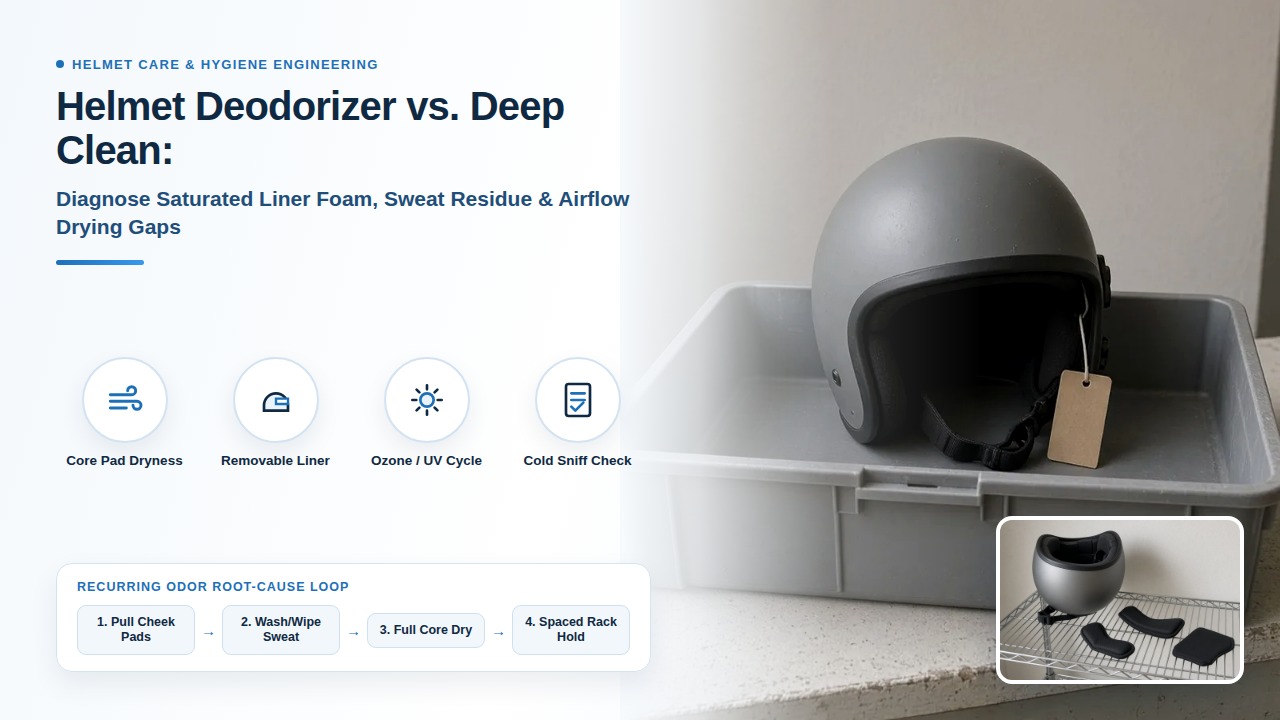
Spraying more deodorizer on a shared helmet that keeps smelling can hide why it smells, and the next renter gets the same helmet back. When an odor complaint repeats on one helmet, stop adding fragrance and hold it.
A helmet deodorizer treats the smell, not the reason for it, so a second complaint on the same helmet ID is a hold, not a second spray. Record where the smell is, whether the interior is still damp, what care was done and how the helmet was stored. Then repeat only a step the helmet’s own care document permits, or escalate it. The log on this page is an operator record. It does not diagnose mold or infection, and it gives no drying time, temperature or dose.
| Check | Where it comes from | Why it matters |
|---|---|---|
| Helmet ID and model | Your intake record | Links every complaint to one helmet |
| Where it smells | Staff observation | Points to the part that needs a decision |
| Interior type | The helmet’s care document | Sets which rework is allowed |
| Still damp? | Staff observation at release and at complaint | Separates a drying problem from a soil problem |
| Storage state | Where the helmet sat before reuse | Shows whether it was stored damp or crowded |
| Earlier actions | Previous log rows | Shows whether fragrance has been added without a finding |
Why does a helmet deodorizer not settle a repeat complaint?
Because a deodorizer works on smell, and smell is a weak record. The site’s cleaning and disinfection guide says it directly: deodorizing concerns odor, a fresher smell does not establish cleaning, sanitizing or disinfection, and fragrance does not prove cleaning or disinfection.
The same guide notes that sweat, skin oils, dust, cosmetics and other residue can remain on padding, straps and shell surfaces, and that a process that reduces odor may not remove this material. If that residue, or moisture, is still there, the smell can come back after the fragrance fades.
The featured homepage configuration lists five cabinet stages: warm-air preparation, ozone treatment, UV treatment, spray cleaning plus fragrance, and controlled drying. Our reading is that re-running a cycle that includes fragrance can make a returned helmet smell better at release without anyone recording why it smelled. That is why the log asks for the observation before the action.
Rider forums show the same pattern from the other side. In a 2022 equestrian forum thread asking for a helmet deodorizer, replies ranged from scented sprays to charcoal packs, sunlight and rubbing alcohol, and one rider said they did not want moisture sitting around. Those are personal habits, not care instructions. Some of them conflict with helmet documents, as the sections below show.
Takeaway: A smell that returns after fragrance is a finding to record, not a reason to spray again.
What should staff record when the smell comes back?
Open one log per helmet ID and add a row each time a complaint or a failed odor check happens. The helmet cleaning SOP already asks for an incident record with the helmet identifier, program, consumable batch where relevant, fault or rejection, action taken and the person authorizing release. This log adds the odor-specific observations to that record.
| Log field | What to enter | Leave blank when |
|---|---|---|
| Date and helmet ID | The internal identifier from intake | Never. Without an ID the row cannot be linked. |
| Complaint source | Renter report, staff release check, or return inspection | — |
| Where it smells | Crown, cheek pads, chin strap, fixed lining, shell vents, or “not located” | Staff could not locate it. Write “not located.” |
| What is visible | Visible soil, staining or damage, in plain words | Nothing is visible. Write “none seen.” |
| Dampness | Damp or dry to the touch, and where | — |
| Interior type | Removable comfort pads, fixed interior, or not identified, from the care document | The document is missing. Write “document absent.” |
| Care step last done | The step and the document section that permits it, or the program version if a cabinet was used | No permitted step is known |
| Fragrance or deodorizer added | Product name as printed, or “none” | — |
| Storage before reuse | Where it sat, whether it was damp when stored, and whether helmets were stacked or touching | Not known. Write “not known.” |
| Earlier rows for this ID | How many earlier odor rows exist | This is the first row |
| Disposition | Release, repeat a permitted step, hold, or refer | — |
| Person responsible | Who decided, and who takes the next action | — |
Fill the observation fields before the action fields. A row that records “deodorizer added” with “where it smells” left empty is the pattern this log is meant to stop.
Common mistake: Recording the action and skipping the observation. Without “where it smells” and “dampness,” the next person cannot tell whether the last rework addressed anything.
Takeaway: One log per helmet ID. Observations first, then the action.
Washable or fixed interior: which rework is allowed?
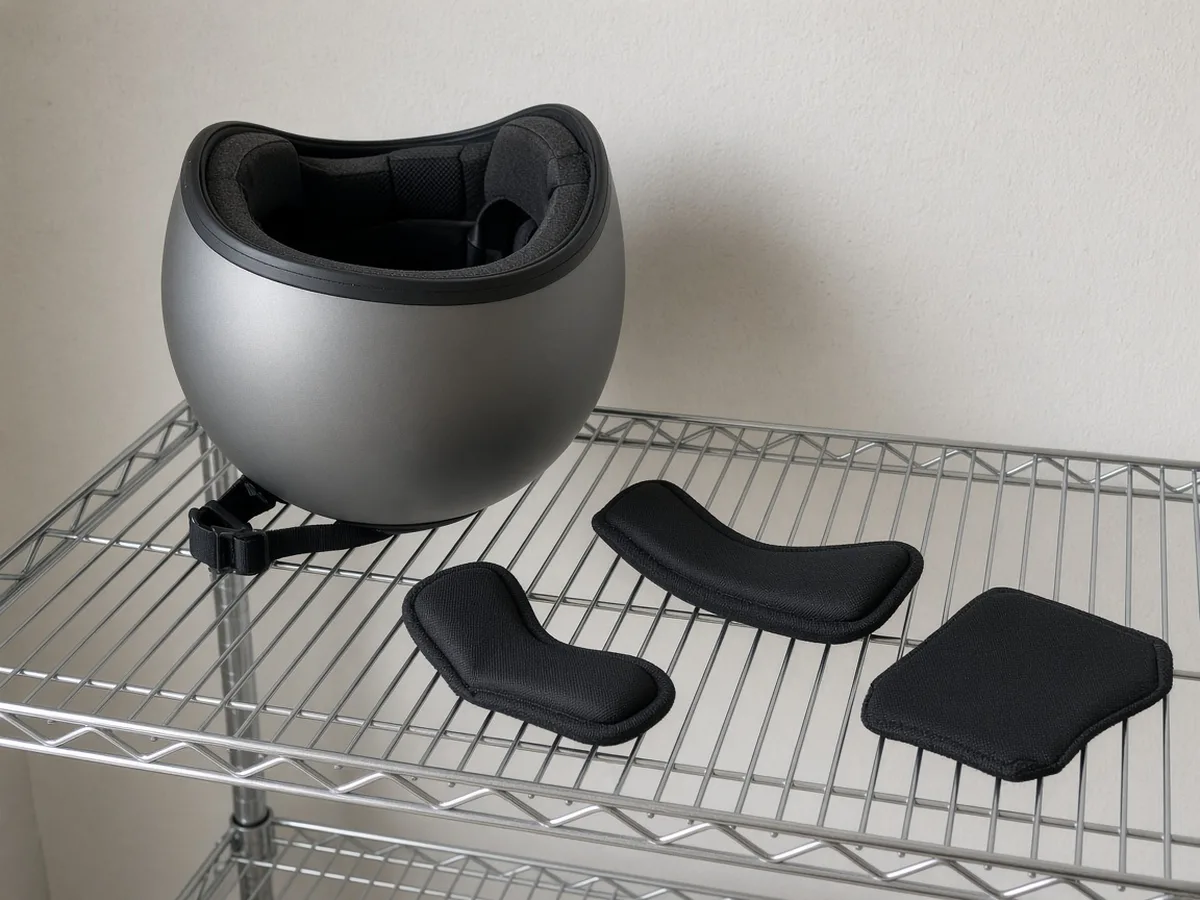
The interior type decides the rework, and the helmet’s own document decides the interior type. Use the padding washability intake guide to separate removable comfort pads, fixed interiors and the impact liner before choosing any step.
Two public helmet documents show how far the permitted care can differ. One motorcycle-helmet maker’s maintenance page says removable interiors may be washed by hand or in a washing machine inside a washing net, and that interiors should be replaced when they get frayed or cut. For fixed interiors, it says to wipe with neutral detergent mixed with water, and for extreme stains to tap them with a cloth soaked in cold or warm water with neutral detergent or shampoo. It also says the EPS liner is weak against solvent or heat.
One hockey-helmet booklet is narrower. It says not to use cleaners or any other chemical unless that maker approved and sold it for that helmet, to use only a damp cloth and mild soap, to wipe with a clean dry cloth, to dry after each use, and not to expose the helmet to direct sunlight.
Each document applies only to its own helmets. They are shown here to explain why the log asks for the interior type and the document, not to supply a method.
| Interior found | Rework the document may allow | Hold or refer when |
|---|---|---|
| Removable comfort pads, washing permitted for that part | Wash that part by the documented method, then record drying before refitting | The smell is located in a part that is not removable |
| Fixed interior with a stated surface-care method | Repeat only that stated method | The document gives no method for the fixed interior |
| Document permits only a damp cloth and mild soap | Repeat that step, wipe and dry as written | A deodorizer, spray or other chemical is being considered |
| Smell or soil located at the impact liner | No routine rework from this page | Always refer to the helmet maker’s route |
| Interior type or document not identified | None | Always hold until the document is found |
If someone wants to use a spray, that is a separate decision with its own record. Use the two-document spray label check before any spray touches the helmet.
Takeaway: Repeat only the step the exact helmet document names for the exact part.
Is the helmet still damp, or was it stored damp?
Check dampness twice: at release, and again when the complaint arrives. The SOP’s release check already covers odor and dryness, and it names releasing a damp helmet because the machine displayed “complete” as a common mistake.
This page gives no drying time or temperature. Take the drying method from the helmet document, and do not borrow a drying time from another helmet. The padding guide asks staff to record the drying observation without inventing a duration or temperature, and the log does the same. Where a document limits drying, follow it: the hockey booklet above says to dry after each use and to keep the helmet out of direct sunlight, and the motorcycle-helmet page warns that its EPS liner is weak against heat.
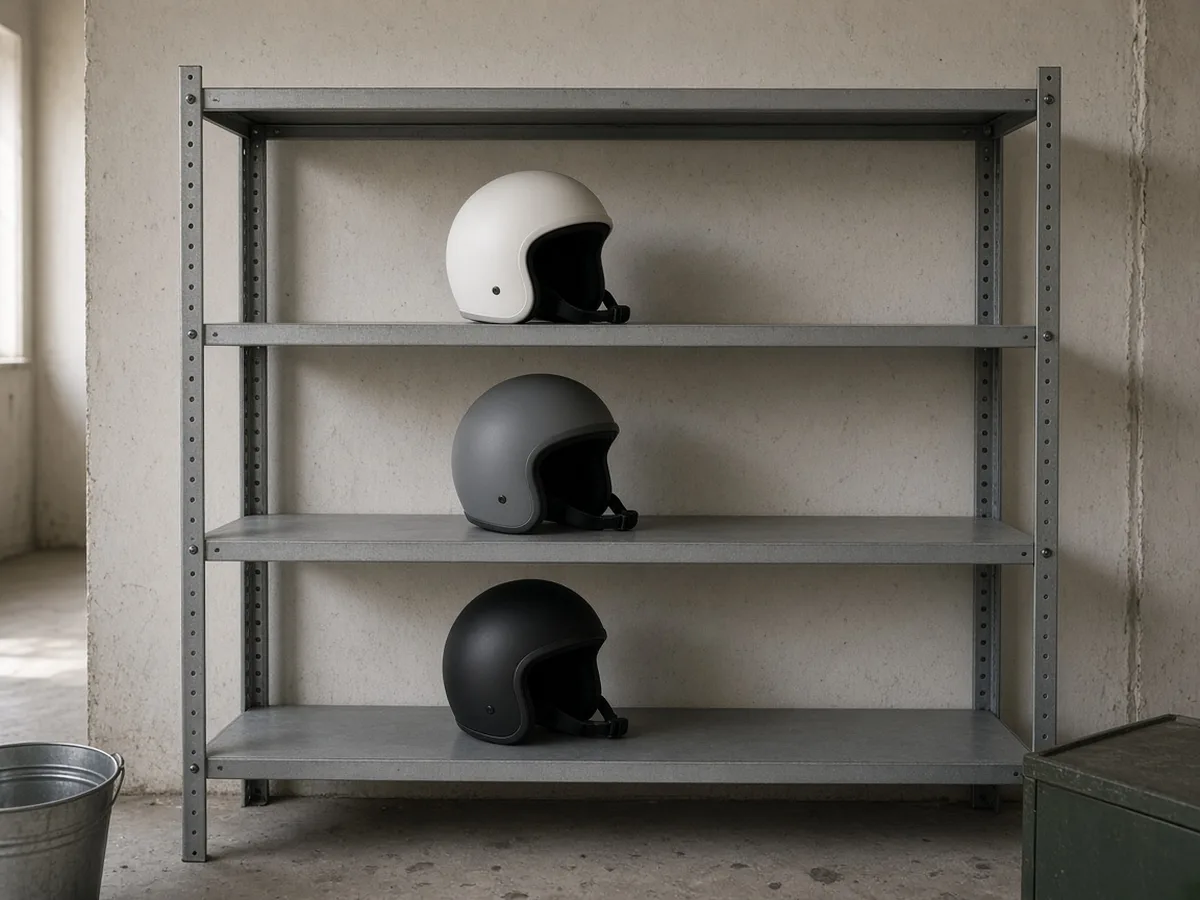
Storage is the other half. The SOP asks for released helmets to go to a clearly separated clean area that protects them from dust, moisture and recontamination. Record where the helmet sat before the complaint and whether it was damp when it went there.
| Dampness and storage finding | Log entry | Next step |
|---|---|---|
| Dry at release, dry at complaint, stored in the clean area | “Dry / dry / clean area” | Look at soil and the care step instead |
| Dry at release, damp at complaint | “Dry / damp” and where it was stored | Hold. Check the storage area before the next release. |
| Damp at release | “Released damp” | Hold. Repeat the documented drying step and record the release check again. |
| Stacked, bagged or touching other helmets in storage | Describe the storage state | Hold. Fix the storage before relying on any rework. |
Takeaway: A helmet that was damp at release or stored damp needs a drying or storage fix, not more fragrance.
When does a repeat complaint become a hold?
Treat any odor complaint on a helmet ID that already has an odor row as a recurrence, and hold it. The SOP already asks each site to define when to repeat a step, quarantine the helmet, escalate to a supervisor or remove it from service, and to track repeated failures so a drying problem does not become routine reprocessing. Write your site’s own recurrence limit into the SOP. This page does not set a number.
| Log shows | Disposition | Who acts |
|---|---|---|
| First odor row, smell located, a permitted step exists | Repeat that step, record dampness and the release check | Operator |
| Recurrence, and the last action was fragrance only | Hold. No further fragrance until a cause is recorded. | Supervisor |
| Recurrence with a damp or storage finding | Hold. Fix drying or storage, then re-check. | Supervisor |
| Recurrence and no permitted step left in the document | Hold and refer to the helmet maker’s route | Supervisor |
| Recurrence and the smell came back after the cabinet cycle | Hold, and raise the cabinet question with the equipment provider | Supervisor |
| Damaged, frayed or cut interior, or a concern at the impact liner | Refer. Cleaning is not repair. | Supervisor |
| Same site limit reached | Remove from service as the SOP defines | Site owner |
Keep a helmet-document question and a machine question apart. If the smell returns after the cabinet cycle, the question about that program goes to the equipment provider, and the maintenance checklist covers the machine side. A question about which care the helmet allows goes to the helmet maker.
Common mistake: Releasing a held helmet because it smells fine after one more cycle. If the log has no recorded cause, the next person has nothing to check the release against.
Takeaway: A second odor row on one helmet ID is a hold with a named next action.
What this log does not show
The log records observations and decisions. It does not identify what causes a smell, and staff should not name mold, bacteria, infection or a scalp condition from smell. It does not certify that a helmet is clean, sanitized or disinfected, and it does not certify protective performance. It does not promise that a smell can be removed. When the document leaves no permitted step, the helmet goes to referral or removal.
This page does not cover:
- Choosing or approving a deodorizer or disinfectant spray, which belongs in the spray label check.
- Washing recipes, homemade mixtures, ozone or UV effectiveness, drying times, temperatures or doses.
- Product rankings or a best helmet deodorizer.
- The full intake-to-release procedure, which belongs in the SOP.
Takeaway: Record what staff observed and decided, and leave causes and approvals to the documents that own them.
Method and sources
The definitions, residue, release-check, incident-record, storage and cabinet-stage points come from this site’s published cleaning and disinfection guide, SOP guide and homepage configuration. The interior and drying examples come from one motorcycle-helmet maker’s public maintenance page and one hockey-helmet booklet’s maintenance section, both read in October 2026. Each applies only to its own helmets. The forum thread is a 2022 rider discussion, used to show what readers ask, not as care advice. The recurring odor log and its tables are an operator record designed for this page. No odor test, drying trial or cabinet result is reported here. For related operating guidance, use the Operations & Maintenance archive.
Last updated: October 2026.
Frequently Asked Questions
How to get mildew out of a helmet?
How to freshen up a smelly motorcycle helmet?
Discuss your requirements
Contact us about the helmet model, its interior type, and the recurring odor log for the helmet that keeps returning.
We reply within 24 hours.
What to send us
| Item | Why we need it | Example format |
|---|---|---|
| Helmet model and interior type | Shows which care document and rework route apply | Model; removable comfort pads, fixed interior, or not identified |
| Recurring odor log | Shows where the smell is, the dampness and storage notes, and each earlier action | The completed log rows for that helmet ID, including blank cells |
| Care step and program used | Separates a cabinet question from a helmet-document question | Care document section; program version, if a machine was used |
We reply within 24 hours.
Related articles
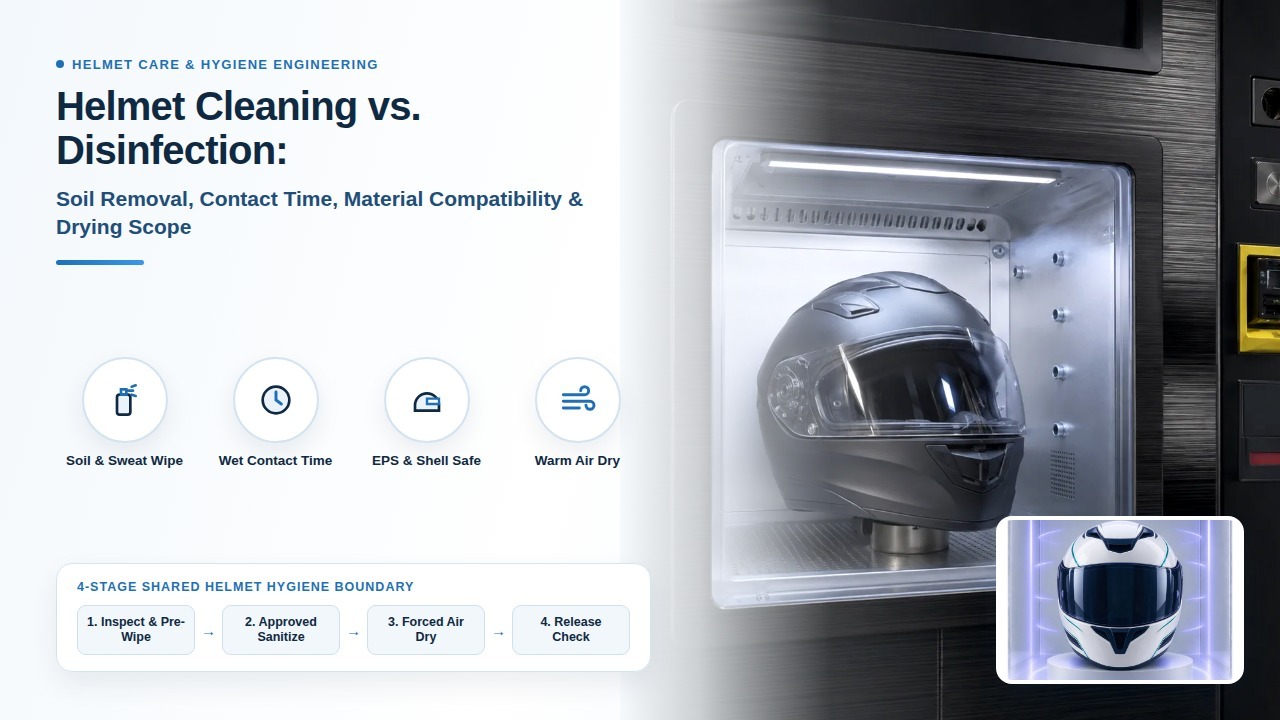
Cleaning, Sanitizing, and Disinfection for Shared Helmets
Compare cleaning, sanitizing (>=3-log), and disinfection (>=4-5 log) for shared helmets: UV-C fluence, dry-mist atomization, O3 destruct, and EPS limits.
Read article
How to Clean a Football Helmet: Team Equipment-Room SOP
Run a football helmet cleaning and sanitizing SOP with component checks, disinfectant label decisions, batch planning and a downloadable team care log.
Read article
How to Clean a Motorcycle Helmet: Manual vs Automated Process
Follow a motorcycle helmet's care instructions, separate washable pads from fixed parts, and compare manual cleaning with a documented automated process.
Read article