How to Clean a Football Helmet: Team Equipment-Room SOP
Run a football helmet cleaning and sanitizing SOP with component checks, disinfectant label decisions, batch planning and a downloadable team care log.
Rushing a football helmet back to the team can cause rework when cleaning is unfinished, padding remains wet or an equipment fault is unresolved. To clean a football helmet, use the actual model’s care instructions for its shell, interior and faceguard, then complete the permitted drying and inspection steps before reissue.
For a team equipment room, a cleaning and sanitizing SOP needs a separate decision for any disinfection claim. Identify each helmet and accessory, remove soil by the permitted method, and use a disinfectant only when both its label and the component’s manufacturer instructions support that use. Keep the required contact conditions, drying and return checks in the same record. The workflow and blank log below help schools and clubs organize a batch without assigning one chemical recipe or cabinet cycle to every helmet.
- Match the shell, padding, chin strap and faceguard to their own care requirements.
- Keep received helmets and unresolved work separate from completed stock.
- Plan staff time and drying space before promising a return time.
- Record care completion separately from protective-condition or recertification decisions.
What should staff check before cleaning football helmets?
Start with the helmet identity and its care document, rather than the apparent material. A white shell does not establish its polymer, and a visible pad does not establish washability. Youth and varsity constructions can differ; a fleet description such as “polycarbonate shells and TPU padding” needs confirmation on each accepted model.
The CDC Football Helmet Fact Sheet, under “Take Care of the Helmet,” gives general cleaning guidance using warm water and mild detergent, with no soaking, high heat or strong cleaners. It also requires trained equipment-manager supervision for removing or changing internal parts. Apply the actual helmet manual before choosing the cleaning product or opening the assembly.
For example, the SpeedFlex Platform Helmet Fitting Guide, printed page 17 limits cleaning and polishing to the manufacturer’s helmet cleaner or wax and warns that other commercial products can damage the shell or liner. That model-specific restriction is a reason to obtain the correct document before adopting a general detergent method.
| Component | Decision before starting | Dominant Failure Mode & Prevention |
|---|---|---|
| Shell and finish | Identify model and approved cleaning product | Unsupported cleaner or polish; keep the applicable care instruction at the bench |
| Internal padding or air system | Confirm whether parts are fixed or removable and permitted access | Pulling out a fixed part or mixing fitted pads; retain identity and use trained supervision |
| Faceguard and attachments | Check its care and fitting instructions | Loose or missing hardware overlooked during cleaning; record a separate inspection or repair referral |
| Chin cup, straps and visor | Identify each accessory and its care route | Assuming the shell's chemical permission covers every accessory; obtain component-specific instructions |
Use the padding washability intake guide when staff cannot distinguish removable comfort parts from the protective assembly. A visor adds another surface and coating decision; use its instructions and the visor chemical checks. Leave an undocumented removal or treatment step on hold.
How do you run the equipment-room batch SOP?
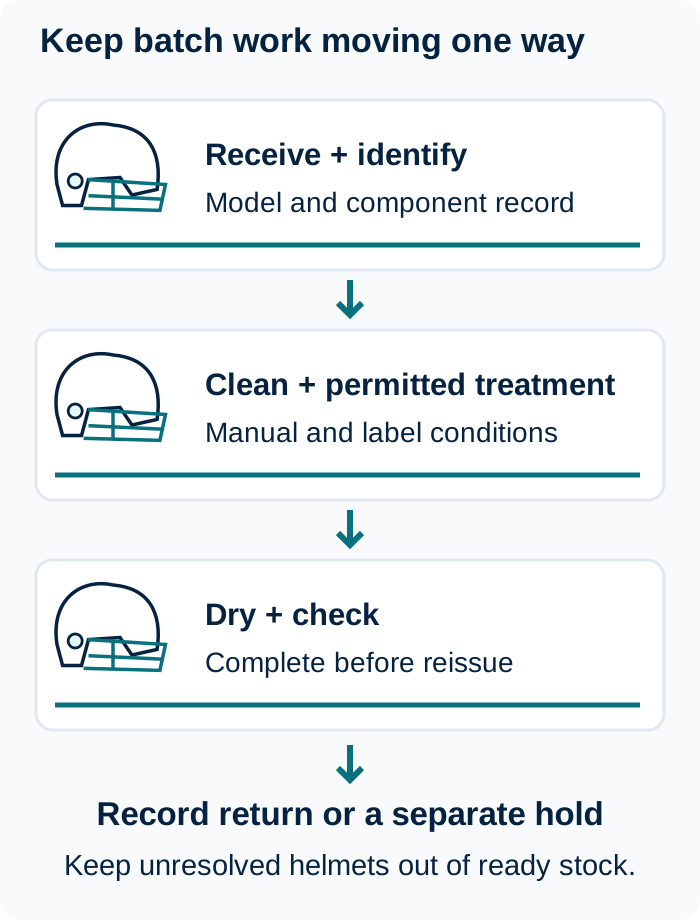
Give every received helmet a traceable route through identification, permitted care, drying and a recorded return or hold. Grouping identical approved methods can simplify work, but each helmet keeps its own identity and final status.
- Receive and record. Assign a team inventory reference, identify the wearer or custody group, and note incoming damage or reported concerns. Keep staff handling incoming stock away from completed items until they have followed the team’s hand-hygiene and work-surface procedures.
- Screen before spending cleaning time. Check for cracks, missing padding and loose or damaged attachments using the helmet instructions. Set aside equipment needing a protective-condition decision. Do not ask players to make repairs as part of the cleaning job.
- Set up the permitted care route. Bring the matching manual and approved materials to the bench. Follow the product label’s protective-equipment requirements. Keep any permitted removed components associated with their original helmet; do not pool fitted pads from different players.
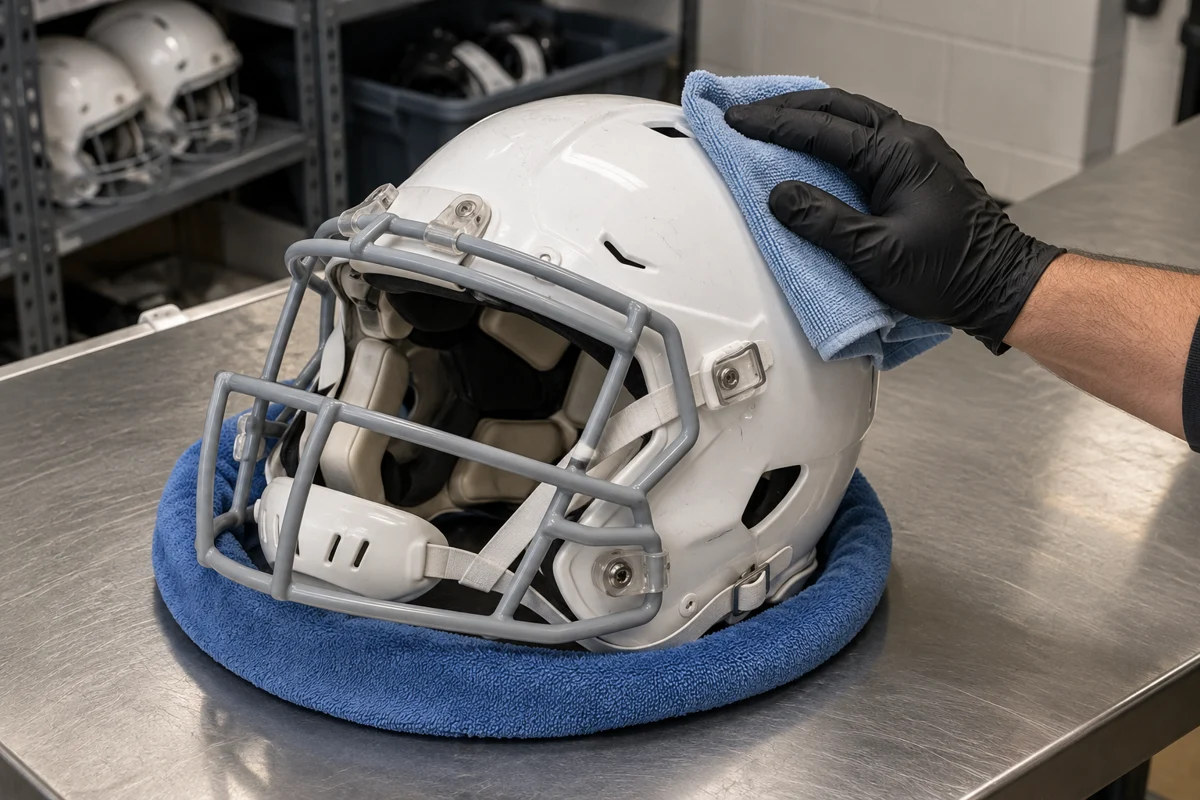
- Remove visible soil. Clean the surfaces covered by the instructions, including accessible skin-contact areas. Change or clean working materials as the care procedure requires, rather than carrying soil into the completed-care area. Do not improvise immersion or a pressure-washing route to speed up the batch.
- Complete any documented disinfection step. Check the decision conditions in the next section. Record the actual product and application conditions. A treatment that lacks component permission stays unresolved, even if that product is already used elsewhere in the locker room.
- Finish drying, reassembly and handover. Use the model’s permitted drying and fitting methods, inspect the completed assembly, and record the next action for held items. Keep damp or unresolved helmets out of ready stock. Store completed helmets as their instructions require.
The CDC athletic-facility guidance, reviewed June 27, 2025, calls for cleaning shared equipment after each use, drying before reuse and following manufacturer instructions. It links MRSA spread to physical contact and contaminated surfaces. Equipment care belongs alongside personal hygiene and wound-management procedures; suspected skin infections need a healthcare provider. A helmet cleaning record cannot establish that an infection has been prevented.
What makes a sanitizing or disinfection step acceptable?
Require a matching product label and a compatible component-care instruction. Cleaning removes soil; a claim to sanitize or disinfect adds specified treatment conditions. Odor removal and a finished timer do not establish those conditions.
For a US team, the EPA’s disinfectant-use guidance directs users to check the intended use and keep a surface visibly wet for the label’s full contact time. Read the label for the target organism, surface type, dilution, precleaning, application and any rinse requirement. A hard, nonporous-surface claim does not by itself cover porous padding. Other markets require the applicable local product authorization and instructions.
Decision rule: if the available treatment window is shorter than the label’s required wet contact time, change the work schedule or select another fully permitted process. Do not shorten the label condition. If the specified wetting, chemical or rinse would conflict with the helmet instructions, hold that route and obtain clarification.
For a sports helmet sanitizing machine, obtain the process description and accepted helmet/component list before comparing cycle times. Ask which surfaces it actually treats and what manual cleaning remains. Any claimed disinfection result needs evidence for the stated load, organism and treatment conditions, together with component compatibility. No universal UV, ozone, heat or mist setting follows from the term “sanitizing machine.”
Can the batch finish before the next practice?
Compare required hands-on work with available staff time, then check drying and treatment capacity separately. Staff-hours do not measure elapsed drying time, and a cabinet’s advertised timer does not account for intake or return checks.
Use minutes consistently:
Required staff-hours = helmets × hands-on minutes per helmet ÷ 60.
Illustrative planning example: assuming 48 helmets and 4 hands-on minutes each, required work is 48 × 4 ÷ 60 = 3.2 staff-hours. Two available staff over a 2-hour work window provide 2 × 2 = 4 staff-hours, leaving 4 − 3.2 = 0.8 staff-hours for interruptions and other work. These assumed inputs demonstrate the calculation; replace them with observed complete-task times.
Staff-load ratio = required staff-hours ÷ available staff-hours = 3.2 ÷ 4 = 0.80. If this ratio exceeds 1 under the planned workload, add staff time or change the collection schedule. A ratio below 1 still needs enough permitted treatment and drying positions to meet the return deadline. Count positions occupied by held equipment separately so they do not disappear into the ready-stock count.
Compare the same season when evaluating an equipment proposal. With the same assumed 48 helmets, 4 minutes and 60 cleaning days, hands-on work is 48 × 4 × 60 ÷ 60 = 192 hours per season. One extra minute per helmet adds 48 × 1 × 60 ÷ 60 = 48 hours. This identifies a measurement worth making before assigning a savings claim to equipment.
| Same-season cost input | What staff should record |
|---|---|
| Labor | Intake, cleaning, application, reassembly, checks and repeat work |
| Consumables | Actual permitted product use, cloth laundering and label-required protective equipment |
| Equipment and energy | Quoted purchase/service scope, measured use and applicable tariff |
| Capacity losses | Drying-space occupation, interrupted work and unavailable equipment |
| Component losses | Documented replacements, their cause and actual cost |
Use the Operations & Maintenance article collection for the surrounding service workflow. Use those measured inputs and written quotations with the equipment catalog and quotation cost factors. Compare routes that complete the same accepted work; a deodorizing-only service and a full component-care process have different scopes.
What should the team record before reissue?
Close the job with the work actually completed and any remaining action. Copy the fields below or download the blank football helmet batch log. Use one row per helmet; the CSV contains no preset chemical, temperature or treatment duration.
| Record field | Entry to complete |
|---|---|
| Batch and identity | Date, batch ID, helmet ID, model and wearer/custody reference |
| Component instructions | Padding, faceguard, chin strap and visor identities; manual version and section |
| Incoming findings | Damage, missing parts, contamination or reported concern; action owner |
| Cleaning completed | Actual method/product and operator |
| Disinfection decision | Applicable label, surface and organism; manufacturer permission, or reason held/not applicable |
| Treatment record | Required contact conditions and actual observations; rinse if required |
| Final checks | Drying complete, parts and refitting checked, outstanding concern |
| Handover | Return or hold; reason, next action, responsible person and time |
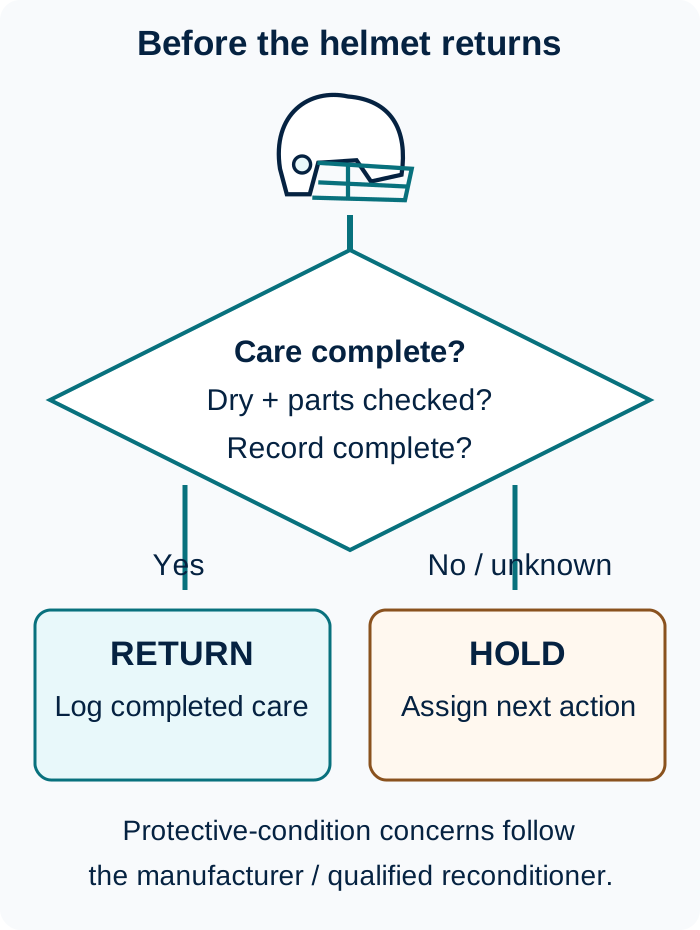
Keep recertification separate from this log. The current NOCSAE ND004 listing identifies ND004-24 as a performance specification for recertified football helmets, effective March 3, 2025. It does not approve a disinfectant or a cleaning cabinet. Follow the actual label and manufacturer requirements for reconditioning/recertification, and refer protective-condition concerns to the manufacturer or qualified reconditioner. A routine care checkbox cannot replace that process.
What to send us for an equipment discussion
Send the accepted helmet set and the work it must complete so the equipment conversation starts with the same scope as the SOP. Resolve manufacturer care permission before adopting a proposed treatment.
| Item | Why we need it | Example format |
|---|---|---|
| Helmet and parts list | Defines the proposed accepted set | Model and size list with component photographs |
| Manuals and labels | Identifies process restrictions and outstanding questions | Manual files plus relevant label sections |
| Batch size and return window | Frames the capacity question | Helmet count, staff availability and observed task times |
| Room and workflow information | Frames installation and handling questions | Country, available supply, bench/rack layout and drying space |
Use the HCE contact page to send these inputs for an equipment configuration and quotation discussion. Identify any unresolved compatibility or disinfection-evidence question in the enquiry. The hockey helmet care guide provides a separate component and club-handover workflow for mixed-sport programs.
Method and sources
Updated October 19, 2026. Compiled from the linked CDC football fact sheet and athletic-facility guidance, EPA disinfectant-use guidance, the named helmet fitting guide and the current NOCSAE standard listing, retrieved on that date. The SOP, batch arithmetic, routing diagrams and blank log are editorial working aids. Model-specific instructions retain their scope; the arithmetic uses explicit hypothetical inputs. This guide supplies no clinical treatment, protective repair procedure, cabinet compatibility approval or product efficacy result.
Related articles
How to Clean a Motorcycle Helmet: Manual vs Automated Process
Follow a motorcycle helmet's care instructions, separate washable pads from fixed parts, and compare manual cleaning with a documented automated process.
Read article
The Five-Year Helmet Rule: Check Dates and Retirement Instructions Before Cleaning
Separate manufacture, purchase, first-use, warranty and replacement dates before accepting an older helmet for cleaning, using a date-source intake register.
Read article
How to Clean a Hockey Helmet: Care and Club Handover
Clean a hockey helmet using its own manual, check the cage separately, and record drying, damage and label observations with a club handover checklist.
Read article