The Five-Year Helmet Rule: Check Dates and Retirement Instructions Before Cleaning
Separate manufacture, purchase, first-use, warranty and replacement dates before accepting an older helmet for cleaning, using a date-source intake register.
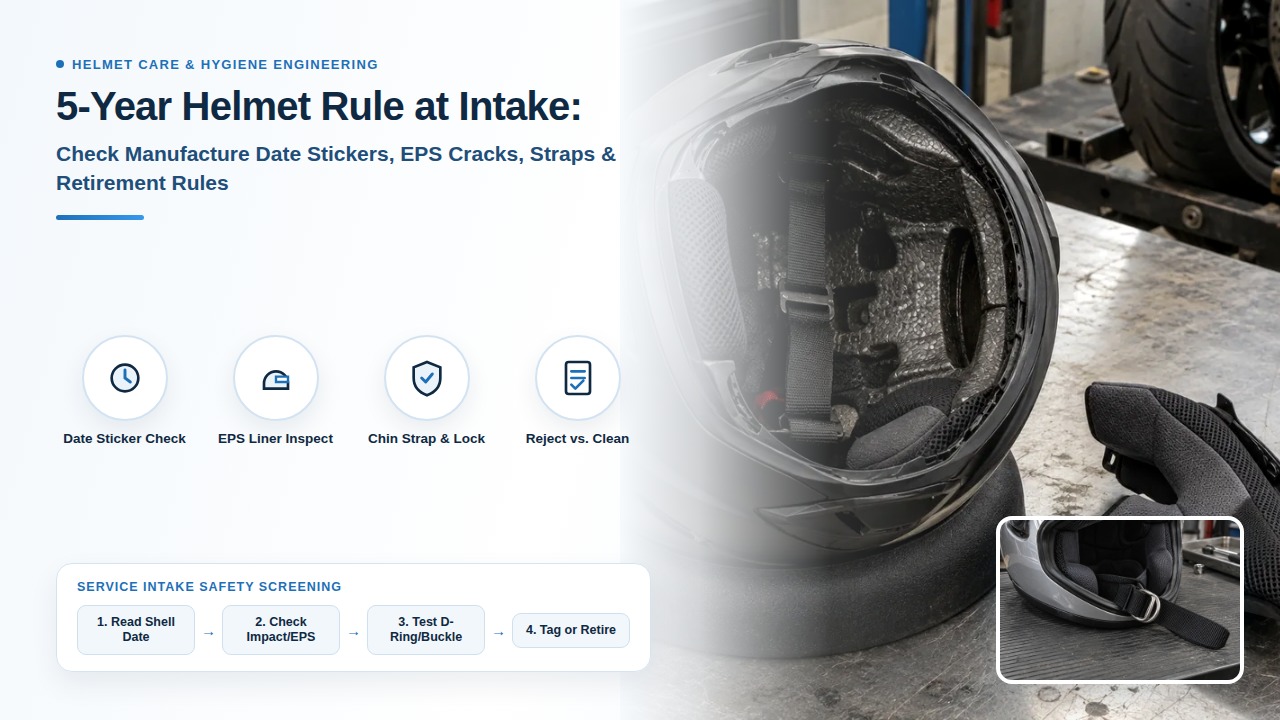
Accepting an older or impact-damaged motorcycle helmet for routine cleaning without checking its manufacture, purchase, and retirement dates wastes service time on a unit the manufacturer already recommends replacing. Separate manufacture, retail purchase, first-use, and warranty dates at intake, then match the helmet to its market-specific manufacturer instruction before running any cleaning step.
The five-year helmet rule is a widely cited replacement guideline—not a single statute or universal shelf-life timer—and published timelines differ by issuer and market. For example, SHOEI USA recommends replacement 5 years after first retail purchase (Retrieved October 2026), SHOEI Worldwide’s FAQ recommends replacement 3 years after purchase (Retrieved October 2026), and the Snell Foundation recommends replacement after 5 years of normal use while noting that unused helmets stored in good condition do not automatically expire after 5 years (Retrieved October 2026). Cleaning removes soil or odor; it never resets a replacement clock or restores impact protection.
| Intake date or record | Where to verify it | Why it matters before cleaning |
|---|---|---|
| Manufacture date | Production sticker or stamp inside the helmet (often under comfort padding) | Sets the factory production baseline and warranty outer limit where specified |
| First retail purchase date | Original dated retail receipt or fleet purchase invoice | Starts purchase-based replacement or warranty windows when required by the manual |
| First-use or fleet issue date | Rental, training, or club deployment log | Tracks years of active wear when no individual retail receipt is attached |
| Applicable replacement instruction | Exact manufacturer manual or regional support page for that model and market | Prevents blending a 3-year regional rule, a 5-year purchase rule, and a 7-year warranty limit |
| Incoming impact and liner state | Owner report plus visual check of shell, EPS liner, padding, and chin strap | Any impact or EPS liner damage triggers immediate hold and replacement referral regardless of age |
Why is there no single universal five-year rule at a service counter?
When a rider or fleet coordinator asks about the five-year rule at a cleaning counter, they are usually referring to one of several different guidance statements that retailer blogs often blend together. Treating those statements as interchangeable creates avoidable disputes at intake: one customer counts from the production sticker under the crown pad, another counts from a dealer invoice, and a third cites a seven-year warranty window as proof that a worn helmet is still fit for service.
Primary public sources show why a service counter must record the issuer and the starting event alongside the number of years:
- Five years of normal use (Snell Memorial Foundation). In its public helmet FAQ (fetched October 17, 2026), the Snell Foundation states that unused helmets stored in good condition do not automatically expire after five years. Instead, Snell recommends replacing a helmet after five years of normal use—a judgment call originating from Dr. George Snively’s testing of helmets used by the California Highway Patrol—because everyday putting on and taking off wears the comfort pads and energy-absorbing foam liner until a helmet with worn-out pads fits at least one to two sizes larger than new.
- Five years after first retail purchase (SHOEI USA). On its U.S. Helmet Maintenance page (fetched October 17, 2026), SHOEI USA states that useful service life depends on intensity and frequency of use, and that even if no impact or physical deterioration applies, it recommends helmet replacement in five years after first purchase at retail.
- Five years from purchase or seven years from manufacture (SHOEI USA warranty and impact-inspection eligibility). On its U.S. Impact Inspection page (fetched October 17, 2026), SHOEI USA specifies that to qualify for its free impact evaluation through U.S. distributor Helmet House, an authentic helmet must be within the factory warranty period—five years from the purchase date or seven years from the manufacturing date—and accompanied by proof of new purchase from an authorized U.S. retailer.
- Three years after purchase (SHOEI Worldwide FAQ). On its Worldwide Products FAQ (fetched October 17, 2026), under “What is the lifetime of a helmet for use?”, SHOEI Worldwide recommends replacing the helmet three years after purchase because overage or deterioration during use may prevent it from maintaining original performance.
| Source and regional scope | Published timeframe | Starting event | What it governs |
|---|---|---|---|
| SHOEI USA — Helmet Maintenance | 5 years | First purchase at retail | Recommended helmet replacement even when no visible damage is present |
| SHOEI USA — Impact Inspection | 5 years or 7 years | Purchase date (5 yr) or manufacturing date (7 yr) | Factory warranty window and U.S. Helmet House impact-inspection eligibility |
| SHOEI Worldwide — Products FAQ | 3 years | Purchase date | Recommended lifetime of a helmet for use under the Worldwide FAQ |
| Snell Memorial Foundation — FAQ | 5 years | Normal use (active service) | Consensus replacement recommendation based on cumulative pad and liner wear |
Common mistake: Treating a “5 years from purchase / 7 years from manufacture” warranty rule as permission to keep a heavily used rental helmet in circulation for seven years. Warranty eligibility defines when the manufacturer or distributor will evaluate a claim; it does not extend the recommended service life of a helmet in daily fleet use.
Takeaway: Record both the date type and the regional manufacturer document before deciding whether a helmet is within its recommended service window.
How do you separate manufacture, purchase, first-use, and warranty dates?
A cleaning operator or fleet manager can only apply a manufacturer’s rule if the supporting date record exists. Before accepting an older helmet or logging a shared-fleet batch into the intake and release SOP, check which date evidence is actually available on the unit or in the customer file.
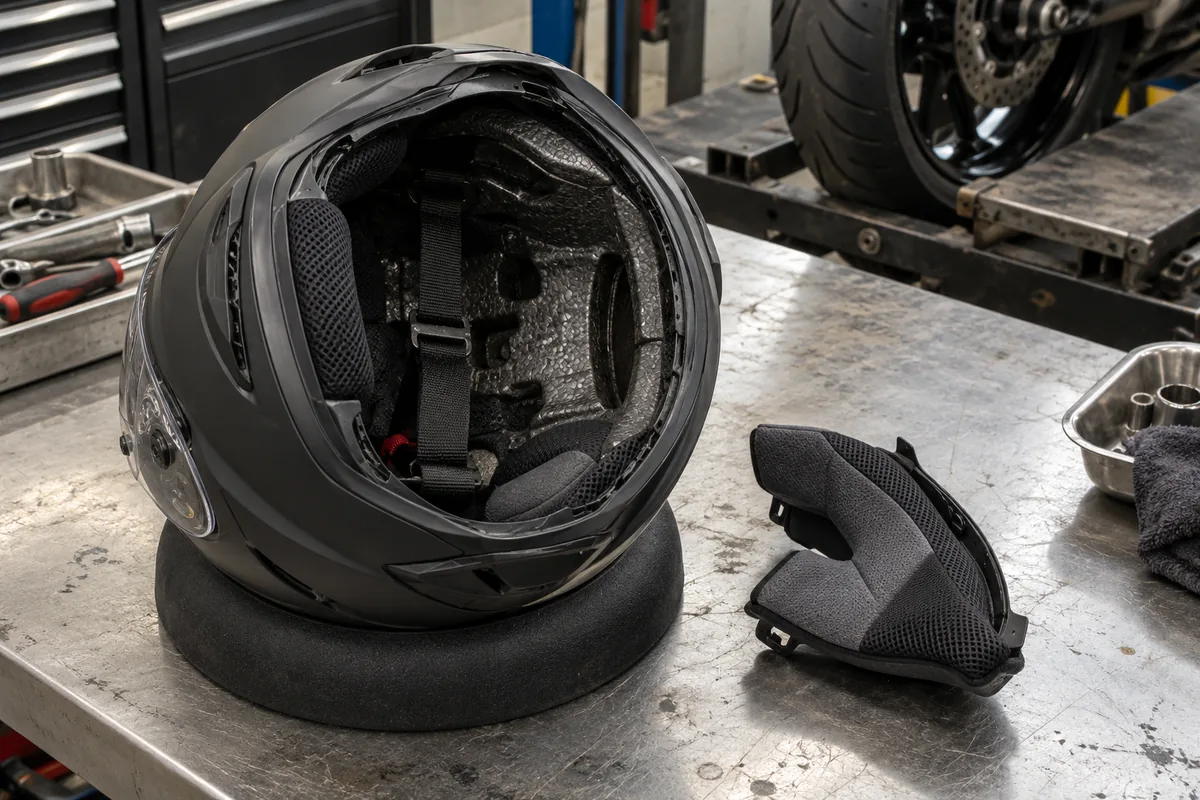
Use four distinct date categories on your intake record so staff never overwrite one date with another:
- Manufacture date (
MFD). Locate the production month and year stamped or printed inside the helmet—typically on a label beneath the removable comfort crown pad or on the chin-strap webbing. Follow the padding washability intake guide before lifting any interior part: only detach comfort padding that the model’s manual permits removing. If the label is missing or unreadable, writeUnreadable / verify on the unitrather than guessing an age from shell graphics. - First retail purchase date. When a manufacturer rule or warranty check counts from retail purchase—such as SHOEI USA’s five-year replacement recommendation or its U.S. impact-inspection eligibility—record whether an original dated sales receipt is present. An unverified verbal estimate (“bought about three years ago”) should be logged as an unconfirmed owner statement, not a verified retail receipt.
- First-use or fleet deployment date. Rental counters, riding schools, and tour operators often buy helmets in bulk and place units into service across different seasons. Record the date the specific helmet ID entered active circulation alongside its purchase invoice so high-cycle fleet wear is evaluated against actual use as well as calendar age.
- Warranty or certification expiry date. Separate commercial warranty coverage from sporting certification rules. As shown in our hockey helmet manual and handover guide, some sports helmets carry a specific certification sticker expiry, whereas motorcycle helmets typically rely on manufacturer replacement timelines or racing-association standard windows.
| Date record presented at intake | What staff can verify | Suggested intake handling |
|---|---|---|
| Readable manufacture label + dated retail receipt + matching regional manual | Both production age and retail-purchase age against the exact instruction | Record both dates and apply the manual’s stated replacement and condition rules |
| Readable manufacture label only (no purchase receipt) | Time elapsed since factory production | Record manufacture date; note that purchase date is unverified and flag if production age exceeds the maker’s window |
| Second-hand or borrowed helmet with unknown history | Only visible physical condition and any readable internal label | Hold or flag unknown impact and purchase history; do not certify remaining service life |
| Unreadable or removed internal labels | Visible exterior/interior condition only | Hold for owner or supervisor review; record Unknown / verify on the unit |
Takeaway: Keep manufacture, retail purchase, first-use, and warranty dates in separate columns; never fill an unknown purchase date by subtracting an assumed shelf period from the manufacture stamp.
Which physical conditions require immediate retirement even inside the date window?
Calendar age is only the outer boundary. Every primary source reviewed for this guide states that a helmet must be replaced immediately—even within three or five years of purchase—when an impact or material failure compromises protection.
Both the SHOEI USA maintenance guide and the SHOEI Worldwide maintenance page (both fetched October 17, 2026) list specific physical conditions that require replacement or stop use before any calendar limit is reached:
- Any crash or significant impact. The energy-absorbing expanded polystyrene (EPS) liner crushes to manage impact energy and cannot be restored by cleaning. SHOEI USA’s impact-inspection notice emphasizes that internal foam damage may compromise effectiveness even without obvious external marks, and that Helmet House does not conduct X-ray tests—its evaluations assess surface damage against SHOEI guidelines.
- EPS liner separation or movement. SHOEI Worldwide warns that if adhesive deteriorates and the EPS liner moves inside the shell, the helmet must never be used because it will not work for safety. Staff must never attempt to glue or re-seat a moving impact liner during cleaning.
- EPS liner wear, heat damage, solvent melting, dents, or white scratches. Because EPS is neither solvent-proof nor heat-proof, exposure to petrochemicals, corrosive cleaners, or high heat can melt or weaken the foam. On EPS liners painted black on the inside surface, SHOEI USA notes that indentations or visible white scratches indicate liner damage requiring replacement.
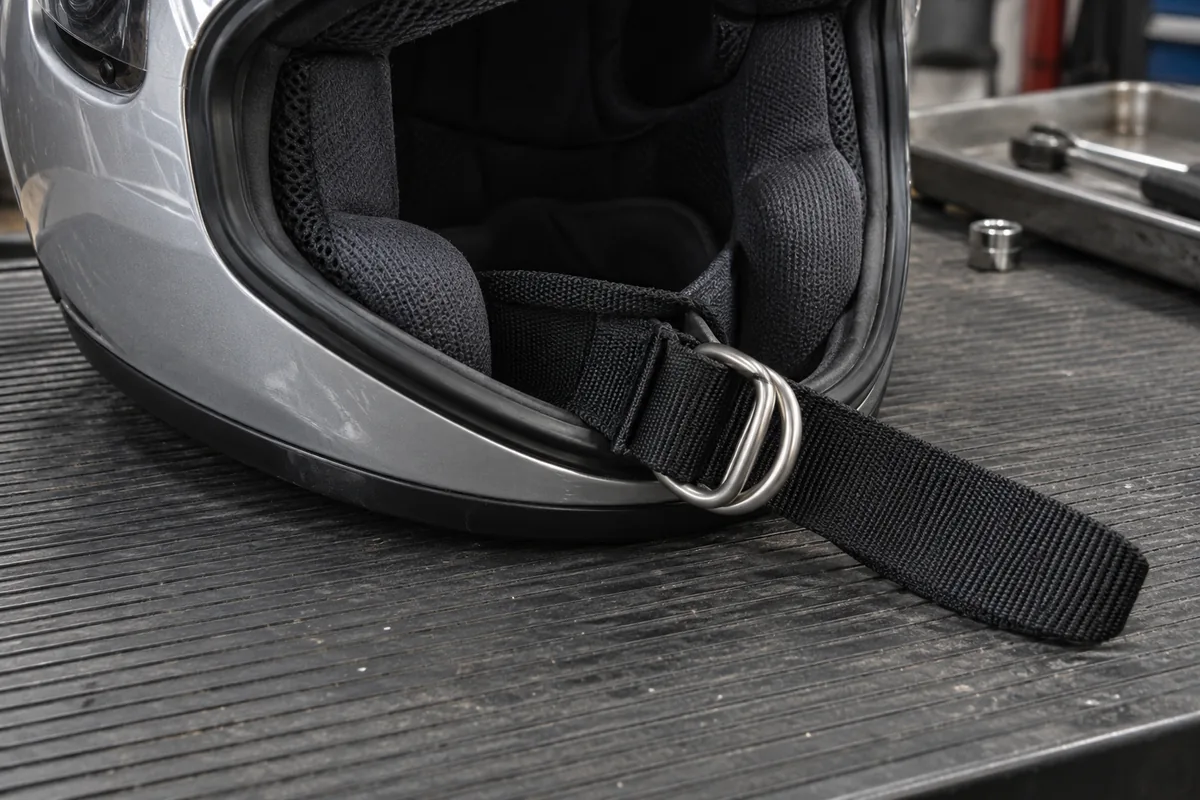
- Loose comfort padding or deteriorated retention system. Over time, heavy use compresses padding and wears chin-strap webbing. SHOEI USA provides a simple check: with the retention system fastened, if the helmet turns to the side when the wearer gently shakes their head, the comfort padding or retention system has become too loose and replacement is recommended.
When a helmet arrives with a recurring smell complaint alongside compressed, flaking foam, check the recurring odor rework log rather than running repeated fragrance cycles. As explained in our cleaning, sanitizing, and disinfection guide, removing surface soil or odor has no effect on structural foam integrity or retention fit.
Takeaway: Inspect the shell, EPS liner surface, liner attachment, comfort-pad fit, and chin strap before every service; a physical failure overrides any remaining calendar years.
Use a date-source intake register before accepting an older helmet
To prevent counter staff or fleet attendants from making ad-hoc judgment calls, record each older helmet in a structured register before placing it into manual care or a self-service cleaning cabinet. You can copy the table structure below or download the blank date-source intake register as a CSV. Leave any unconfirmed cell as Unknown / verify on the unit.
| Register column | What to record at intake | Worked Example A (U.S. retail customer unit) | Worked Example B (International shared-fleet unit) |
|---|---|---|---|
| Helmet, model, and market | Brand, model name, internal fleet ID, and regional market scope | SHOEI RF-1400 (Customer ID #C-104; U.S. retail market) | SHOEI NXR2 / fleet unit #F-019 (Non-U.S. / Worldwide FAQ scope) |
| Date type and supporting record | Manufacture stamp (MFD), retail purchase receipt date, first-use log date, and warranty window | MFD: 2020-06 on inner crown label; original U.S. dealer receipt dated 2021-04-12 (5 yr 6 mo since retail purchase) | MFD: 2023-02; fleet purchase and first-use invoice dated 2023-05-01 (3 yr 5 mo in active rental use) |
| Exact current manufacturer instruction | Document title, URL/version, and verbatim replacement/warranty rule | SHOEI USA Helmet Maintenance: recommends replacement 5 years after first retail purchase; Impact Inspection warranty window is 5 yr purchase / 7 yr manufacture | SHOEI Worldwide FAQ: recommends replacing helmet 3 years after purchase due to overage or deterioration during use |
| Reported impact and visible condition | Customer/rider report plus shell, EPS liner, padding, and strap observations | No crash reported; comfort pads compressed; past 5-year U.S. retail purchase replacement threshold | No crash reported; heavy daily rental sweat wear; past 3-year Worldwide FAQ purchase threshold |
| Next review date | Scheduled follow-up date for held or active fleet items | Immediate counter handover review (2026-10-17) | Immediate fleet retirement review (2026-10-17) |
| Hold or referral decision | Accept within scope, hold for supervisor/owner, or refer to manufacturer channel | Hold cleaning request; show customer SHOEI USA 5-year retail purchase replacement guidance before accepting paid care | Hold from rental circulation; flag for fleet manager retirement decision under Worldwide 3-year guidance |
Notice how the two worked examples avoid blending regional instructions into one policy:
- In Worked Example A, the helmet is six years and four months past its
2020-06manufacture stamp and five years and six months past its2021-04-12U.S. retail receipt. It has passed both SHOEI USA’s five-year retail replacement recommendation and the five-year purchase / seven-year manufacture warranty-inspection window. Recording both dates shows why routine cleaning does not make the helmet current. - In Worked Example B, the fleet operates under SHOEI Worldwide’s three-year post-purchase FAQ guidance rather than SHOEI USA’s five-year U.S. retail guidance. Keeping the market column explicit prevents staff from applying a five-year U.S. rule to a fleet governed by a three-year regional instruction.
When this guide does not apply
This page provides an administrative intake register for cleaning counters and shared-helmet managers. Keep its scope separate from safety recertification, legal compliance, and chemical or equipment compatibility:
- Not a statutory expiry law or crash recertification. Neither this register nor a visual counter check certifies that a helmet meets FMVSS No. 218, ECE, or Snell impact standards. Only the manufacturer or its authorized inspection channel can evaluate a model within its stated program limits.
- No life extension through cleaning. Running a manual cloth wipe, pad wash, or cabinet cycle never extends a helmet’s replacement timeline or repairs compressed EPS foam, degraded adhesive, or stretched chin straps.
- Not a substitute for component or chemical compatibility checks. Even when a helmet is within its recommended service dates and passes visual inspection, staff still need to check component washability in the padding intake guide, optical shield restrictions in the visor chemical check guide, and consumable permissions in the disinfectant spray label check.
What to send when planning service intake and fleet workflow
If you are configuring a commercial helmet cleaning station or self-service cabinet workflow and want to align your intake procedure with your accepted helmet fleet, prepare the project variables below before contacting our team:
| Item | Why we need it | Example format |
|---|---|---|
| Helmet models and regional markets | Identifies which manufacturer manuals and service-life instructions govern your accepted set | CSV or list of helmet brands, models, and operating country/region |
| Current manufacturer care and retirement documents | Shows the permitted cleaning methods, temperature/solvent limits, and replacement rules to respect at intake | PDF booklets or official manufacturer support links |
| Intake date-source and hold register fields | Clarifies how your staff or fleet logs track manufacture, purchase, and first-use dates before processing | Completed sample rows in /resources/helmet-five-year-rule-intake-register.csv |
Send your helmet model list, applicable manufacturer care documents, and proposed intake register fields through the HCE contact page for a workflow and equipment configuration discussion. Keep impact-inspection requests, warranty claims, and helmet replacement decisions with the helmet manufacturer or its authorized distributor.
Method and sources
Compiled from primary manufacturer and standards documents live-fetched on October 17, 2026: SHOEI USA Helmet Maintenance, SHOEI USA Impact Inspection Service, SHOEI Worldwide FAQ — Others, SHOEI Worldwide — How to Maintain Helmet, and the Snell Memorial Foundation FAQ. Each manufacturer statement applies only to the models and regional markets covered by that issuer. The date-source intake register and worked examples are editorial workflow tools designed for service counters and fleet managers, not a safety test or manufacturer certification form. For related operational guides, visit the Operations & Maintenance archive.
Frequently Asked Questions
What is the 5 year rule for motorcycle helmets?
What is the lifetime of a helmet for use?
Related articles
How to Clean a Football Helmet: Team Equipment-Room SOP
Run a football helmet cleaning and sanitizing SOP with component checks, disinfectant label decisions, batch planning and a downloadable team care log.
Read article
How to Clean a Motorcycle Helmet: Manual vs Automated Process
Follow a motorcycle helmet's care instructions, separate washable pads from fixed parts, and compare manual cleaning with a documented automated process.
Read article
How to Clean a Hockey Helmet: Care and Club Handover
Clean a hockey helmet using its own manual, check the cage separately, and record drying, damage and label observations with a club handover checklist.
Read article