How to Build a Helmet Cleaning Standard Operating Procedure
Build a 5-stage commercial helmet cleaning SOP: pH-neutral visor pre-wipe, >= 45° visor mounting, EPA/EN dry-mist + UV-C dwell, <= 50 °C PTC dry, and ATP audit.
Mixing uncleaned, interrupted-cycle, or damp shared helmets with sanitized release stock causes costly rework, rejected rental turnover, and OSHA 29 CFR 1910.132(a) compliance failures, while improvising with ammonia glass sprays or unregulated heat guns ruins $$45\text{–}$85$ Pinlock anti-fog visors and softens expanded polystyrene (EPS) liners. Fleet managers at go-kart tracks, motorcycle and e-moped rental depots, ski schools, industrial PPE cribs, and unattended vending routes need a quantitative Helmet Cleaning Standard Operating Procedure (SOP) that locks intake quarantine, pre-wipe chemistry, chamber mounting geometry, antimicrobial dwell time, low-temperature PTC drying, and post-cycle release auditing into one repeatable shift workflow.
A commercial shared-helmet hygiene program operates on a standardized 5-Stage Daily Shift SOP embedded within an 8-step physical custody route (Segregated Intake Quarantine → Structural & Age Screening → Stage 1 Gross Soil & Visor Pre-Wipe → Stage 2 Inverted Visor-Open Chamber Mounting → Stage 3 Automated Dry-Mist + UV-C + Ozone Dwell → Stage 4 Low-Temp PTC Drying → Stage 5 ATP Swab & Dryness Release Audit → Segregated Clean Rack Storage). Under Standard Engineering Baselines, operators pre-wipe external shells and shields with a pH-neutral (6.5–7.5) microfiber cloth (banning ammonia, ketones, and alcohols per SHOEI and Snell M2020/M2025), mount the helmet inverted over the chamber nozzle post with the visor open >= 45°–90° (2–3 detents) and chin strap unbuckled, execute an uninterrupted 180–300 s micronized (<= 5–10 µm) biocide dry-mist + 253.7 nm UV-C (ISO 15858) + catalytic ozone destruct (< 0.05 ppm per FDA 21 CFR 801.415) dwell (U.S. EPA OCSPP 810.2300 / EN 1276 / EN 13697), dry at <= 45 °C–50 °C via self-regulating PTC forced air to protect expanded polystyrene (EPS) crush liners (UNECE R22.06), and verify <= 100 RLU via ATP bioluminescence swabbing before tagging for release.
| Shift SOP Stage | Active Operator vs. Machine Time | Key Physical & Chemical Control Parameter | Governing Regulatory / OEM Standard |
|---|---|---|---|
| Pre-Gate — Intake Quarantine & Structural Screen | 15–20 s active operator check | Segregate into red/blue intake bins; reject cracked shells, dented EPS, frayed straps, or units $> 5\text{ yr}$ service age | OSHA 29 CFR 1910.132(a) & (e); 5-Year Service Intake SOP |
| Stage 1 — Gross Soil & Visor Optical Pre-Wipe | 30–45 s active operator wipe | Lint-free microfiber + lukewarm water ($\le 30\text{ }^\circ\text{C}$) + pH 6.5–7.5 surfactant; zero ammonia, alcohol, or ketones | SHOEI Maintenance Baseline; Snell M2020/M2025; Pinlock Optical Spec |
| Stage 2 — Inverted Rack Placement & Visor Geometry | 15–20 s active operator load | Mount inverted on chamber nozzle post; open visor >= 45°–90° (2–3 detents), open brow vents, unbuckle chin strap | HCE Chamber Aerodynamic Baseline (HCE-S1 / HCE-D2 / HCE-K2) |
| Stage 3 — Automated Dry-Mist + UV-C + Ozone Dwell | 180–300 s unattended PLC dwell | $3\text{–}5\text{ mL}$ atomized mist ($\le 5\text{–}10\text{ }\mu\text{m}$), $t_{\text{contact}} \ge 180\text{–}300\text{ s}$, 253.7 nm UV-C + carbon $\text{O}_3$ destruct $< 0.05\text{ ppm}$ | U.S. EPA OCSPP 810.2300 ($\ge 3\text{-log}$); EN 1276 / EN 13697; ISO 15858; FDA 21 CFR 801.415 |
| Stage 4 — PTC Forced-Air Thermal Drying | 120–180 s unattended PLC dry | Centrifugal airflow with self-regulating PTC ceramic heater clamped strictly $\le 45\text{ }^\circ\text{C–}50\text{ }^\circ\text{C}$ ($65\text{ }^\circ\text{C}$ thermal cutout) | Snell M2020/M2025; DOT FMVSS 218; UNECE R22.06 ($50\text{ }^\circ\text{C}$ EPS ceiling) |
| Stage 5 — Post-Cycle ATP Swab Audit & Fleet Tagging | 15–25 s active operator release | Zero tissue-press dampness; batch ATP swab check on cheek pad/chin strap $\le 100\text{ RLU}$ (<= 50 RLU strict); green release tag | OSHA 29 CFR 1910.132(a) Sanitary PPE Record; Commercial ATP Hygiene Baseline |
How does the 5-stage daily shift helmet cleaning SOP prevent microbial survival and polymer degradation?
A repeatable commercial helmet SOP separates manual pre-cleaning and structural screening from automated chamber sanitization, ensuring that gross organic soil is wiped away with pH-neutral chemistry before micronized dry-mist and UV-C treatment, and that every helmet passes a quantitative dryness and ATP hygiene gate before returning to the clean rack.
When go-kart centers, moped rental fleets, or industrial safety cribs install an automated commercial helmet cleaning machine without a written SOP, counter staff inevitably treat the cabinet like a household dishwasher—tossing mud-splattered or sweat-saturated helmets inside with the visor latched shut, spraying window cleaner on anti-fog shields, or pulling helmets out mid-cycle when a customer queue forms. As established in our cleaning, sanitizing, and disinfection evidence guide, automated dry-mist + UV-C cabinets are precision sanitizing instruments whose log-reduction efficacy depends on unobstructed aerosol trajectories, verified wet contact time ($t_{\text{contact}}$), and strict polymer temperature ceilings.
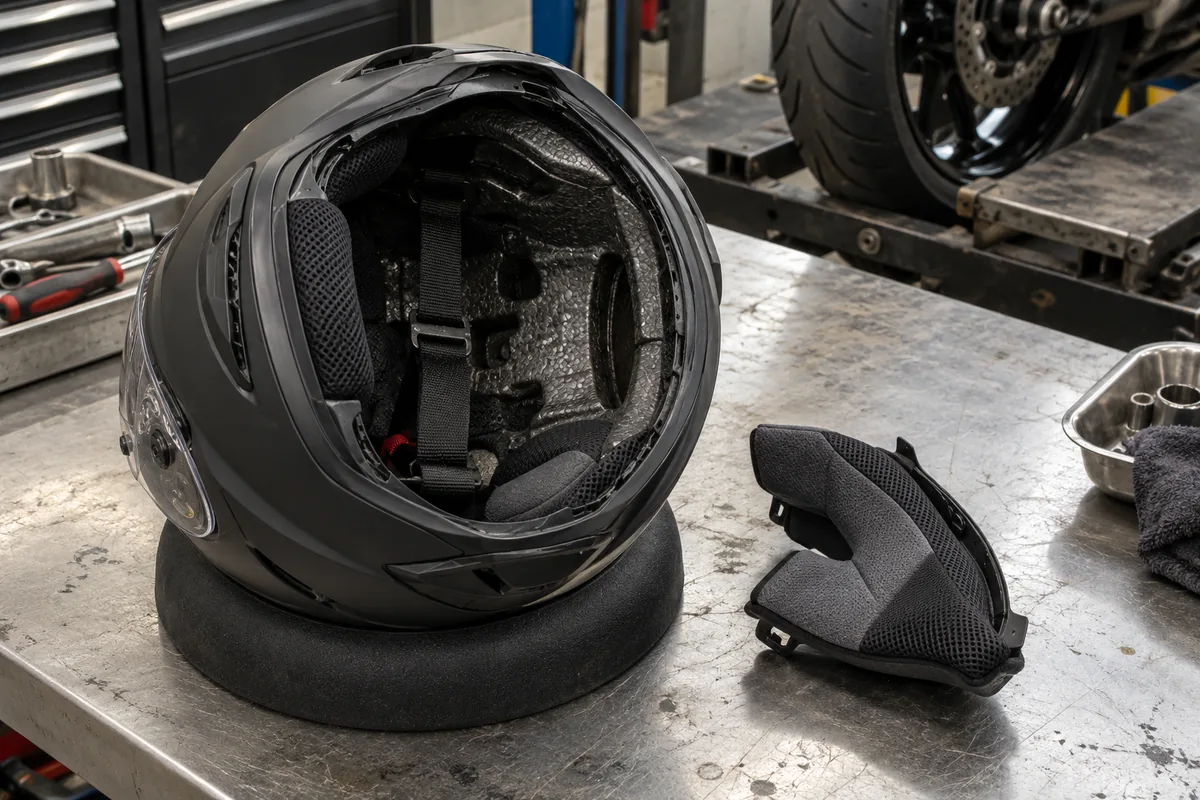
5-Stage Daily Shift SOP Engineering & Failure Prevention Matrix
The table below defines the Standard Engineering Baseline under Reference Conditions for each of the five daily shift SOP stages, specifying exact operator actions, machine parameters, verification metrics, and the Dominant Failure Mode & Prevention across the service route:
| SOP Stage & Custody Zone | Operator & Machine Execution Protocol | Target Physical / Chemical Parameter | Quality Verification Gate | Dominant Failure Mode & Prevention |
|---|---|---|---|---|
| Stage 1: Pre-Inspection & Visor Optical Pre-Wipe (Quarantine Intake Bench) | Segregate returned helmet into red intake tote; inspect shell, EPS liner, D-ring strap (5-year intake register) & liner type (padding washability guide); wipe outer shell, chin bar & visor with microfiber cloth | Lukewarm water ($\le 30\text{ }^\circ\text{C} / 86\text{ }^\circ\text{F}$) + pH 6.5–7.5 non-ionic surfactant; zero bulk mud, hair gel, insect crust, or bodily fluids remaining | Visual optical clarity check under bench light; zero shell fractures or EPS compression dents (OSHA 29 CFR 1910.132(e)) | Polycarbonate stress crazing & Pinlock anti-fog delamination from ammonia/alcohol sprays: Wiping shields with glass cleaner or $> 5%$ IPA causes micro-fissure hazing and strips hydrophilic anti-fog coatings in 10–15 wipes. Prevention: Stock only approved pH 6.5–7.5 surfactant at the intake bench (visor chemical check SOP) and detach Pinlock lenses for lukewarm water rinsing only (SHOEI / Snell M2020/M2025) |
| Stage 2: Inverted Chamber Mounting & Visor/Vent Orientation (Chamber Load Zone) | Place helmet inverted or crown-up over the vertical stainless nozzle post in the HCE-S1, HCE-D2, or HCE-K2 chamber; open face shield, slide brow/chin vents open, and unbuckle chin strap | Face shield opened >= 45°–90° (2–3 detents minimum); chin strap unbuckled and draped clear of the central mist/air plenum; crown clearance $\ge 30\text{ mm}$ from top UV-C bar | Visual confirmation through UV-blocking tempered glass window before pressing cycle start | Closed-visor aerodynamic shadowing (> 75% mist & airflow blockage in chin bar): Loading a full-face helmet with the shield latched closed deflects micronized dry-mist and warm air around the outer shell, leaving the oral-nasal chin pad wet and unsanitized. Prevention: Enforce a mandatory >= 45° (2–3 detent) visor-open and unbuckled-strap check painted on the chamber loading decal |
| Stage 3: Automated Biocide Dry-Mist + UV-C Sanitizing Dwell (Locked Treatment Chamber) | Initiate PLC hygiene cycle: ultrasonic/pneumatic dry-mist atomization + 253.7 nm germicidal UV-C + controlled ozone (O3) diffusion + catalytic carbon destruct | $3\text{–}5\text{ mL}$ metered biocide (pH 6.5–7.5, droplet diameter $\le 5\text{–}10\text{ }\mu\text{m}$); contact dwell $t_{\text{contact}} \ge 180\text{–}300\text{ s}$; UV-C fluence $10\text{–}30\text{ mJ/cm}^2$; post-destruct $\text{O}_3 < 0.05\text{ ppm}$ | PLC timer completes full misting and catalytic destruct sequence with zero door-interlock fault codes (ISO 15858) | Incomplete microbial log reduction (< 3-log) & fugitive aerosol venting from early door-open override: Pulling a helmet out mid-dwell cuts $t_{\text{contact}}$ below EPA OCSPP 810.2300 / EN 1276 limits and vents un-destructed mist/ozone into the room. Prevention: Use electromagnetic door locks wired to the PLC completion relay and quarantine any interrupted helmet for a full Stage 3 repeat |
| Stage 4: Low-Temperature PTC Forced-Air Drying (Locked Treatment Chamber) | High-static centrifugal blower sweeps warm air through the open visor, EPS ventilation channels, and 3D polyurethane cheek pads out the exhaust duct | Self-regulating PTC ceramic air temperature strictly $\le 45\text{ }^\circ\text{C–}50\text{ }^\circ\text{C}$ ($113\text{ }^\circ\text{F–}122\text{ }^\circ\text{F}$) with redundant $60\text{ }^\circ\text{C–}65\text{ }^\circ\text{C}$ bimetallic safety cutout; 120–180 s dry phase | Chamber exhaust humidity drops to ambient baseline; liner surface temperature verified $\le 50\text{ }^\circ\text{C}$ | EPS impact liner bead softening (> 50 °C) or deep cheek-pad dampness from overloaded moisture: Unregulated heating coils $> 60\text{ }^\circ\text{C}$ deform EPS crush foam (Snell M2020/M2025 & UNECE R22.06), while placing dripping-wet pads into a 5-minute dry-mist cycle leaves $> 15%$ residual moisture. Prevention: Clamp PTC heaters $\le 50\text{ }^\circ\text{C}$ and route water-saturated pads to a 20–30 min dedicated air dryer |
| Stage 5: Post-Cycle ATP Swab Audit & Fleet Release Tagging (Clean Release & Storage Zone) | Unload helmet with clean hands/gloves; press dry tissue against cheek pads and chin strap to confirm dryness; run scheduled ATP bioluminescence swab; attach release tag | Zero moisture transfer on tissue press; odor-neutral check; ATP bioluminescence swab score $\le 100\text{ RLU}$ ($\le 50\text{ RLU}$ strict skin-contact standard) on 10 x 10 cm cheek-pad/strap zone | Log helmet ID, operator, cycle status, and RLU audit in service log CSV; place on segregated clean rack | Cross-contamination of released helmets or sebum-caked liner biofilm survival (> 250 RLU): Storing finished helmets on the intake counter or skipping periodic deep pad washing lets salt/sebum crusts shield bacteria. Prevention: Separate dirty intake and green-tagged clean racks by $\ge 2\text{ m}$ and mandate a $\le 30\text{ }^\circ\text{C}$ deep pad wash every 50–100 rental cycles |
Scope Note: The 5-stage operating parameters above represent Standard Engineering Baselines under Reference Conditions aligned with HCE commercial cabinets (HCE-S1, HCE-D2, HCE-K2, and the homepage 5-step deep cleaning configuration). Site operators should validate exact cycle timers, biocide SDS compatibility, and helmet model clearances during sample trials and Factory Acceptance Testing (FAT).
Takeaway: A compliant helmet SOP controls both the chemistry outside the cabinet (Stage 1 pH-neutral pre-wipe and Stage 5 ATP release audit) and the physics inside the chamber (Stage 2 visor-open geometry, Stage 3 full dwell time, and Stage 4 $\le 50\text{ }^\circ\text{C}$ PTC drying).
Why do chamber mounting geometry, visor chemistry, and cycle lockouts govern daily shift execution?
Even a hospital-grade disinfectant and a calibrated UV-C + PTC cabinet will fail field hygiene audits if operators load helmets with closed visors, wipe polycarbonate shields with solvent cleaners, override cycle timers during rush waves, or let sweat salts accumulate across 100+ cycles without deep pad washing.
To eliminate operator guesswork during busy go-kart heat changes or rental return waves, embed these four physical-threshold rules directly into your laminated workstation placard and staff training sign-off:
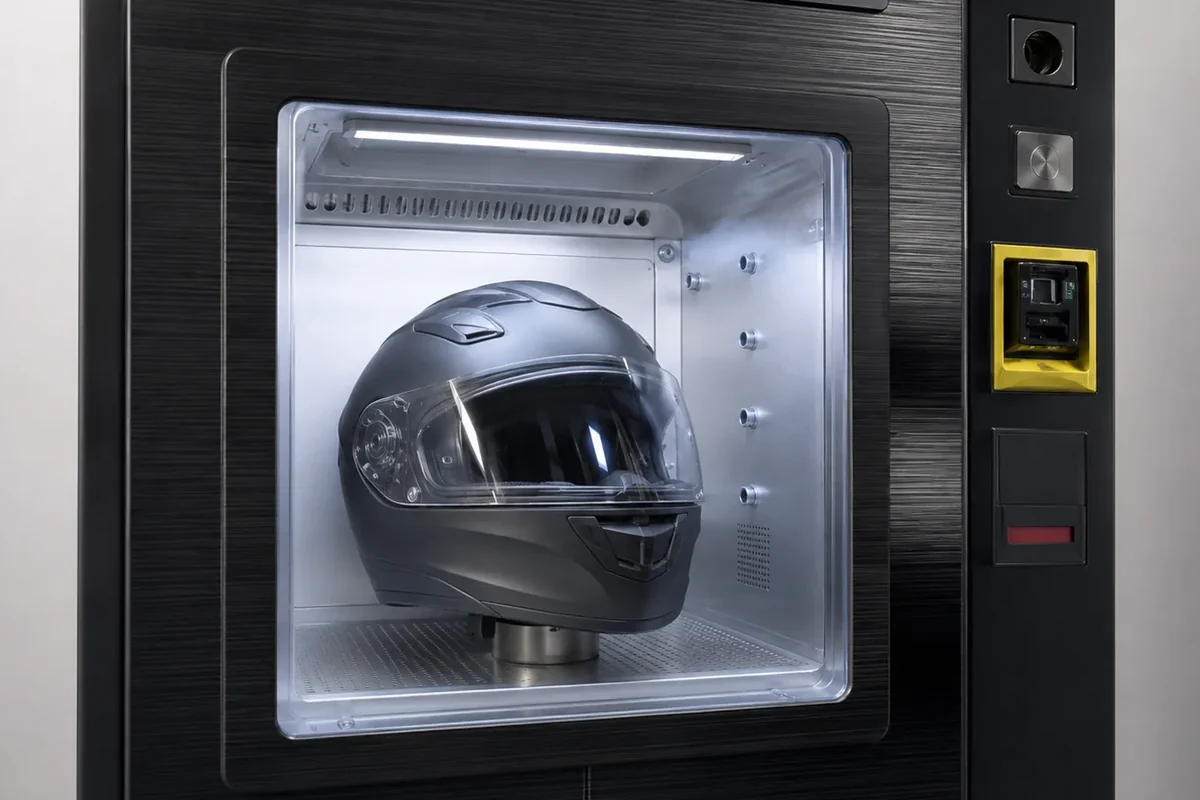
Physical-Threshold Rules-of-Thumb for Daily Shift Operators
Rule-of-Thumb 1 — Visor-Open (
>= 45°–90°/2–3 Detents) & Unbuckled Chin-Strap Mounting Geometry: If mounting a full-face, modular, or Flip-Up helmet onto the vertical chamber support post in anHCE-S1,HCE-D2, orHCE-K2cabinet $\rightarrow$ physically open the face shield at least2–3 ratcheting detents(>= 45°–90°), slide all forehead and chin intake vents to the open position, and unbuckle the retention chin strap before closing the chamber door because a closed visor acts as an impermeable aerodynamic shield that blocks> 75%of micronized (<= 5–10 µm) dry-mist aerosol and<= 50 °CPTC drying airflow from entering the oral-nasal chin-bar cavity and brow liner channels.
Rule-of-Thumb 2 — Banning Alcohol & Ammonia Cleaners on Polycarbonate Visors & Pinlock Coatings: If removing bug splatter, road grime, or fingerprint oils from polycarbonate visors, internal drop-down sun shields, or ABS/polycarbonate shells during Stage 1 intake $\rightarrow$ use only a lint-free microfiber cloth dampened with lukewarm water (
<= 30 °C) and apH-neutral (6.5–7.5)surfactant, strictly prohibiting ammonia window cleaners, isopropyl alcohol (> 5%), acetone, ketones, or petroleum degreasers because alkaline and solvent cleaners attack polycarbonate ester bonds—inducing microscopic stress crazing (permanent optical haze) and dissolving hydrophilic Pinlock anti-fog silicone seals and coatings within10–15 wipes(SHOEI Maintenance Baseline & Snell M2020/M2025).
Rule-of-Thumb 3 — Enforcing Full Cycle Completion Without Early Door-Open Override: If a counter attendant or self-service rider attempts to open the chamber door before the automated
180–300 sdry-mist + UV-C + ozone dwell and120–180 sPTC drying sequence reports completion $\rightarrow$ enforce electromagnetic door lock hold untilt = 100%and mandate a full program restart if power or a manual emergency release interrupts the cycle because opening the door during the misting dwell cuts chemical contact time ($t_{\text{contact}}$) below the U.S. EPA OCSPP 810.2300 and EN 1276 / EN 13697 threshold—dropping microbial kill below3-log(99.9 percent)—and vents un-destructed aerosol and> 0.05 ppmozone (FDA 21 CFR 801.415) into the breathing zone.
Rule-of-Thumb 4 — Deep-Washing Removable 3D Comfort Liner Pads Every
50–100 Rental Cycles: If a shared fleet helmet accumulates50–100 rental turnaround cycles(approx. 40–60 hoursof direct scalp/facial sweat contact) or fails a post-cycle cheek-pad ATP swab (> 250 RLU) or recurring odor check $\rightarrow$ pull the helmet from the rapid dry-mist rotation, unsnap the removable 3D polyurethane cheek and crown pads, and wash them in<= 30 °C (86 °F)pH-neutral detergent followed by20–30 minutesof<= 45 °C–50 °Cforced-air drying because accumulated sodium chloride sweat crystals and human sebum (>= 5%organic soil load) form a hydrophobic crust that quenches oxidizing dry-mist radicals and blocks253.7 nmUV-C photons (< 0.2 mmtextile depth).
Takeaway: Enforce the four physical thresholds—>= 45° visor opening, pH 6.5–7.5 solvent-free pre-wipe, zero early door overrides, and 50–100 cycle deep pad washing—as non-negotiable pass/fail gates in daily shift supervision.
How do you calculate annual shift labor hours saved ($\Delta T_{\text{labor,hr/yr}}$) and contact-time microbial log reduction ($\text{LR}$)?
Quantify the operational payoff of a standardized 5-stage automated SOP from the reduction in active attendant handling minutes per helmet across your annual turnaround volume ($\Delta T_{\text{labor,hr/yr}} = [N_{\text{helmets/day}} \cdot D_{\text{days/yr}} \cdot (t_{\text{manual,min}} - t_{\text{active,min}})] / 60$), and govern chamber cycle lockouts using the Chick-Watson chemical contact-time log-reduction equation ($\text{LR} = \log_{10}(N_0 / N_t) = k_{\text{eff}} \cdot C^n \cdot t_{\text{contact}}$).
When building a staffing budget or explaining to track attendants why a 4-minute sanitizing dwell cannot be cut short at 90 seconds, replace rules of thumb with explicit engineering math. Combine the two equations below with our helmet cleaning throughput calculation guide and HCE ROI Calculator to establish your site’s operational baseline.
Equation 1: Annual Shift Fleet Operator Labor Hours Saved ($\Delta T_{\text{labor,hr/yr}}$)
In an ad-hoc manual cleaning setup, a counter attendant spends $t_{\text{manual,min}} = 5.5\text{ to }8.0\text{ minutes per helmet}$ manually spraying interior foam, scrubbing chin straps, wiping the visor, and blotting/blowing the comfort liner dry with a hand dryer. When the site transitions to a standardized 5-Stage Automated Cabinet SOP (HCE-S1 or dual-chamber HCE-D2), the machine executes Stage 3 (dry-mist + UV-C + ozone dwell) and Stage 4 ($\le 50\text{ }^\circ\text{C}$ PTC drying) unattended while the attendant returns to customer check-in. The annual direct labor hours saved across the fleet is:
$$\Delta T_{\text{labor,hr/yr}} = \frac{N_{\text{helmets/day}} \cdot D_{\text{days/yr}} \cdot \left(t_{\text{manual,min}} - t_{\text{active,min}}\right)}{60}$$
Where:
- $\Delta T_{\text{labor,hr/yr}}$ = Net attendant labor hours saved per year ($\text{hours/year}$).
- $N_{\text{helmets/day}}$ = Average number of fleet helmets processed per operating day ($\text{helmets/day}$).
- $D_{\text{days/yr}}$ = Active operating days per year ($\text{days/year}$).
- $t_{\text{manual,min}}$ = Active attendant labor time per helmet under manual spray, scrub, wipe, and hand-dry workflow ($\text{min/helmet}$).
- $t_{\text{active,min}}$ = Active attendant handling time per helmet under the 5-Stage Automated SOP, summing Stage 1 pre-wipe ($0.75\text{ min}$), Stage 2 chamber load ($0.25\text{ min}$), and Stage 5 unload/dryness check/tag ($0.25\text{ min}$) while the $3\text{–}5\text{ min}$ chamber cycle runs unattended ($\text{min/helmet}$).
Worked Example (80-Helmet/Day Go-Kart Track / Rental Depot Operating 300 Days/Year): Assume a rental depot processes $N_{\text{helmets/day}} = 80\text{ helmets/day}$ across $D_{\text{days/yr}} = 300\text{ days/yr}$ ($24,000\text{ helmet turnarounds/yr}$), replacing a manual spray-and-towel workflow of $t_{\text{manual,min}} = 6.50\text{ min/helmet}$ with a standardized HCE-D2 dual-chamber SOP requiring $t_{\text{active,min}} = 1.25\text{ min/helmet}$ ($75\text{ seconds}$ of active hands-on work per helmet). The annual operator labor saved is $\Delta T_{\text{labor,hr/yr}} = [80 \times 300 \times (6.50 - 1.25)] / 60 = (24,000 \times 5.25) / 60 = 2,100\text{ labor hours/year}$—which at a burdened counter wage of $$18.00/\text{hr}$ saves $$37,800/\text{year}$ in direct labor while freeing staff to handle customer check-ins and safety briefings.
Equation 2: Chemical Contact-Time Microbial Log Reduction ($\text{LR}$ — Chick-Watson Kinetics)
During Stage 3 (Automated Dry-Mist Disinfection Dwell), the log-10 reduction ($\text{LR}$) of vegetative bacteria (Staphylococcus aureus, Pseudomonas aeruginosa, Escherichia coli) on the helmet’s inner comfort liner and chin strap follows Chick-Watson first-order inactivation kinetics:
$$\text{LR} = \log_{10}\left(\frac{N_0}{N_t}\right) = k_{\text{eff}} \cdot C^n \cdot t_{\text{contact}}$$
Where:
- $\text{LR}$ = Microbial log-10 reduction achieved during the chamber dwell ($\text{log}_{10}\text{ units}$, where $3.0\text{-log} = 99.9\text{ percent}$ reduction under U.S. EPA OCSPP 810.2300 non-food contact sanitizing and $4.0\text{-log} = 99.99\text{ percent}$ under EN 13697 bactericidal surface disinfection).
- $N_0$ = Initial viable microbial bioburden on the sweat-contaminated cheek pad or chin strap prior to Stage 3 ($\text{CFU}$, colony-forming units).
- $N_t$ = Surviving viable microbial bioburden at contact time $t_{\text{contact}}$ ($\text{CFU}$, where $N_t = N_0 \cdot 10^{-\text{LR}}$).
- $k_{\text{eff}} \cdot C^n$ = Effective first-order inactivation rate constant at the chamber’s metered dry-mist active biocide concentration $C$ and dilution exponent $n$ ($\text{log}_{10}/\text{s}$).
- $t_{\text{contact}}$ = Uninterrupted wet/mist aerosol contact dwell time inside the closed chamber ($\text{s}$).
Worked Example (Full 240 s Validated Dwell vs. 90 s Interrupted Cycle): Assume a returned rental helmet carries an initial bacterial load of $N_0 = 5.0 \times 10^5\text{ CFU}$ ($500,000\text{ CFU}$) on the chin strap, and the approved pH 6.5–7.5 dry-mist biocide (verified via label approval SOP) provides an effective rate constant of $k_{\text{eff}} \cdot C^n = 0.01667\text{ log}{10}/\text{s}$, achieving $\text{LR} = 0.01667 \times 240\text{ s} = 4.0\text{-log}$ ($99.99\text{ percent}$ kill, leaving $N_t = 5.0 \times 10^5 \times 10^{-4.0} = 50\text{ CFU}$) over a full $t{\text{contact}} = 240\text{ s}$ ($4.0\text{ min}$) dwell. If an attendant overrides the door lock early at $t_{\text{contact}} = 90\text{ s}$ ($1.5\text{ min}$), the achieved log reduction collapses to $\text{LR} = 0.01667 \times 90\text{ s} = 1.50\text{-log}$ ($96.84%$ kill), leaving $N_t = 5.0 \times 10^5 \times 10^{-1.50} = 15,811\text{ CFU}$ of viable bacteria on the cheek pads—failing the EPA OCSPP 810.2300 $\ge 3.0\text{-log}$ ($500\text{ CFU}$ max) sanitizing standard by more than $31\times$.
Takeaway: Post both calculations in the supervisor manual: automated 5-stage cabinets save over $2,000\text{ labor hours/year}$ at an 80-helmet/day site, but only if operators respect the full $180\text{–}300\text{ s}$ Chick-Watson contact-time lockout.
How do you execute Stage 5 ATP swab release audits, exception quarantine, and shift handovers?
Every helmet exiting Stage 4 must pass a tactile dryness check, visual optical inspection, and batch ATP bioluminescence swab audit ($\le 100\text{ RLU}$) before receiving a clean release tag—while any unit that experiences an interrupted cycle, persistent odor, damp padding, or structural defect is physically isolated in a quarantined hold tote with a logged disposition.
Under OSHA 29 CFR 1910.132(a), (e), and (f), an employer or commercial fleet operator must prove not only that protective headgear is sanitized between users, but also that defective or unverified units cannot re-enter active circulation during a shift change.
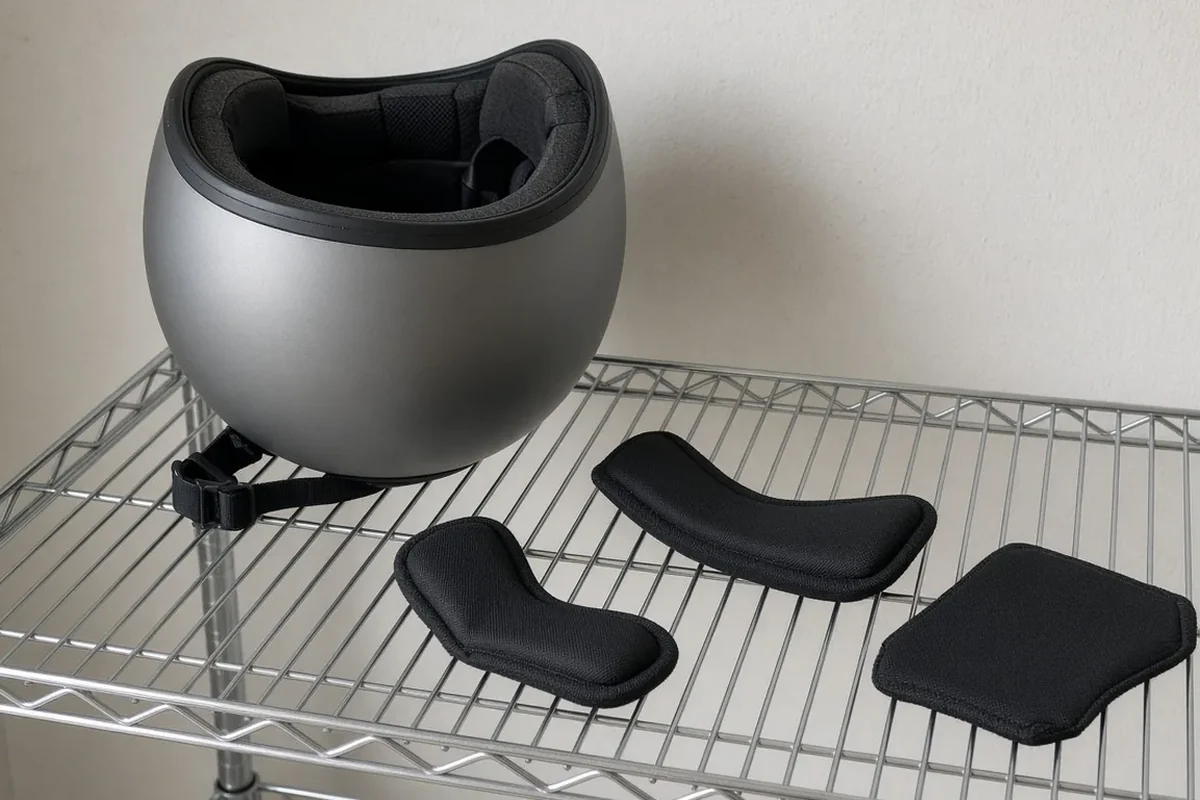
Exception & Interrupted-Cycle Disposition Matrix (With Dominant Failure Modes)
Download and print the blank helmet service and exception log (CSV) at your intake and release counter. Whenever a helmet fails any check in Stages 1 through 5, apply the mandatory quarantine and corrective protocol below:
| Exception / Non-Conformance Event | Immediate Custody Action | Mandatory Corrective & Recovery Protocol | Authorized Release Gate | Dominant Failure Mode & Prevention |
|---|---|---|---|---|
| 1. Interrupted Machine Cycle (power loss, emergency stop, low-fluid float trip, or early door open) | Move helmet immediately to Yellow Quarantine Hold Tote; log timestamp, chamber ID & fault code | Rectify machine fault per maintenance return-to-service checklist; refill biocide reservoir if $< 1.5\text{ L}$; run a complete 100% Stage 3 + Stage 4 cycle from $t = 0$ | PLC displays 100% Complete + zero tissue dampness + logged supervisor sign-off | Assuming a partial cycle achieved sanitization (< 1.5-log survival): Releasing a helmet after a 90-second interrupted cycle leaves $> 15,000\text{ CFU}$ active bacteria and un-evaporated biocide on skin-contact pads. Prevention: Treat every interrupted cycle as 0% treated and require a full restart |
| 2. Post-Cycle Cheek-Pad Dampness (tissue press shows wet transfer after Stage 4) | Hold in Yellow Drying Quarantine Rack; do not place in enclosed plastic bags or customer bins | Verify Stage 2 visor-open geometry; run a dedicated 10–15 min $\le 45\text{ }^\circ\text{C–}50\text{ }^\circ\text{C}$ PTC air-dry cycle (or detach wet pads to an open-air drying tree if rider was caught in heavy rain) | Dry tissue press on deepest cheek-pad crease + gravimetric weight within $\pm 2\text{ g}$ of dry baseline | Mold & Candida biofilm incubation inside sealed damp foam: Placing a helmet with $> 10\text{ g}$ trapped moisture onto a rental shelf breeds sour volatile organic acids within $6\text{–}12\text{ hours}$. Prevention: Never release a helmet that fails the tissue-press dryness gate |
3. Failed ATP Swab (> 250 RLU) or Persistent Sour Odor After 2 Cycles | Move to Orange Deep-Overhaul Tote; open an entry in the recurring odor log | Detach removable 3D comfort cheek/crown pads; hand-wash at $\le 30\text{ }^\circ\text{C}$ ($86\text{ }^\circ\text{F}$) in pH 6.5–7.5 detergent (SHOEI baseline); rinse thoroughly; force-air dry at $\le 50\text{ }^\circ\text{C}$ for 20–30 min; wipe inner EPS channels | Post-reassembly ATP swab registers $\le 100\text{ RLU}$ (<= 50 RLU strict) and zero sour odor at $5\text{ cm}$ | Repeatedly running dry-mist over salt/sebum-encrusted pads: Micronized mist cannot dissolve thick sebum crusts after 100+ sweat cycles. Prevention: Enforce scheduled $\le 30\text{ }^\circ\text{C}$ deep pad washing every 50–100 cycles or whenever ATP exceeds 250 RLU |
| 4. Unapproved Electronic Accessory or Hockey Cage Assembly | Hold at Stage 1 Intake Bench; check model against approved accessory matrix | Verify waterproof rating of Bluetooth intercom before dry-mist cycle; for hockey helmets with wire/polycarbonate cages, apply the hockey helmet & cage handover SOP | Accessory compatibility verified against OEM manual and logged on service ticket | Water intrusion into unsealed intercom USB ports or uncleaned chin cups: Leaving charging ports unplugged or skipping chin-cup wiping leaves high-touch zones contaminated. Prevention: Seal rubber USB port covers at Stage 1 and pre-wipe chin cups manually |
| 5. Cracked Shell, Dented/Painted EPS Liner, Frayed Strap, or $> 5\text{ Yr}$ Age | Isolate in Red Permanent Retirement Bin; attach DO NOT USE lockout tag (OSHA 29 CFR 1910.132(e)) | Do not clean or return to rental fleet; cut chin strap or remove comfort liner to prevent accidental reuse; log retirement in 5-year service intake register | Fleet supervisor disposal sign-off (or documented return to private owner with written safety notice) | Mistaking hygiene sanitization for structural impact certification: A clean, odor-free helmet with a compressed EPS liner or solvent-embrittled polycarbonate shell fails in a crash (Snell M2020/M2025). Prevention: Screen structural integrity at Stage 1 before any cleaning labor is spent |
Takeaway: Give every held helmet a color-coded physical bin (Red retirement, Orange deep pad wash, Yellow cycle repeat/drying hold, Green released) so incoming shift staff never guess a helmet’s status from where it sits on the counter.
What does a 5-year TCO comparison reveal about ad-hoc manual wiping vs. a standardized 5-stage automated helmet SOP?
Over a 5-year operating horizon (120,000 fleet helmet turnarounds at 80 helmets/day), an ad-hoc manual spray-and-wipe workflow costs $$196,000\text{ to }$285,000+$ in attendant labor, solvent-crazed visor replacements, premature liner rot, and hygiene churn—more than $4.5\times$ the total 5-year cost of running a standardized 5-Stage Automated Dry-Mist + UV-C + PTC SOP.
When fleet operators evaluate equipment quotes on our helmet cleaning machine price page or compare hardware architectures in our helmet cleaning equipment types comparison, they often compare machine capex against the price of a spray bottle and microfiber rags. In reality, unstandardized manual cleaning drains fleet profitability through four hidden cost multipliers:
- Uncontrolled Counter Labor Drain ($6.5\text{ min}$ vs. $1.25\text{ min}$ per Helmet): As proven in Equation 1, paying staff to manually spray, scrub, wipe, and blow-dry 80 helmets a day consumes $2,600\text{ hours/year}$, versus $500\text{ hours/year}$ of active Stage 1/2/5 handling alongside a dual-chamber
HCE-D2cabinet. - Polycarbonate Visor & Pinlock Crazing Loss: When untrained seasonal staff grab ammonia glass cleaner or alcohol sanitizing wipes to clean shields quickly, hydrophilic anti-fog layers peel and polycarbonate visors haze within weeks—forcing the fleet to replace $$35\text{–}$80$ visors and Pinlock inserts 3 to 4 times per year per helmet.
- Comfort Liner Delamination & Premature Helmet Replacement: Saturating fixed or removable foam pads with trigger-sprayer liquid and leaving them damp overnight rots sponge backing adhesives and breeds permanent mildew odors, cutting a shared helmet’s usable service life from 3–5 years down to 12–18 months.
- Customer Odor Rejections & Regulatory Hygiene Liability: Handing a damp, sweaty-smelling helmet to a go-kart or tour customer triggers immediate refund demands, negative online reviews, and potential citations under OSHA 29 CFR 1910.132(a) for industrial shared PPE fleets.
5-Year Fleet Hygiene TCO Ledger: Ad-Hoc Manual Wipe vs. Standardized 5-Stage Automated SOP (80 Helmets/Day, 120,000 Cycles over 5 Years)
Note: The comparative engineering ledger below models an active 100-helmet rental or industrial fleet processing $80\text{ turnarounds/day}$ across $300\text{ operating days/year}$ ($24,000\text{ cycles/year}$; $120,000\text{ cycles}$ over 5 years) under stated reference baselines:
| 5-Year TCO Cost Category | Ad-Hoc Manual Spray-Wipe & Uncontrolled Air/Heat Drying (No Formal SOP) | Standardized 5-Stage Automated Dry-Mist + UV-C + $\le 50\text{ }^\circ\text{C}$ PTC SOP (HCE-D2 Dual-Chamber) | Engineering Root Cause & SOP Control Reference |
|---|---|---|---|
| Equipment Capital & Station Setup (Year 0) | $$400\text{–}$900$ (spray bottles, utility sink, domestic hair dryers, uncalibrated racks) | $$3,200\text{–}$5,400$ (HCE-D2 dual-chamber cabinet + color-coded quarantine bins + ATP luminometer) | Plug-and-play 2200 W dual-chamber cabinet with independent PLC timers and 16 L internal reservoir |
| Direct Operator Cleaning Labor ($120,000\text{ cycles}$ @ $$18/\text{hr}$) | $13,000\text{ labor hrs}$ ($6.50\text{ min/helmet}$ manual scrub/wipe/dry) = $$234,000$ | $2,500\text{ labor hrs}$ ($1.25\text{ min/helmet}$ Stage 1/2/5 handling; Stages 3–4 unattended) = $$45,000$ | Saves $2,100\text{ hrs/yr}$ ($\Delta T_{\text{labor,hr/yr}}$, Equation 1) worth $$189,000$ over 5 years |
| Biocide Consumables, ATP Swabs & Drying Energy | $$6,000\text{–}$9,600$ (over-sprayed trigger bottles at $15\text{–}25\text{ mL/helmet}$ + paper towels) | $$5,400\text{–}$7,800$ ($3\text{–}5\text{ mL/cycle}$ metered dry-mist + $0.12\text{ kWh/cycle}$ PTC air + batch ATP swabs) | Ultrasonic $\le 5\text{–}10\text{ }\mu\text{m}$ atomization cuts chemical waste by $75%$ while ensuring uniform foam penetration |
| Polycarbonate Visor & Pinlock Crazing Replacements | $$9,000\text{–}$16,500$ ($60\text{–}110\text{ ruined visors/yr}$ from ammonia/alcohol wipes & paper towel scratches) | $$1,200\text{–}$2,400$ (normal road-wear replacement only under Stage 1 pH 6.5–7.5 microfiber rule) | Stage 1 chemical control (visor chemical checks) prevents polycarbonate stress crazing |
| Premature Comfort Liner & Helmet Fleet Replacement | $$12,000\text{–}$22,000$ (damp foam adhesive rot & heat-damaged EPS forcing early 18-mo retirement) | $$2,500\text{–}$4,500$ (scheduled $\le 30\text{ }^\circ\text{C}$ pad wash every 50–100 cycles + $\le 50\text{ }^\circ\text{C}$ PTC ceiling) | Clamped $\le 45\text{ }^\circ\text{C–}50\text{ }^\circ\text{C}$ PTC drying preserves EPS bead fusion across full 5-year service window |
| 5-Year Cumulative Fleet Hygiene TCO | $$261,400\text{–}$283,000$ ($\approx $2.18\text{–}$2.36\text{ per helmet turnaround}$) | $$57,300\text{–}$65,100$ ($\approx $0.48\text{–}$0.54\text{ per helmet turnaround}$) | Net 5-Year Fleet Savings: $$196,300\text{–}$225,700$ ($77%$ reduction in cost per sanitized helmet) |
Takeaway: Standardizing on a 5-stage automated cabinet SOP cuts per-helmet turnaround cost from over $$2.20$ down to $$0.50$ by eliminating 5.25 minutes of manual labor per cycle and halting solvent-induced visor and liner destruction.
What to send us to configure your fleet helmet cleaning SOP and equipment quotation
Whether you are standardizing an existing staffed rental desk (HCE-S1 / HCE-D2), launching an unattended self-service helmet cleaning vending machine route (HCE-K2), or scoping an OEM custom-branded fleet cabinet with pre-programmed SOP timers, send us the five operational inputs below through our supplier document & quotation checklist so our engineering team can configure your hardware and cycle parameters:
| Item | Why we need it | Example format |
|---|---|---|
| 1. Accepted helmet models, shell types & visor coatings | Verifies chamber post clearance (full-face, modular, open-face, off-road, or industrial hard hats), Pinlock anti-fog shield compatibility, and removable vs. fixed 3D comfort padding | Fleet inventory list (e.g., 60 full-face go-kart helmets with Pinlock visors, 40 open-face scooter helmets with Bluetooth intercoms) |
| 2. Daily turnaround volume ($N_{\text{helmets/day}}$) & peak 15-min wave | Sizes single- vs. dual-chamber capacity (HCE-S1 vs. HCE-D2/HCE-K2) and buffer rack count so attendants never truncate Stage 3 dwell or Stage 4 drying during rush periods | Daily and peak wave counts (e.g., 80 helmets/day total, with 20 helmets returning every 15 minutes between track heats) |
| 3. Target microbial standard & approved biocide SDS | Aligns Stage 3 ultrasonic dry-mist dosing (3–5 mL) and contact dwell timer ($t_{\text{contact}} \ge 180\text{–}300\text{ s}$) with your local biocide registration (EPA OCSPP 810.2300, EN 1276, or EN 13697) | Biocide Safety Data Sheet (SDS), pH 6.5–7.5 confirmation, or request for HCE baseline sanitizing solution specification |
| 4. Release verification method & shift handover format | Configures your Stage 5 release checklist, color-coded quarantine bin layout, and optional ATP bioluminescence RLU pass/caution/fail thresholds ($\le 100\text{ RLU}$) | Current inspection sheet, CSV service log fields, or corporate EHS/OSHA 29 CFR 1910.132 audit requirements |
| 5. Site electrical supply, ventilation & operating mode | Matches cabinet voltage (110V/60Hz or 220V–240V/50–60Hz), circuit breaker rating (1200 W to 2650 W), attended push-button vs. MDB cashless payment, and 4G telemetry | Site country/voltage, indoor counter vs. sheltered kiosk dimensions, and attended vs. self-service mode |
Send your accepted helmet list, daily turnaround volume, biocide SDS, and release criteria through the HCE contact page or review commercial system configurations on our helmet cleaning machine price & quotation page for a tailored SOP parameter sheet, sample trial, and Factory Acceptance Testing (FAT) discussion. We reply within 24 hours.
Method and sources
Compiled and verified on October 18, 2026 from primary occupational safety regulations, antimicrobial efficacy test guidelines, helmet manufacturer polymer maintenance manuals, and commercial OEM engineering baselines:
- OEM Helmet Shell, Visor, Pinlock & EPS Liner Maintenance Baselines: SHOEI USA Helmet Maintenance Guide (fetched October 18, 2026), SHOEI Worldwide — How to Maintain Helmet (fetched October 18, 2026), Snell Memorial Foundation M2020/M2025 FAQ (fetched October 18, 2026), Pinlock Official Lens Care & FAQ (fetched October 18, 2026), U.S. DOT FMVSS No. 218, and UNECE Regulation 22.06 ($50\text{ }^\circ\text{C} / 122\text{ }^\circ\text{F}$ EPS thermal conditioning ceiling; $\le 30\text{ }^\circ\text{C} / 86\text{ }^\circ\text{F}$ removable comfort-pad immersion washing baseline; prohibition of ammonia, alcohol, ketones, and aromatic solvents on polycarbonate visors and shells).
- Antimicrobial Dry-Mist Contact Dwell & Surface Disinfection Standards: U.S. EPA Series 810 — Product Performance Test Guidelines (
OCSPP 810.2200,810.2300Non-Food Contact Sanitizers $\ge 3\text{-log}$,810.2400) (updated June 25, 2026; fetched October 18, 2026), U.S. EPA — What are Antimicrobial Pesticides? (updated January 29, 2026; fetched October 18, 2026), and European EN 14885, EN 1276 ($\ge 5\text{-log}$ bactericidal suspension), EN 13697 ($\ge 4\text{-log}$ bactericidal and $\ge 3\text{-log}$ fungicidal surface disinfection), and EN 14476 ($\ge 4\text{-log}$ virucidal) standards ($t_{\text{contact}} \ge 180\text{–}300\text{ s}$ baseline). - Occupational PPE Hygiene, UV-C Safety & Ozone Exposure Regulations: OSHA 29 CFR § 1910.132 — General Requirements for Personal Protective Equipment (Subparagraphs
(a)sanitary and reliable condition,(b)employee-owned PPE sanitation,(e)defective and damaged equipment lockout, and(f)employee training and retraining; fetched October 18, 2026), ISO 15858 (UV-C Devices — Safety information — Permissible human exposure, $\le 6.0\text{ mJ/cm}^2$ 8-hour actinic dose limit at $253.7\text{ nm}$), and U.S. EPA — Ozone Generators that are Sold as Air Cleaners (citing FDA 21 CFR 801.415 $\le 0.05\text{ ppm}$ indoor medical/sanitizing device ozone output ceiling and OSHA 29 CFR 1910.1000 Table Z-1 $0.10\text{ ppm}$ 8-hour TWA PEL; fetched October 18, 2026). - Commercial Helmet Chamber Mounting Geometry, 5-Stage SOP & ATP Swab Verification: HCE published commercial baselines for
HCE-S1Single-Chamber (1200 W,8 Ltank),HCE-D2Dual-Chamber (2200 W,16 Ltank),HCE-K2Self-Service Kiosk (1800 Wrated /2650 Wmax,25 Ltank), and the 5-stage deep-cleaning cabinet (src/data/products.ts,src/data/home-machine.ts,src/data/home-cleaning-process.ts), cross-referenced with commercial dual-slot and tactical helmet dry-mist sanitizer operating documentation (iHelmetSpa / FresHelmet Technical Documentation, fetched October 18, 2026) and commercial ATP bioluminescence hygiene monitoring benchmarks ($\le 100\text{ RLU}$ pass, $101\text{–}250\text{ RLU}$ caution/re-wipe, $> 250\text{ RLU}$ deep liner wash). Standard catalog figures reflect baseline reference conditions; operators should verify model-specific cycle timers, biocide compatibility, and helmet fitment via sample trials and Factory Acceptance Testing (FAT). For related operating guides, visit the Operations & Maintenance archive.
Frequently Asked Questions
Why must operators open the helmet visor at least 2–3 detents (>= 45°) before starting an automated cleaning cycle?
What happens if an attendant opens the cabinet door early to hand a helmet to a waiting customer?
Why are alcohol wipes and ammonia glass cleaners banned in a commercial helmet cleaning SOP?
What ATP bioluminescence RLU threshold verifies that a shared helmet is ready for fleet release?
How often do removable comfort liner pads require deep immersion washing when an automated dry-mist cabinet is used daily?
Does passing a post-cycle cleanliness, dryness, and ATP audit certify that a helmet's impact protection is intact?
Related articles
How to Clean a Football Helmet: Team Equipment-Room SOP
Run a football helmet cleaning and sanitizing SOP with component checks, disinfectant label decisions, batch planning and a downloadable team care log.
Read article
How to Clean a Motorcycle Helmet: Manual vs Automated Process
Follow a motorcycle helmet's care instructions, separate washable pads from fixed parts, and compare manual cleaning with a documented automated process.
Read article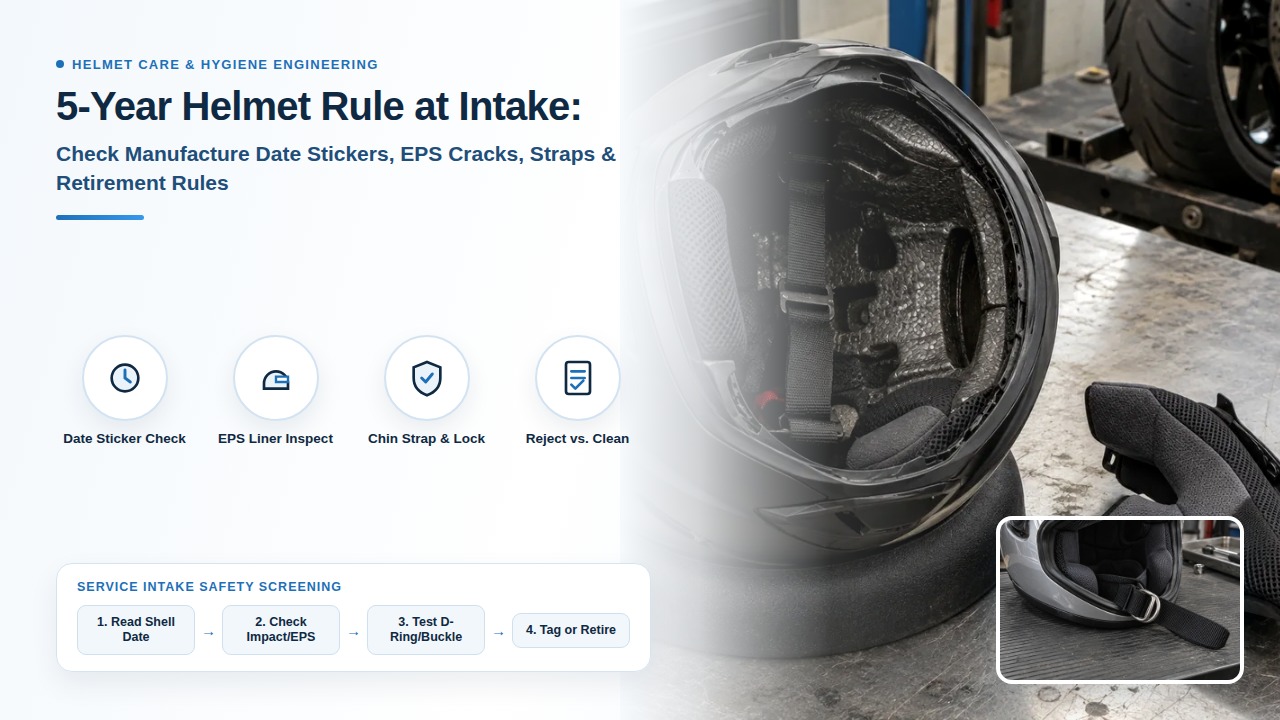
The Five-Year Helmet Rule: Check Dates and Retirement Instructions Before Cleaning
Separate manufacture, purchase, first-use, warranty and replacement dates before accepting an older helmet for cleaning, using a date-source intake register.
Read article