Cleaning, Sanitizing, and Disinfection for Shared Helmets
Compare cleaning, sanitizing (>=3-log), and disinfection (>=4-5 log) for shared helmets: UV-C fluence, dry-mist atomization, O3 destruct, and EPS limits.
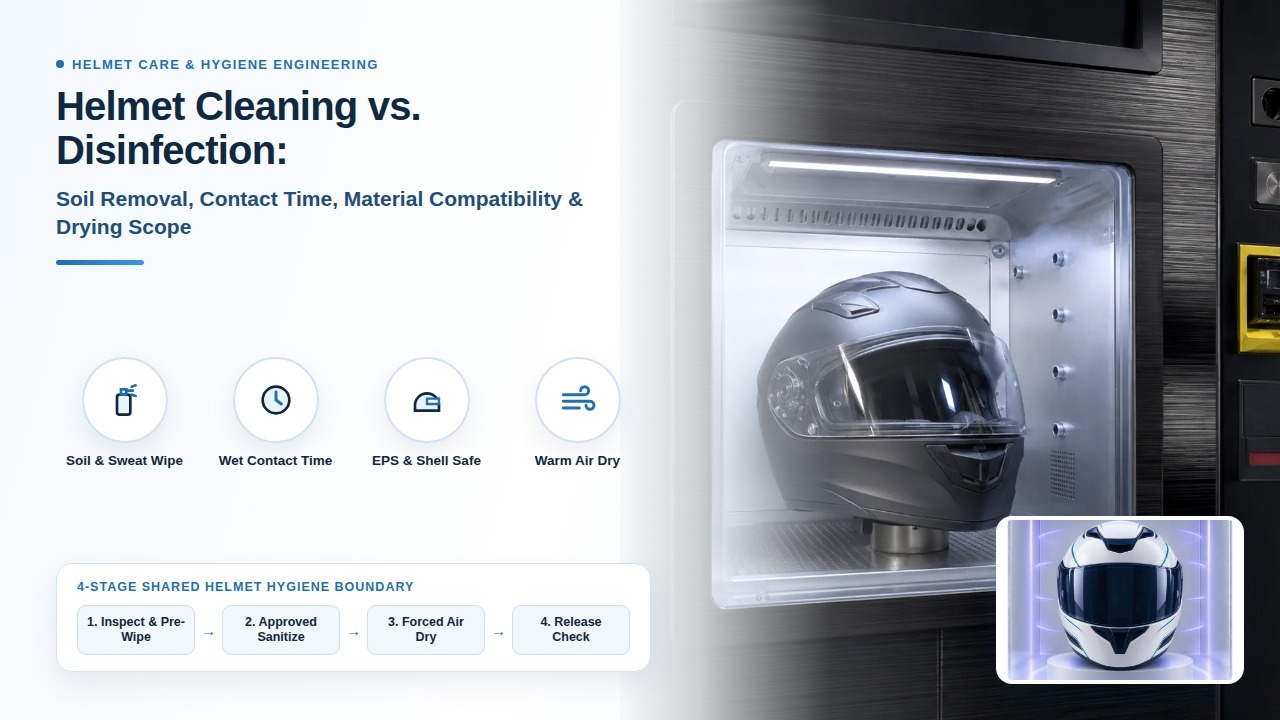
Substituting a fragrance mist or a line-of-sight UV lamp for a validated hygiene cycle leaves sweat-borne bacteria active inside 3D comfort padding and causes costly solvent or thermal damage to expanded polystyrene (EPS) impact liners. Fleet operators must compare and confirm physical cleaning, sanitizing, disinfection, and deodorizing by their regulatory test standards, optical and gaseous penetration physics, and helmet polymer limits before selecting commercial helmet cleaning equipment.
For shared motorcycle rental fleets, go-kart tracks, ski resorts, ride-hailing hubs, and industrial PPE lockers, cleaning, sanitizing, and disinfection represent distinct engineering targets rather than interchangeable marketing labels. Under U.S. EPA Series 810 guidelines (Retrieved October 2026) and European EN 14885 standards, cleaning physically removes sebum, sweat salts, and organic soil; sanitizing requires a verified $\ge 3\text{-log}$ ($10^3\text{-fold}$, or $99.9\text{ percent}$) bacterial reduction under EPA OCSPP 810.2300 or ASTM E1153; and disinfection requires a $\ge 4\text{-log}$ to $5\text{-log}$ ($10^4\text{- to }10^5\text{-fold}$, or $99.99\text{ to }99.999\text{ percent}$) bacterial and fungal inactivation under EPA OCSPP 810.2200, EN 1276, or EN 13697. Because $253.7\text{ nm}$ UV-C light penetrates $< 0.2\text{ mm}$ into open-cell foam and EPS impact liners soften above $50\text{ }^\circ\text{C}$ ($122\text{ }^\circ\text{F}$ per DOT FMVSS 218 and ECE 22.06 conditioning limits), commercial helmet cabinets combine micronized dry-mist atomization, controlled ozone ($< 0.05\text{ ppm}$ post-destruct release vs $0.10\text{ ppm}$ OSHA 29 CFR 1910.1000 PEL), and $\le 45\text{ }^\circ\text{C–}50\text{ }^\circ\text{C}$ PTC forced-air drying.
| Hygiene Stage or Subsystem Parameter | Standard Engineering Baseline / Regulatory Threshold | Why It Governs Shared-Helmet Fleet Operations |
|---|---|---|
| Physical Cleaning (Soil & Sebum Removal) | Manual pre-wipe or removable liner wash at $\le 30\text{ }^\circ\text{C}$ ($86\text{ }^\circ\text{F}$) with pH-neutral detergent (SHOEI USA Maintenance Baseline) | Removes organic sweat, hair oil, and dust that shield microbes and neutralize quaternary or oxidative biocides |
| Sanitizing (Non-Food-Contact Surfaces & Textiles) | $\ge 3\text{-log}$ ($10^3\text{-fold}$ / $99.9\text{ percent}$) vegetative bacterial reduction within stated contact time (U.S. EPA OCSPP 810.2300 / 810.2400; ASTM E1153) | Establishes the minimum documented bacterial reduction benchmark for routine turnover between healthy riders |
| Disinfection (Environmental Surfaces) | $\ge 5\text{-log}$ ($10^5\text{-fold}$ / $99.999\text{ percent}$) bacterial kill (EPA OCSPP 810.2200 / EN 1276 suspension) or $\ge 4\text{-log}$ ($10^4\text{-fold}$ / $99.99\text{ percent}$) bacterial & $\ge 3\text{-log}$ fungal kill (EN 13697 surface) | Required when service claims promise pathogen inactivation across bacteria, yeasts, and dermatophytic fungi |
| Deodorizing (VOC Oxidation / Fragrance) | Aesthetic odor reduction only (U.S. EPA FIFRA non-public-health boundary) | Masking sweat volatiles with fragrance never proves soil removal, sanitization, or pathogen kill |
Optical UV-C Irradiation (253.7 nm) | Radiant fluence $H = E \cdot t$ of $5\text{–}30\text{ mJ/cm}^2$ on line-of-sight surfaces; $< 0.2\text{ mm}$ foam depth; $\le 6.0\text{ mJ/cm}^2$ 8-hr human limit (ISO 15858) | Treats exposed shell/visor surfaces but requires dry-mist or gaseous pairing to reach shaded 3D cheek-pad pores |
Controlled Ozone (O3) & Catalytic Destruct | Chamber oxidation followed by activated-carbon destruct to $< 0.05\text{ ppm}$ ambient release (FDA 21 CFR 801.415; OSHA 29 CFR 1910.1000 PEL is $0.10\text{ ppm}$ 8-hr TWA) | Reaches recessed foam pores while protecting attendants and customers from respiratory ozone exposure at door unlock |
| Low-Temperature PTC Forced-Air Drying | $\le 45\text{ }^\circ\text{C–}50\text{ }^\circ\text{C}$ ($113\text{ }^\circ\text{F–}122\text{ }^\circ\text{F}$) circulating air stream (DOT FMVSS 218 & ECE 22.06 $50\text{ }^\circ\text{C}$ conditioning ceiling) | Evaporates liner moisture without softening EPS crush-liner beads or delaminating shell adhesives |
| Commercial Cabinet Cycle Duration | $3\text{–}5\text{ min}$ ($180\text{–}300\text{ s}$) standard baseline (HCE-S1, HCE-D2, HCE-K2); $180\text{–}480\text{ s}$ across full dry-mist + drying programs | Governs hourly fleet throughput and prevents wet-liner handovers during peak rental or shift changeovers |
How do U.S. EPA and European EN standards separate cleaning, sanitizing, disinfection, and deodorizing?
Cleaning removes physical organic soil, sanitizing reduces target bacteria by at least $3\text{-log}$ ($10^3\text{-fold}$ / $99.9\text{ percent}$), disinfection irreversibly inactivates specified pathogenic bacteria and fungi by $4\text{-log}$ to $5\text{-log}$ ($10^4\text{- to }10^5\text{-fold}$ / $99.99\text{ to }99.999\text{ percent}$), and deodorizing addresses malodorous compounds without establishing any public-health microbial reduction.
When evaluating a commercial helmet cleaning machine or reviewing a chemical supplier’s datasheet, procurement teams frequently encounter terms like “sterilization,” “sanitization,” and “deodorization” used as if they were interchangeable. In regulatory microbiology and personal protective equipment (PPE) maintenance, each claim is governed by strict test protocols and carrier substrates:
- Physical Cleaning (Soil, Sebum, and Salt Removal). Shared helmets accumulate epidermal lipids (sebum), eccrine sweat salts, hair products, road dust, and cosmetics on the interior polyurethane comfort liner, woven nylon chin strap, and polycarbonate visor. Both the U.S. EPA Product Performance Test Guidelines (OCSPP 810.2000) (fetched October 18, 2026) and the European EN 14885 framework specify that heavy organic soil creates a physical barrier over microorganisms and chemically quenches active biocides such as hypochlorous acid (
HOCl), quaternary ammonium compounds, and ozone. Pre-cleaning heavily soiled liners or running a physical soil-removal stage is a mandatory prerequisite before any antimicrobial step. - Deodorizing (Aesthetic Odor Control). In its official overview of Antimicrobial Pesticides (updated January 29, 2026; fetched October 18, 2026), the U.S. EPA separates non-public-health products—which control odor-causing bacteria or aesthetic spoilage—from public-health antimicrobial products. Applying a fragrance mist in stage four of an enclosed cabinet leaves a pleasant scent, but fragrance molecules do not remove sweat residue or establish pathogen kill.
- Sanitizing ($\ge 3\text{-log}$ / $99.9\text{ percent}$ Bacterial Reduction). Under U.S. EPA OCSPP 810.2300 (Sanitizers for Use on Hard Surfaces) and ASTM E1153, a non-food-contact surface sanitizer must demonstrate at least a $3\text{-log}$ ($10^3\text{-fold}$, or $99.9\text{ percent}$) reduction of specified Gram-positive and Gram-negative test bacteria (typically Staphylococcus aureus and Klebsiella pneumoniae or Enterobacter aerogenes) within the stated contact window (30 seconds to 5 minutes). When a sanitizer claim is made for fabric comfort pads or chin-strap webbing, testing must address porous textiles under EPA OCSPP 810.2400 (Disinfectants and Sanitizers for Use on Fabrics and Textiles).
- Disinfection ($\ge 4\text{-log}$ to $5\text{-log}$ / $99.99\text{ to }99.999\text{ percent}$ Pathogen Kill). Under U.S. EPA OCSPP 810.2200 (Disinfectants for Use on Environmental Surfaces) and AOAC Use-Dilution / Germicidal Spray methods, a disinfectant destroys or irreversibly inactivates infectious bacteria and fungi (though not bacterial endospores), requiring a $\ge 5\text{-log}$ ($10^5\text{-fold}$, or $99.999\text{ percent}$) bacterial reduction over a defined wet contact time (typically 3 to 10 minutes). Under the European EN 14885 standard architecture, EN 1276 (Phase 2, Step 1 quantitative suspension test) requires a $\ge 5\text{-log}$ ($99.999\text{ percent}$) bacterial reduction in $\le 5\text{ minutes}$, while EN 13697 (Phase 2, Step 2 quantitative non-porous surface test without mechanical wiping) requires a $\ge 4\text{-log}$ ($10^4\text{-fold}$, or $99.99\text{ percent}$) bactericidal reduction and a $\ge 3\text{-log}$ ($10^3\text{-fold}$, or $99.9\text{ percent}$) fungicidal and yeasticidal reduction (Candida albicans and Aspergillus brasiliensis).
- Sterilization (Excluded from Commercial Helmet Care). As defined by the U.S. EPA (
OCSPP 810.2100), sterilants eliminate all microbial life, including highly resistant bacterial endospores, using pressurized steam autoclaves ($121\text{ }^\circ\text{C–}134\text{ }^\circ\text{C}$), dry-heat ovens, or ethylene oxide gas. Because helmet shells, adhesives, and EPS liners suffer irreversible structural failure above $60\text{ }^\circ\text{C}$, no commercial helmet cabinet performs true medical sterilization.
| Regulatory Standard / Test Protocol | Target Claim & Test Phase | Required Minimum Log Reduction | Tested Carrier Substrate | Dominant Verification Failure Mode & Prevention |
|---|---|---|---|---|
| U.S. EPA OCSPP 810.2300 / ASTM E1153 | Non-food-contact surface sanitizing | $\ge 3\text{-log}$ ($99.9\text{ percent}$) vegetative bacteria in $0.5\text{–}5\text{ min}$ | Hard, non-porous glass or stainless-steel carriers | Extrapolating hard-coupon data to porous foam: A report on glass slides does not prove penetration into 3D polyurethane cheek pads; pair with OCSPP 810.2400 fabric data or dry-mist/gaseous diffusion |
| U.S. EPA OCSPP 810.2200 / AOAC Spray | Broad-spectrum / hospital surface disinfection | $\ge 5\text{-log}$ ($99.999\text{ percent}$) vegetative bacteria; $\ge 3\text{-log}$ viruses | Hard, non-porous carriers under stated organic soil load | Premature evaporation before wet contact time expires: Running high-heat drying blowers immediately after spraying flashes off biocide before the $3\text{–}10\text{ min}$ dwell time completes; sequence mist dwell before drying |
| EN 1276 (Phase 2, Step 1) | European bactericidal suspension efficacy | $\ge 5\text{-log}$ ($99.999\text{ percent}$) against 4 reference bacterial strains ($\le 5\text{ min}$) | Liquid test suspension with clean ($0.3\text{ g/L}$ albumin) or dirty ($3.0\text{ g/L}$) interfering load | Treating liquid suspension kill as whole-helmet proof: Liquid tube contact ignores chamber nozzle geometry and shadow zones; require Step 2 surface carrier (EN 13697) and cabinet distribution mapping |
| EN 13697 (Phase 2, Step 2) | European bactericidal & fungicidal surface efficacy | $\ge 4\text{-log}$ ($99.99\text{ percent}$) bacteria; $\ge 3\text{-log}$ ($99.9\text{ percent}$) fungi/yeasts | Dried inoculum on non-porous stainless-steel discs without mechanical wiping | Unremoved sebum quenching active chemistry: Heavy rider sweat and hair oil exceed clean-condition albumin test loads; enforce intake pre-wiping or removable pad washing on heavily soiled units |
| EPA OCSPP 810.2400 | Fabric & textile sanitizing / disinfection | $\ge 3\text{-log}$ ($99.9\text{ percent}$) sanitizing or complete carrier kill for disinfection | Porous textile swatches simulating apparel and padding fabrics | Liquid over-saturation of comfort foam: Soaking non-removable padding to meet wet textile contact times traps moisture against the EPS liner; use micronized dry-mist ($1\text{–}10\text{ }\mu\text{m}$) plus $\le 50\text{ }^\circ\text{C}$ forced-air drying |
Takeaway: Never accept “100% sterilization” marketing copy for a helmet cabinet; require the exact test standard (EPA OCSPP 810.2300, EN 1276, or EN 13697), log-reduction target, contact time, and substrate scope.
How do UV-C irradiation, ultrasonic dry-mist atomization, controlled ozone, and PTC drying compare inside an enclosed helmet chamber?
No single physical or chemical modality treats every zone of a helmet safely: $253.7\text{ nm}$ UV-C only treats unshadowed exterior/visor surfaces, ultrasonic dry-mist (HOCl or quaternary ammonium) and gaseous ozone (O3) penetrate recessed 3D comfort liner pores, and low-temperature PTC forced-air convection ($\le 45\text{ }^\circ\text{C–}50\text{ }^\circ\text{C}$) removes moisture without degrading the EPS impact liner.
When comparing helmet cleaning equipment types, buyers should evaluate how each subsystem inside an enclosed chamber interacts with three distinct helmet zones: the outer shell and polycarbonate shield, the removable 3D open-cell polyurethane comfort padding and nylon chin strap, and the underlying expanded polystyrene (EPS) energy-absorbing impact liner.
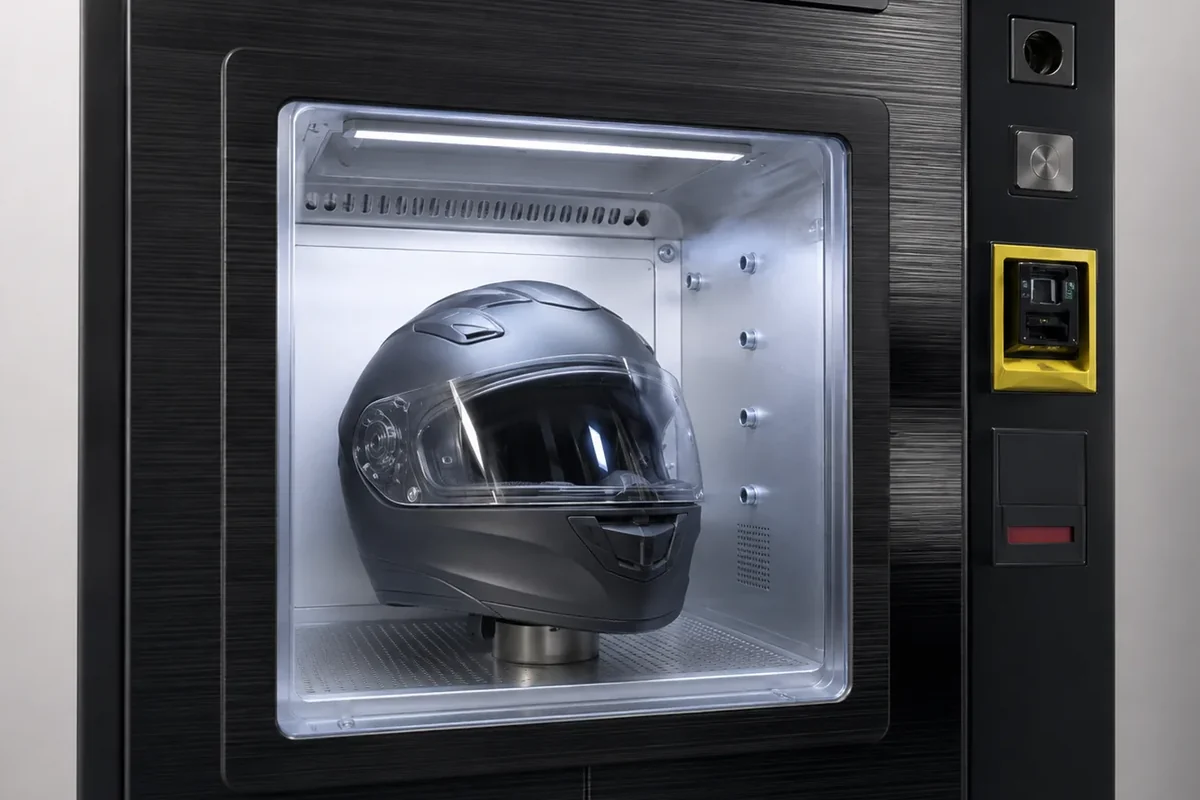
Subsystem Engineering Comparison & Dominant Failure Modes
The table below establishes the Standard Engineering Baseline under Reference Conditions across the four core subsystems used in commercial helmet hygiene cabinets (such as the HCE-S1 single-chamber unit, HCE-D2 dual-chamber unit, HCE-K2 self-service kiosk, and the 5-stage multifunction cabinet) alongside the dominant field failure mode and required mechanical or operational prevention for each technology:
| Chamber Subsystem / Modality | Primary Mechanism & Target Helmet Zone | Standard Engineering Baseline (Reference Conditions) | Helmet Polymer & Component Compatibility | Dominant Failure Mode & Prevention |
|---|---|---|---|---|
UV-C Optical Irradiation Only (253.7 nm / 254 nm) | Pyrimidine dimer disruption of microbial DNA/RNA on direct line-of-sight outer shell, visor exterior, and exposed cavity surfaces | $H_{\text{UVC}} = 10\text{–}30\text{ mJ/cm}^2$ on unshadowed surfaces over $60\text{–}180\text{ s}$; optical penetration depth $< 0.2\text{ mm}$ into polyurethane foam | Safe for FRP/polycarbonate shells under short cycle bursts; prolonged unshielded UV degrades dyed nylon webbing and ABS plastics | Line-of-sight optical shadowing inside 3D cheek pads & quartz sleeve fouling: Deep liner folds receive $< 3%$ of nominal irradiance ($< 1\text{ mJ/cm}^2$). Prevention: Combine UV-C with micronized dry-mist or gaseous O3 diffusion, mount helmets on open-plenum pedestals, wipe quartz lamp sleeves weekly, and enforce ISO 15858 door interlocks ($\le 6.0\text{ mJ/cm}^2$ 8-hr human limit) |
Ultrasonic Dry-Mist Atomized Biocide (HOCl / Neutral Quat) + UV-C Hybrid | Piezoelectric or pneumatic atomization ($1\text{–}10\text{ }\mu\text{m}$ aerosol droplets) convected into 3D comfort liner fabric, chin straps, and air vents | $3\text{–}5\text{ mL}$ metered solution per cycle; $60\text{–}180\text{ s}$ mist + dwell stage achieving $\ge 3\text{-log}$ to $4\text{-log}$ reduction when paired with EPA/EN-listed neutral solutions | Compatible with EPS, polycarbonate visors, and comfort foam only when pH-neutral ($6.0\text{–}7.5$), solvent-free, alcohol-free formulations are used | Piezo transducer mineral scaling & polycarbonate visor crazing: Hard tap water ($> 50\text{ ppm }\text{CaCO}_3$) calcifies ultrasonic discs, while alcohol/ammonia sprays crack polycarbonate shields and dissolve EPS. Prevention: Use demineralized carrier water with approved neutral biocides verified via the disinfectant spray label worksheet and visor chemical checklist |
Controlled Ozone (O3) Oxidation + Catalytic Destruct Cycle | Gaseous diffusion of triatomic oxygen into deep open-cell polyurethane pores and EPS ventilation channels to oxidize odor VOCs and surface microbes | Enclosed chamber O3 generation stage ($60\text{–}120\text{ s}$) followed by mandatory catalytic activated-carbon purge before door release | Reaches deep foam pores without wetting; excessive cumulative O3 oxidizes natural latex rubber edge beading and elastic strap fibers | Fugitive ambient ozone leakage (> 0.10 ppm) & elastomer embrittlement: Opening the cabinet door before ozone decomposition exposes staff and riders to respiratory irritation exceeding the $0.10\text{ ppm}$ OSHA 29 CFR 1910.1000 PEL. Prevention: Enforce electromagnetic door interlocks and catalytic carbon destruct cycles that pull residual ozone strictly $< 0.05\text{ ppm}$ (FDA 21 CFR 801.415 ceiling) before unlocking, and inspect EPDM door gaskets monthly |
Thermal Forced-Air Drying & Deodorization (40 °C–50 °C PTC) | High-volume circulating warm-air convection across crown pads, cheek pads, and chin straps to evaporate sweat and dry-mist moisture | Self-regulating PTC heater + centrifugal blower at $40\text{ }^\circ\text{C–}50\text{ }^\circ\text{C}$ ($104\text{ }^\circ\text{F–}122\text{ }^\circ\text{F}$) over $120\text{–}240\text{ s}$ (1200 W on HCE-S1; 1800–2650 W on HCE-K2) | Preserves EPS bead structure and shell adhesives when clamped $\le 50\text{ }^\circ\text{C}$ (DOT FMVSS 218 / ECE 22.06 thermal conditioning ceiling) | Thermal runaway softening EPS beads (> 60 °C) or short-cycled damp liners: Unregulated heating coils above $60\text{ }^\circ\text{C–}65\text{ }^\circ\text{C}$ deform EPS impact foam and delaminate shell glue, while clogged intake filters leave pads damp ($> 15%$ moisture). Prevention: Use self-limiting PTC heating elements with dual bi-metal thermal cutoffs clamped $\le 50\text{ }^\circ\text{C}$ and clean lint filters weekly per the maintenance checklist |
Engineering Rules-of-Thumb for Shared-Helmet Hygiene Selection
Use these four physical-threshold rules when configuring treatment cycles or auditing equipment quotations for rental, track, or delivery fleets:
Rule-of-Thumb 1 — Porous 3D Liner Penetration vs. Line-of-Sight UV-C: If target microbial sanitization includes porous 3D polyurethane cheek pads and woven nylon chin straps (
where 253.7 nm UV-C optical penetration is < 0.2 mm) under shared-fleet sweat loading $\rightarrow$ never rely on line-of-sight UV-C bulbs alone; combine micronized dry-mist biocide (1–10 µmdroplet diameter) or controlled gaseousO3diffusion with UV-C because fabric weaves and recessed foam cells block $> 95%$ of direct photon flux.
Rule-of-Thumb 2 — EPS Thermal Ceiling & Liner Adhesive Protection: If forced-air chamber drying air temperature approaches
50 °C (122 °F)(with removable comfort pads rated to 30 °C / 86 °F per SHOEI maintenance manuals and statutory impact conditioning capped at 50 °C under DOT FMVSS 218 and ECE 22.06) $\rightarrow$ clamp PTC heater output strictly<= 45 °C–50 °Cand increase blower volumetric airflow rather than raising air temperature because thermal exposure above60 °C–65 °C (140 °F–149 °F)softens expanded polystyrene (EPS) bead fusion and delaminates structural shell adhesives, voiding impact certification.
Rule-of-Thumb 3 — Ozone Destruct & Door-Interlock Occupational Safety: If an enclosed helmet cabinet utilizes gaseous ozone (
O3) inside an indoor rental shop, go-kart briefing room, or retail vestibule $\rightarrow$ require an electromagnetic door interlock paired with a catalytic activated-carbon destruct purge that reduces external breathing-zone and residual chamber ozone strictly< 0.05 ppm(FDA 21 CFR 801.415 indoor device ceiling and 50% below the 0.10 ppm OSHA 29 CFR 1910.1000 8-hour TWA PEL and NIOSH ceiling) prior to door release.
Rule-of-Thumb 4 — Cycle Duration vs. Peak Fleet Turnaround Rate: If peak fleet return demand exceeds
12–15 helmets/hour per chamberduring group check-ins or shift handovers (where a complete dry-mist contact, O3 destruct, and <= 50 °C forced-air drying cycle requires t_cycle = 180–480 s [3–8 min]) $\rightarrow$ deploy multi-chamber hardware (HCE-D2orHCE-K2dual-chamber units) or stage a pre-sanitized exchange rack because truncating cycle time below180 sviolates chemical wet-contact windows and leaves comfort padding damp.
Takeaway: Match each stage of a multi-stage cabinet (preheating, ozone, UV-C, dry-mist spray, and <= 50 °C PTC drying) to its physical boundary and failure prevention mechanism before approving fleet use.
How do you calculate UV-C germicidal dose and size chamber capacity for shared-fleet turnaround?
Calculate optical UV-C fluence from surface irradiance, exposure duration, and geometric view factor ($H_{\text{UVC}} = E_{254\text{nm}} \cdot t_{\text{exp}} \cdot f_{\text{view}}$), and size commercial cabinet chambers from peak hourly helmet returns, verified cycle duration, and loading efficiency ($N_{\text{chambers}} = \lceil (Q_{\text{helmets/hr}} \cdot t_{\text{cycle,min}}) / (60 \cdot \eta_{\text{load}}) \rceil$).
Published catalog ratings—such as the 3–5 min ($180\text{–}300\text{ s}$) cycle window and recommended daily volumes on the HCE-S1 ($20\text{–}45\text{ helmets/day}$), HCE-D2 ($40\text{–}120\text{ helmets/day}$), and HCE-K2 ($50\text{–}150\text{ helmets/day}$)—represent Standard Engineering Baselines under Reference Conditions (moderate sweat moisture, ambient $20\text{ }^\circ\text{C–}25\text{ }^\circ\text{C}$ intake air, and standard full-face or open-face geometry). To prevent under-dosing interior surfaces or creating queue bottlenecks during peak rental returns, apply the two explicit engineering equations below and verify actual cycle parameters during Factory Acceptance Testing (FAT) or sample trials.
Equation 1: Germicidal UV-C Fluence (Dose) & Shadow Derating
The radiant germicidal dose delivered to any specific surface patch inside a $253.7\text{ nm}$ ($254\text{ nm}$) UV-C cabinet is governed by the Bunsen-Roscoe reciprocity law modified by the local geometric view/shadow factor $f_{\text{view}}$:
$$H_{\text{UVC}} = E_{254\text{nm}} \cdot t_{\text{exp}} \cdot f_{\text{view}}$$
Where:
- $H_{\text{UVC}}$ = Delivered germicidal UV-C fluence (dose) on the target surface ($\text{mJ/cm}^2$, where $1\text{ mJ/cm}^2 = 1\text{ mW}\cdot\text{s/cm}^2$).
- $E_{254\text{nm}}$ = Unobstructed nominal UV-C irradiance at the helmet reference plane ($\text{mW/cm}^2$).
- $t_{\text{exp}}$ = Active UV-C lamp exposure time during the cycle ($\text{s}$).
- $f_{\text{view}}$ = Geometric line-of-sight view and reflectance factor ($1.0$ for directly illuminated exterior shell/visor surfaces; $0.01\text{–}0.05$ inside recessed 3D cheek-pad folds and beneath crown comfort padding).
Worked Example (Line-of-Sight Exterior vs. Shaded Cheek-Pad Recess): Assume an enclosed chamber delivers a nominal unshadowed irradiance of $E_{254\text{nm}} = 0.25\text{ mW/cm}^2$ at the helmet surface over an active UV-C stage of $t_{\text{exp}} = 120\text{ s}$. On the directly illuminated polycarbonate visor and outer shell ($f_{\text{view}} = 1.0$), delivered fluence is $H_{\text{UVC,shell}} = 0.25\text{ mW/cm}^2 \times 120\text{ s} \times 1.0 = 30.0\text{ mJ/cm}^2$ (exceeding the $5\text{–}20\text{ mJ/cm}^2$ reference threshold for vegetative bacteria). However, inside a folded 3D polyurethane cheek pad ($f_{\text{view}} = 0.03$), delivered optical fluence drops to $H_{\text{UVC,pad}} = 0.25 \times 120 \times 0.03 = 0.90\text{ mJ/cm}^2$—demonstrating mathematically why dry-mist atomization or gaseous ozone must accompany UV-C to sanitize interior foam.
Equation 2: Shared-Fleet Turnaround Chamber Sizing
To size the number of active cleaning chambers required to process returning helmets without queue delays or truncated drying cycles, use the continuous-service capacity equation (see our complete-service throughput calculation guide for multi-shift scheduling):
$$N_{\text{chambers}} = \left\lceil \frac{Q_{\text{helmets/hr}} \cdot t_{\text{cycle,min}}}{60 \cdot \eta_{\text{load}}} \right\rceil$$
Where:
- $N_{\text{chambers}}$ = Minimum number of active treatment chambers required (rounded up to the next whole integer).
- $Q_{\text{helmets/hr}}$ = Peak hourly helmet return rate requiring immediate turnaround ($\text{helmets/hr}$).
- $t_{\text{cycle,min}}$ = Total validated cycle time per helmet, including preheat, dry-mist/ozone/UV treatment, catalytic destruct, and $\le 50\text{ }^\circ\text{C}$ PTC drying ($\text{min}$).
- $\eta_{\text{load}}$ = Operational chamber utilization factor accounting for door loading, intake inspection, pre-wiping, and payment/program selection (typically $0.75\text{–}0.85$ for staffed counters).
Worked Example (Peak Go-Kart Track / Rental Fleet Turnaround): Assume a karting circuit or scooter rental hub receives $Q_{\text{helmets/hr}} = 28\text{ helmets/hr}$ between heats, runs a validated $t_{\text{cycle,min}} = 5.0\text{ min}$ ($300\text{ s}$) full hygiene and drying cycle, and operates at a staffed loading efficiency of $\eta_{\text{load}} = 0.80$. The required chamber count is $N_{\text{chambers}} = \lceil (28 \times 5.0) / (60 \times 0.80) \rceil = \lceil 140 / 48 \rceil = \lceil 2.92 \rceil = 3\text{ active chambers}$—which can be configured using one dual-chamber HCE-D2 ($2\text{ chambers}$) paired with one single-chamber HCE-S1 ($1\text{ chamber}$), or two dual-chamber HCE-D2 / HCE-K2 cabinets ($4\text{ chambers}$ total, providing a $25%$ maintenance reserve).
Takeaway: Size chamber counts from peak hourly turnaround and full validated cycle time ($3\text{–}5\text{ min}$ baseline plus loading), never by dividing a 24-hour day by a shortened fragrance-only cycle.
How do you protect EPS impact liners, polycarbonate visors, and comfort padding from chemical and thermal degradation?
Keep chamber drying temperatures strictly at or below $45\text{ }^\circ\text{C–}50\text{ }^\circ\text{C}$ ($113\text{ }^\circ\text{F–}122\text{ }^\circ\text{F}$), prohibit petroleum solvents, alcohols, ammonia, and strong acids/alkalis near the helmet, and wash heavily soiled removable comfort pads in a mesh bag at $\le 30\text{ }^\circ\text{C}$ ($86\text{ }^\circ\text{F}$) with pH-neutral detergent.
A microbial reduction report on a stainless-steel coupon is useless if the chemical or thermal cycle compromises the helmet’s crash protection. Primary helmet manufacturer maintenance specifications and statutory impact standards define strict material boundaries that every commercial cleaning workflow must respect:
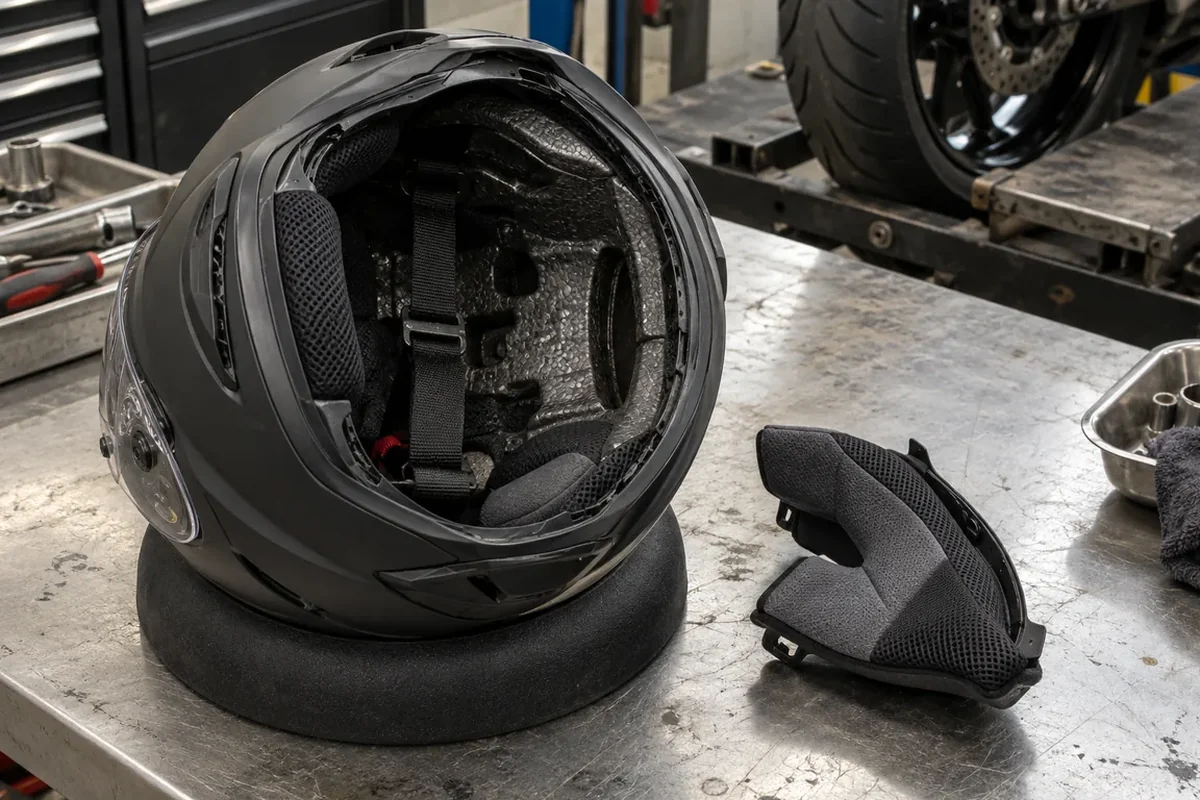
- Expanded Polystyrene (
EPS) Impact-Absorption Liner. Both SHOEI USA’s Helmet Maintenance Guide and SHOEI Worldwide’s Maintenance Manual (both fetched October 18, 2026) state explicitly that the EPS liner is neither solvent-proof nor heat-proof. Exposure to organic solvents, petrochemicals, gasoline, thinners, or corrosive cleaners dissolves polystyrene beads, while high heat softens bead fusion and degrades the structural adhesive bonding the EPS liner to the outer shell. Under U.S. DOT FMVSS 218 ($45\text{ }^\circ\text{C–}55\text{ }^\circ\text{C}$, centered at $50\text{ }^\circ\text{C} / 122\text{ }^\circ\text{F}$) and UNECE Regulation 22.06 ($50\text{ }^\circ\text{C}$ high-temperature conditioning), $50\text{ }^\circ\text{C}$ represents the upper environmental conditioning benchmark. Any helmet whose EPS liner moves inside the shell, exhibits heat deformation, or shows white scratches/indentations on black-painted EPS surfaces must be retired immediately under our five-year rule and physical retirement intake guide. - Polycarbonate Visors, Pinlock Inserts, and ABS Ventilation Sliders. SHOEI’s maintenance instructions warn that plastic mechanisms and shields absorb solvent-bearing agents, acid or alkali cleaners, and household glass/window cleaners—leading to environmental stress cracking (
ESC), hinge breakage, and loss of anti-fog or UV optical coatings. Before introducing any liquid into an ultrasonic mist tank or manual wipe station, verify polycarbonate and Pinlock compatibility using the visor cleaning chemical checklist. - Removable vs. Fixed 3D Comfort Padding. Under SHOEI USA guidelines, removable polyurethane foam and moisture-wicking fabric pads should be hand-washed or machine-washed inside a mesh washing net at $\le 30\text{ }^\circ\text{C}$ ($86\text{ }^\circ\text{F}$) using a mild, neutral detergent, then dried completely before reinstallation. Fixed interiors and EPS surfaces may only be wiped gently with a damp cloth wrung out in lukewarm water and neutral soap. Use the helmet padding washability intake guide to log which models in your fleet have removable vs fixed liners.
Takeaway: Verify that every chemical consumable and chamber thermal setting complies with the helmet manufacturer’s EPS, polycarbonate, and comfort-liner limits before placing fleet inventory into the machine.
What hidden costs separate manual spray wiping from automated dry-mist + UV-C helmet sanitizing machines over 5 years?
Over a 5-year fleet lifecycle ($10,000\text{ helmet cycles/year}$), uncontrolled manual aerosol spraying and ambient rack drying typically generate $3\times\text{ to }4\times$ higher total operating cost than an automated dry-mist + UV-C + PTC drying cabinet once chemical over-spray waste, solvent-induced visor/liner damage, wet-liner buffer inventory, and staff labor are accounted for.
Many rental desks and fleet depots initially treat manual trigger-bottle disinfectant sprays and open wire racks as a “zero-capital” hygiene solution. However, an engineering Total Cost of Ownership (TCO) audit exposes five compounding hidden costs in manual spray workflows:
- Consumable Over-Spray & Drip Waste: Manual trigger spraying typically expels $15\text{–}25\text{ mL}$ of liquid per helmet—soaking the top fabric layer while dripping off the shell—whereas a closed-chamber ultrasonic dry-mist manifold atomizes a metered $3\text{–}5\text{ mL}$ dose into $1\text{–}10\text{ }\mu\text{m}$ droplets that convect evenly across the liner.
- Premature Liner Delamination & Visor Crazing Liability: When staff grab off-the-shelf alcohol, quaternary-alcohol, or ammonia glass sprays to speed up evaporation between riders, polycarbonate visors develop micro-crazing and comfort-pad adhesives delaminate within $6\text{–}12\text{ months}$.
- Wet-Liner Turnaround Downtime & Extra Helmet Buffer Capital: A manually sprayed comfort pad requires $45\text{–}90\text{ minutes}$ of ambient room drying before the next customer can wear it without encountering cold, damp foam. That delay forces high-turnover fleets to purchase $30%\text{–}50%$ more spare helmets or suffer recurring odor complaints documented in our recurring odor rework log.
- Unstandardized Labor Minutes per Cycle: Manual pre-wiping, spraying, visor wiping, and rack transfers consume $3\text{–}5\text{ minutes}$ of active attendant labor per helmet versus $< 30\text{ seconds}$ of load/unload handling on an automated self-service or counter cabinet.
5-Year Fleet Hygiene TCO Ledger (Assumed Baseline: 10,000 Cycles/Year, 50,000 Cycles over 5 Years)
Note: The table below illustrates a comparative engineering cost model using stated reference assumptions for a mid-size scooter rental, karting, or delivery depot processing $10,000\text{ cycles/year}$ ($\approx 28\text{ helmets/day}$). Buyers can model their exact local utility tariffs, labor rates, and paid vending revenue in the HCE ROI Calculator and request order-specific hardware pricing on the helmet cleaning machine price page.
| Cost Category (5-Year Cumulative Basis) | Manual Aerosol Spray + Ambient Drying Rack | Automated Dry-Mist + UV-C + $\le 50\text{ }^\circ\text{C}$ PTC Cabinet (HCE-S1 / HCE-D2) | Primary Engineering Cost Driver & Verification |
|---|---|---|---|
| Chemical Consumable Consumption | $750\text{–}1,250\text{ L}$ ($15\text{–}25\text{ mL/cycle}$ manual trigger spray) $\approx $6,000\text{–}$10,000$ (at $$8/\text{L}$) | $150\text{–}250\text{ L}$ ($3\text{–}5\text{ mL/cycle}$ metered ultrasonic dry-mist) $\approx $1,200\text{–}$2,000$ | Closed-loop ultrasonic atomization eliminates liquid runoff and over-saturation of polyurethane cheek pads |
| Visor & Comfort-Pad Premature Replacement | $25\text{–}40$ damaged visors/liner sets per year from alcohol/solvent exposure $\approx $5,000\text{–}$9,000$ over 5 yr | Near-zero chemical degradation when operated with pH-neutral aqueous mist and $\le 50\text{ }^\circ\text{C}$ PTC air | Prevents environmental stress cracking (ESC) on polycarbonate shields and adhesive failure on EPS liners |
| Wet-Liner Fleet Buffer Inventory Cost | Requires $+15\text{ to }+25$ extra buffer helmets ($\approx $2,250\text{–}$5,000$) to cover $45\text{–}90\text{ min}$ ambient drying lag | $3\text{–}5\text{ min}$ enclosed cycle returns dry, wearable helmets immediately to active rotation | High-volume $\le 50\text{ }^\circ\text{C}$ PTC convection eliminates damp-liner customer rejections during peak hours |
| Direct Attendant Labor ($50,000\text{ cycles}$) | $2,500\text{–}4,167\text{ labor hours}$ ($3\text{–}5\text{ min/helmet}$) $\approx $37,500\text{–}$62,500$ (at $$15/\text{hr}$) | $417\text{–}625\text{ labor hours}$ ($30\text{–}45\text{ s}$ load/unload + weekly filter care) $\approx $6,250\text{–}$9,375$ (or $$0$ in rider self-service mode) | Automated stage sequencing frees counter staff for service intake and release checks |
| Electricity & Routine Wear Parts | Minimal rack electricity ($\approx $0$), plus replacement spray bottles and microfiber cloths ($\approx $600$) | $\approx 0.09\text{–}0.15\text{ kWh/cycle}$ ($4,500\text{–}7,500\text{ kWh}$ over 5 yr $\approx $675\text{–}$1,350$) + UV-C bulbs, piezo discs & carbon filters ($\approx $900\text{–}$1,500$) | Calculated from 1200 W–2200 W peak heating over $3\text{–}5\text{ min}$ cycles; verify local kWh tariff and spare-parts kit in quotation |
| Process Auditability & Customer Trust | Unverified manual wiping; high risk of skipped contact times during busy rushes | Locked program timer, visible progress display, and repeatable stage control across every cycle | Aligns customer service descriptions with documented supplier document checks |
Takeaway: Evaluate automated helmet sanitizing cabinets on 5-year total cost per dry, ready-to-issue helmet rather than comparing hardware capital against the price of a spray bottle.
How do you verify supplier test reports and integrate the cycle into a daily fleet SOP?
Audit every supplier test report against five physical alignment criteria—tested carrier surface, accessible helmet geometry, exact consumable and program version, pre-cleaning/drying steps, and stated microbial scope—before locking the approved combination into your daily intake and release SOP.
A laboratory efficacy report can be genuine and still fail to support your real-world helmet service if the test was run on a flat glass slide for 10 minutes while your cabinet runs a 3-minute mist cycle on a loaded full-face helmet. Before approving a machine program or publishing a hygiene claim at your counter, complete the five-point engineering verification below (and cross-check the vendor’s technical dossier using our supplier document verification guide):
| Supplier Report Detail | Engineering Comparison to Perform | Action When a Gap Exists |
|---|---|---|
| 1. Tested Object or Carrier Surface | Was the log reduction measured on porous 3D polyurethane foam/nylon webbing (EPA OCSPP 810.2400) or only on flat stainless-steel/glass discs (OCSPP 810.2200 / EN 13697)? | Restrict hard-surface claims to exterior shell/visor surfaces, or run a sample trial on actual helmet liner swatches |
| 2. Accessible Chamber Geometry | Does the test arrangement reflect an inverted or pedestal-mounted helmet inside the cabinet (HCE-S1 / HCE-D2 / HCE-K2), including recessed cheek-pad folds? | Position helmets on open-plenum pedestals with visors cracked open so dry-mist, O3, and drying airflow circulate through the cavity |
| 3. Process & Consumable Configuration | Are the active biocide concentration, atomized dose ($\text{mL/cycle}$), UV-C wattage, ozone concentration, and program duration identical to the ordered machine? | Record the exact consumable SKU, tank dilution ratio, and PLC program timer in your operating register |
| 4. Pre-Cleaning & Post-Cycle Steps | Does the laboratory protocol require pre-wiping gross organic soil (0.3 g/L clean vs 3.0 g/L dirty albumin load) or post-treatment drying and ozone destruct? | Build mandatory pre-wiping of visible sweat/mud and post-cycle moisture/odor release checks into the daily counter workflow |
| 5. Stated Microbial & Regulatory Scope | Is the documented result a $\ge 3\text{-log}$ bacterial sanitization (OCSPP 810.2300) or a $\ge 4\text{-log}$ to $5\text{-log}$ bactericidal/fungicidal disinfection (EN 1276 / EN 13697)? | Describe your customer service using the exact verified scope (“5-stage enclosed cleaning, sanitizing mist, and warm-air drying”) rather than “100% medical sterilization” |
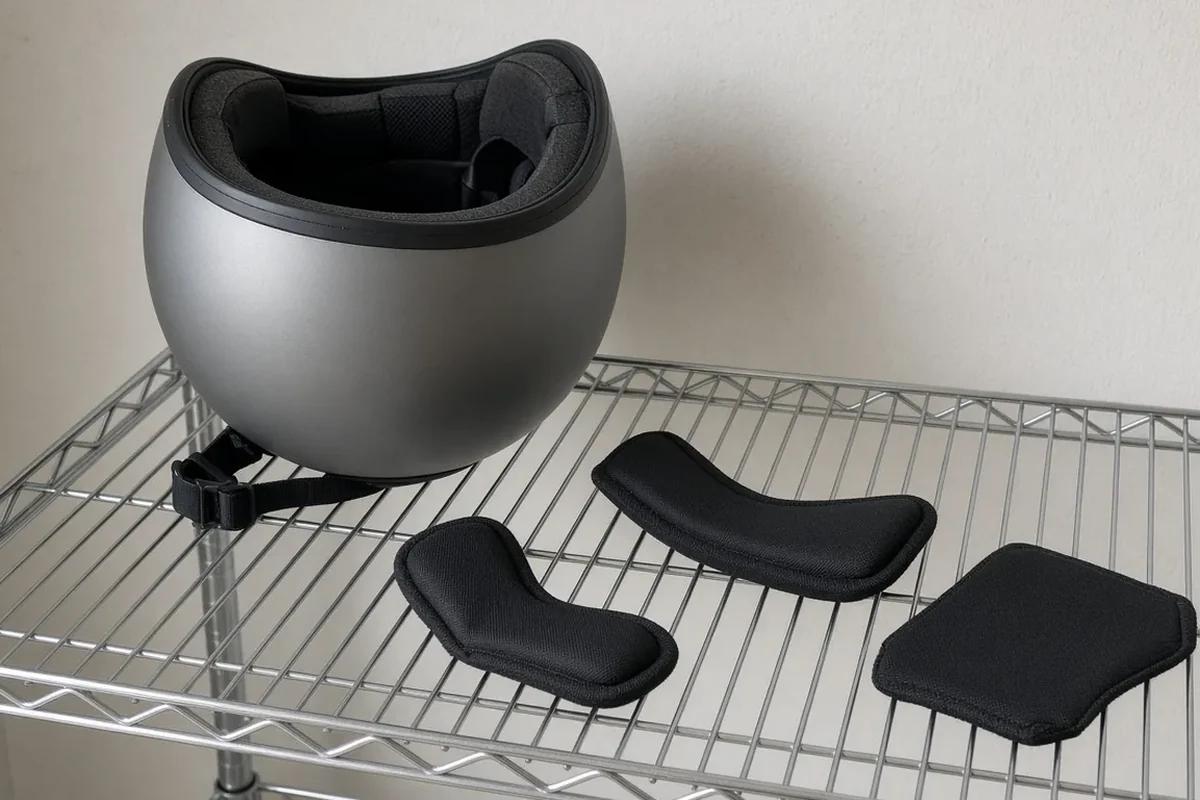
Describing a Multi-Stage Cabinet Cycle Accurately (/#deep-cleaning 5-Stage Reference)
On the HCE homepage 5-step deep cleaning configuration, the enclosed cabinet sequence moves through five stages:
- Warm-Air Preparation (Preheating): Gently warms the chamber air to aid mist dispersion without exceeding EPS thermal limits.
- Ozone Treatment (
O3): Diffuses gaseous ozone inside the sealed compartment to oxidize odor volatiles inside porous padding, followed by catalytic destruct so external ozone stays $< 0.05\text{ ppm}$. - UV Treatment (
253.7 nmUV-C): Irradiates line-of-sight exterior shell and visor surfaces inside the UV-shielded tempered-glass door. - Spray Cleaning + Fragrance: Atomizes the approved cleaning/sanitizing solution and light fragrance mist into the helmet cavity.
- Controlled Drying: Circulates $\le 45\text{ }^\circ\text{C–}50\text{ }^\circ\text{C}$ forced warm air to evaporate surface moisture before release.
When integrating this 5-stage cabinet—or our commercial single-chamber and dual-chamber product lineup—into your helmet cleaning standard operating procedure (SOP) or rental deployment evaluation, train staff on three operational release rules:
- Intake Gate: Check production/purchase age and inspect for crash dents, loose EPS liners, or torn straps before loading. Heavily soiled or mud-caked pads require manual neutral-soap pre-washing (
<= 30 °C) before cabinet sanitization. - Cycle Execution: Never open or bypass the cabinet door during UV-C, dry-mist, or ozonedestruct phases, and never substitute unapproved alcohol or solvent sprays into the
8 L,16 L, or25 Lsolution reservoir. - Release Gate: Confirm the comfort liner and chin strap are dry to the touch, the visor is optically clear, and no chemical residue remains before handing the helmet to the next rider.
Takeaway: Connect your supplier’s laboratory evidence directly to an intake pre-wipe, a locked cabinet program, and a physical release check so staff can execute and explain the workflow consistently.
What to send us when specifying a commercial helmet cleaning and sanitizing system
Whether you are equipping a motorcycle rental counter, a ride-hailing driver hub, an indoor karting facility, or scoping an OEM custom-branded self-service kiosk, share your operational parameters below so our engineering team can match chamber count, cycle programming, and consumable documentation to your fleet:
| Item | Why we need it | Example format |
|---|---|---|
| Helmet models, shell types, and liner construction | Confirms chamber clearance (up to XXL full-face, modular, or motocross), removable vs fixed 3D comfort padding, and manufacturer thermal/solvent rules | List or CSV of brands/models (e.g., 60 full-face rental helmets with Pinlock visors; 40 open-face scooter helmets) |
| Target hygiene claim and regulatory jurisdiction | Determines whether your operation requires routine odor/soil refresh, $\ge 3\text{-log}$ sanitization (EPA OCSPP 810.2300), or $\ge 4\text{-log}$ to $5\text{-log}$ disinfection (EN 1276 / EN 13697) | Country/state, setting type (rental desk, unattended vending, industrial PPE), and any local health-code or insurer clauses |
| Peak hourly helmet turnaround and operating window | Sizes chamber count ($N_{\text{chambers}}$) across HCE-S1 ($1\text{ chamber}$), HCE-D2 ($2\text{ chambers}$), or HCE-K2 ($2\text{ chambers}$) without truncating the $3\text{–}5\text{ min}$ drying cycle | Peak helmets/hour (e.g., 28 helmets/hr between track heats or 80 helmets/day across two shift handovers) |
| Proposed liquid consumable or supplier test report | Verifies pH neutrality ($6.0\text{–}7.5$), solvent-free EPS/polycarbonate compatibility, atomization viscosity, and contact-time alignment | Product SDS/label PDF, EPA registration or EN test report number, and any specific claim needing clarification |
| Site electrical supply, ventilation, and payment mode | Matches voltage/frequency (110V/60Hz or 220V–240V/50–60Hz), circuit capacity (1200 W to 2650 W peak), indoor ozone destruct interlocks, and card/cash/QR payment hardware | Site voltage/breaker rating, indoor vestibule dimensions, and attended vs self-service payment specification |
Send your helmet list, peak hourly turnaround target, proposed consumable or test report scope, and site electrical details through the HCE contact page or request a model-specific breakdown on our commercial quotation page for a configuration, sample trial, and Factory Acceptance Testing (FAT) discussion. We reply within 24 hours.
Method and sources
Compiled and verified on October 18, 2026 from primary regulatory standards, manufacturer maintenance manuals, and HCE engineering baseline specifications:
- U.S. Environmental Protection Agency (EPA): What are Antimicrobial Pesticides? (updated January 29, 2026; fetched October 18, 2026) and Series 810 — Product Performance Test Guidelines (
OCSPP 810.2000,810.2100,810.2200,810.2300,810.2400) (updated June 25, 2026; fetched October 18, 2026). - European Disinfectant Standards Framework: EN 14885 (Chemical disinfectants and antiseptics — Application of European standards), EN 1276 (Phase 2, Step 1 quantitative suspension test for bactericidal activity, $\ge 5\text{-log}$ reduction), and EN 13697 (Phase 2, Step 2 quantitative non-porous surface test for bactericidal $\ge 4\text{-log}$ and fungicidal/yeasticidal $\ge 3\text{-log}$ activity).
- Helmet Polymer, Thermal & Solvent Boundaries: SHOEI USA Helmet Maintenance (fetched October 18, 2026), SHOEI Worldwide — How to Maintain Helmet (fetched October 18, 2026), Snell Memorial Foundation FAQ (fetched October 18, 2026), U.S. DOT FMVSS No. 218 ($50\text{ }^\circ\text{C} / 122\text{ }^\circ\text{F}$ high-temperature conditioning), and UNECE Regulation 22.06 ($50\text{ }^\circ\text{C}$ thermal conditioning).
- Ozone & UV-C Occupational Exposure Limits: U.S. EPA — Ozone Generators that are Sold as Air Cleaners (Table 1 citing FDA 21 CFR 801.415 $\le 0.05\text{ ppm}$ indoor medical device ozone output limit, OSHA 29 CFR 1910.1000 Table Z-1 $0.10\text{ ppm}$ 8-hour TWA PEL, and NIOSH $0.10\text{ ppm}$ ceiling; fetched October 18, 2026) and ISO 15858 (UV-C Devices — Safety information — Permissible human exposure, $6.0\text{ mJ/cm}^2$ 8-hour actinic dose limit at $253.7\text{ nm}$).
- HCE Standard Engineering Baselines: Published catalog specifications for
HCE-S1,HCE-D2,HCE-K2, and the 5-stage deep-cleaning cabinet (src/data/products.ts,src/data/home-machine.ts, andsrc/data/home-cleaning-process.ts). Standard catalog figures reflect baseline reference conditions; field microbial outcomes, drying times, and material compatibility depend on the buyer’s exact helmet models, biocide registration, and ambient loading, which should be confirmed via sample trials and Factory Acceptance Testing (FAT). For related guides, browse the Operations & Maintenance archive.
Frequently Asked Questions
Does deodorizing or fragrance spraying prove that a shared helmet is sanitized or disinfected?
Can 253.7 nm UV-C light alone disinfect the inside of helmet cheek pads?
What is the maximum safe drying temperature inside a commercial helmet cleaning cabinet?
How do you verify a supplier's disinfectant spray or cabinet efficacy report before fleet deployment?
Related articles
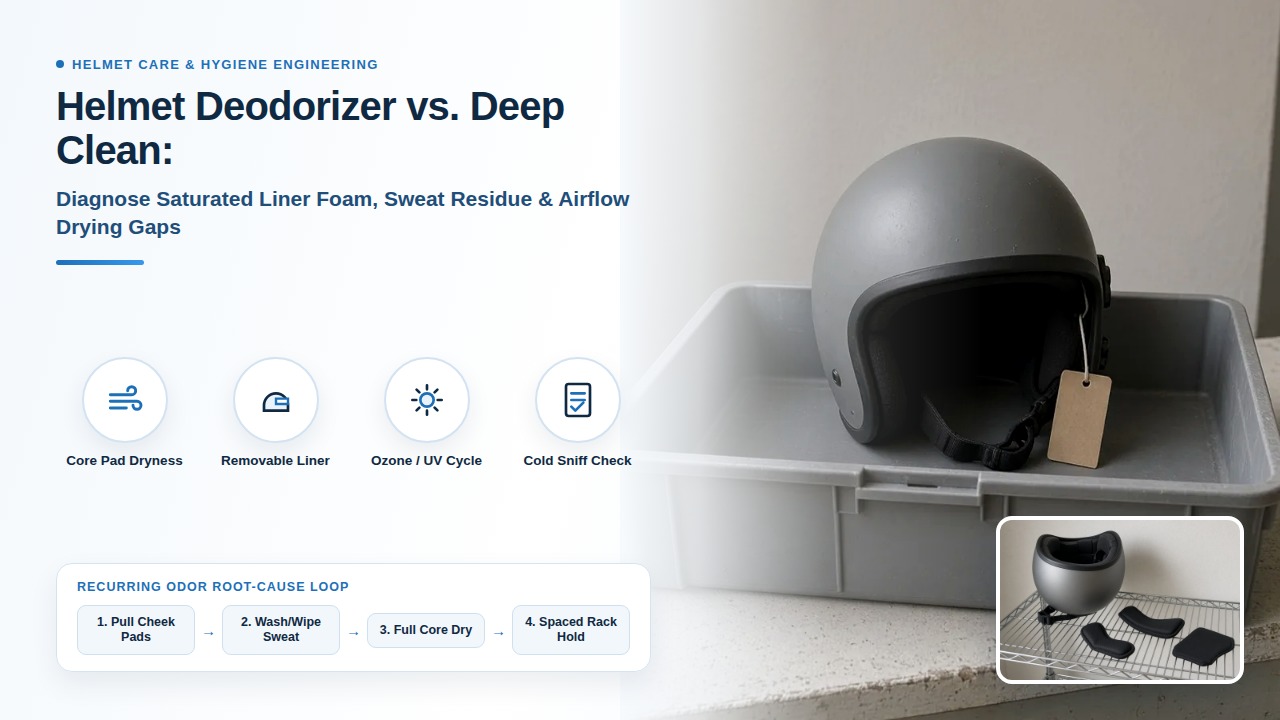
Helmet Deodorizer or Recleaning? Track Recurring Odor Before Release
When a shared helmet keeps smelling, hold it and log where it smells, whether it is damp, what care was done and how it was stored before adding fragrance.
Read article
How to Clean a Football Helmet: Team Equipment-Room SOP
Run a football helmet cleaning and sanitizing SOP with component checks, disinfectant label decisions, batch planning and a downloadable team care log.
Read article
How to Clean a Motorcycle Helmet: Manual vs Automated Process
Follow a motorcycle helmet's care instructions, separate washable pads from fixed parts, and compare manual cleaning with a documented automated process.
Read article