How to Choose a Commercial Helmet Cleaning Machine
A practical framework for comparing helmet cleaning systems by compatibility, process control, throughput, drying, and operating cost.
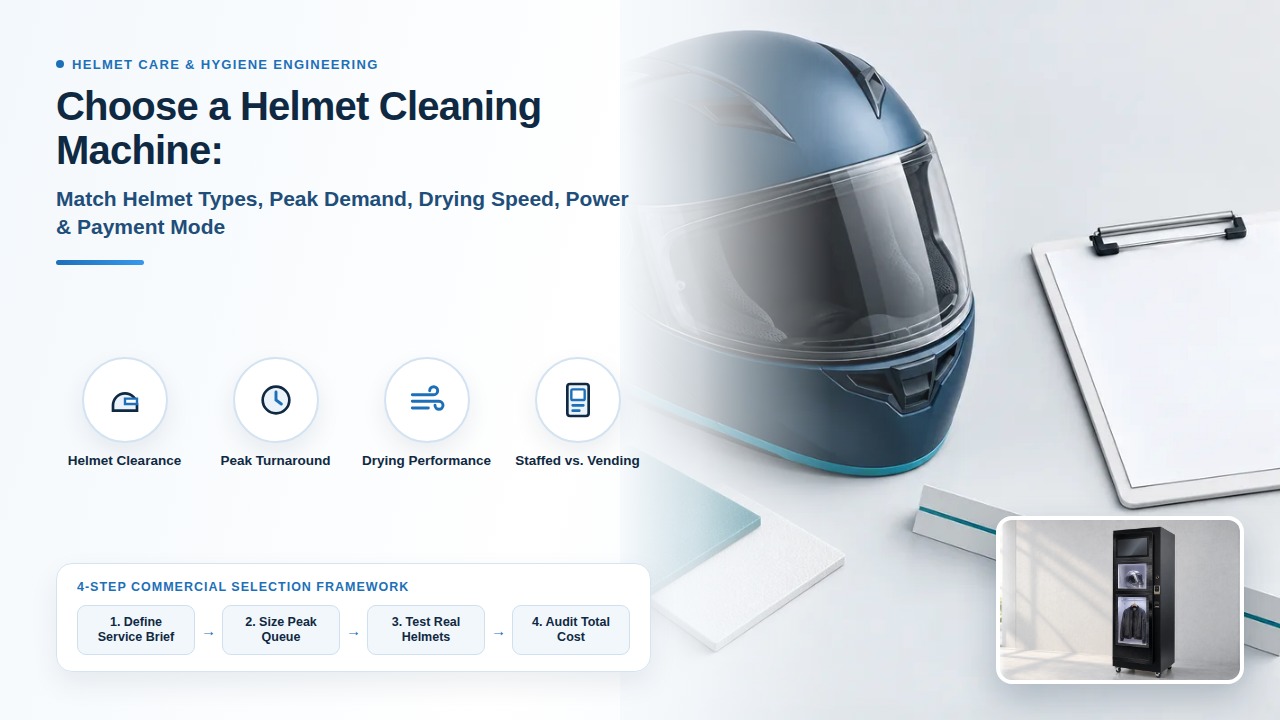
Choosing by cabinet size alone can leave compatibility or peak demand unresolved. Select a commercial helmet cleaning machine against a defined service: the helmets you accept, the result you promise, the busiest arrival period, and the staff who keep the operation running. Start with those requirements before comparing cabinet size or advertised cycle speed. A useful purchase decision combines a written equipment specification with a repeatable demonstration and a realistic operating budget.
This guide provides a buying framework for staffed counters, rental fleets and self-service sites. It does not prescribe one cleaning program for every helmet. The delivered machine configuration, helmet instructions and order documents determine the approved process.
| Input | HCE reading or record | Decision affected |
|---|---|---|
| Accepted helmets | Evidence and material scope | Compatibility and exceptions |
| Peak demand | Complete-service timing | Capacity and staffing |
| Site and power | Homepage technical specifications | Access route and order-specific electrical review |
| Budget | Quotation scope | Delivered and operating costs |
| Required functions | Equipment comparison | Work inside and outside the cabinet |
| Demonstration | Quote comparison record | Common acceptance criteria |
| Maintenance | Maintenance responsibilities | Replenishment, faults and support |
| Payment | Self-service configuration | Provider, failed starts and refunds |
1. Write a service brief before requesting prices
Describe where the machine will operate and what happens before and after its automatic cycle. A rental fleet can schedule returns and keep spare helmets. A public kiosk must handle unpredictable arrivals, customer questions and interrupted payments. These differences affect staffing, storage and support as much as the equipment itself.
Record helmet types, removable liners, electronic accessories and typical dirt. Measure demand in short intervals during representative operating days. Foot traffic alone does not tell you how many riders will buy a cleaning service or wait for completion.
Takeaway: Write the service brief from observed demand and accepted helmets.
2. Make compatibility a purchase condition
Request written guidance for the shell, comfort liner, energy-absorbing foam, adhesives, visor coatings and accessories. A process that is acceptable for one combination cannot automatically be extended to another. Identify accessories that must be removed and helmets that should be declined or held for review.
SHOEI’s maintenance guidance notes that EPS is sensitive to solvents and heat. That is a reason to consult the actual helmet instructions, not evidence that a particular commercial machine cycle is approved. Ask how the supplier’s proposed settings were evaluated for your accepted helmets.
If a demonstration exposes a mismatch, resolve it before agreeing on the service description. Do not let a favorable odor or visual appearance substitute for checking compatibility and the intended treatment outcome.
Takeaway: Resolve compatibility questions before accepting the service description.
3. Compare complete processes on the same basis
Map intake, preparation, loading, cleaning, any documented treatment, drying, inspection and release. Record which steps occur outside the cabinet. Two quotations may describe very different services even when both suppliers use the phrase “automatic helmet cleaning.”
| Purchase question | Document or observation to request |
|---|---|
| What is included in the cycle? | A step list identifying machine work and operator work |
| What helmets are accepted? | Compatibility instructions for the relevant materials and accessories |
| What does the treatment claim mean? | Applicable evidence, tested conditions and limitations |
| When is the helmet ready? | Written cleanliness, residue and dryness acceptance criteria |
| What happens after a fault? | The approved hold, recovery and customer-support procedure |
Use the cleaning and disinfection guide to distinguish odor reduction from other outcomes. A list of technologies is not a substitute for a clear service specification.
Takeaway: Compare the complete service and its documented outcome.
4. Check the site and electrical requirements
Measure the access route as well as the final position: doors, lifts, steps, loading access and space needed for maintenance. Ask for the installed dimensions, shipping dimensions, clearance requirements and placement instructions for the quoted configuration. Establish responsibility for unloading and moving the cabinet into position.
The homepage Technical Specifications list K2 with a nominal power rating of 1800 W and a maximum power rating of 2650 W. These are power ratings, not energy consumed per service. Supply voltage, circuit suitability and installation work should be confirmed for the delivered order with a qualified installer. Do not infer another model’s requirements from the K2 values.
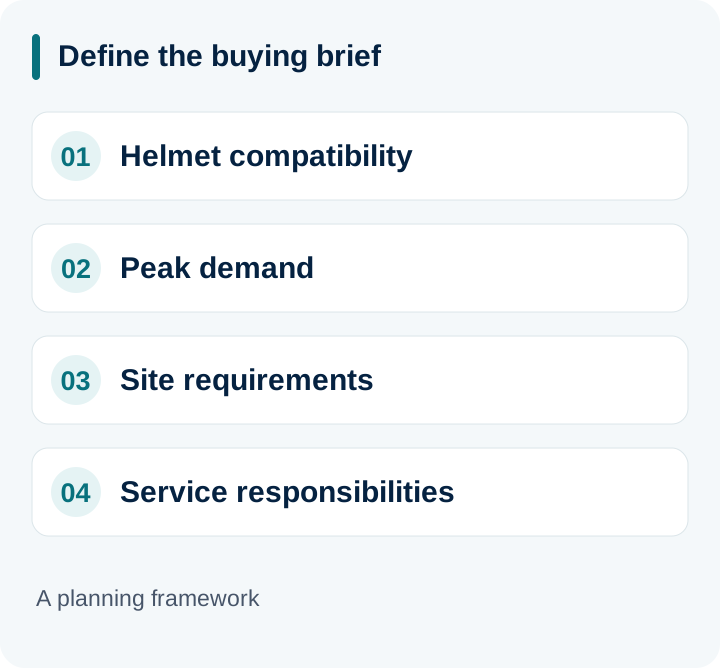
Takeaway: Verify the access route and order-specific electrical requirements.
5. Calculate usable capacity from a timed trial
Include loading, the full selected cycle, unloading and any required reset. If a chamber processes two helmets together, confirm that this arrangement is supported for the exact load; two compartments alone do not prove independent operation or doubled throughput.
For an illustrative calculation, suppose a tested workflow takes 12 minutes per load and accepts two helmets. Its theoretical ceiling is 2 × 60 ÷ 12 = 10 helmets per hour, before interruptions. These are example inputs, not HCE performance figures. Lower demand, slower inspection or additional drying can reduce actual sales below this ceiling.
Track arrival time and release time during a peak-period trial. The throughput planning guide explains how to find the limiting stage and account for queues. A machine should be selected for the whole service route, not its fastest isolated action.
Common mistake: Recording repeat work as another released helmet. Count the accepted item once and keep the additional time in the trial.
Takeaway: Use accepted output from the full route, not the fastest machine action.
6. Run a demonstration you can compare
Provide the same representative helmet set and acceptance criteria to each supplier. Record the equipment version, program, consumables and any preparation performed before filming starts. Ask to see ordinary handling and inspection, not only the cabinet opening at the end.
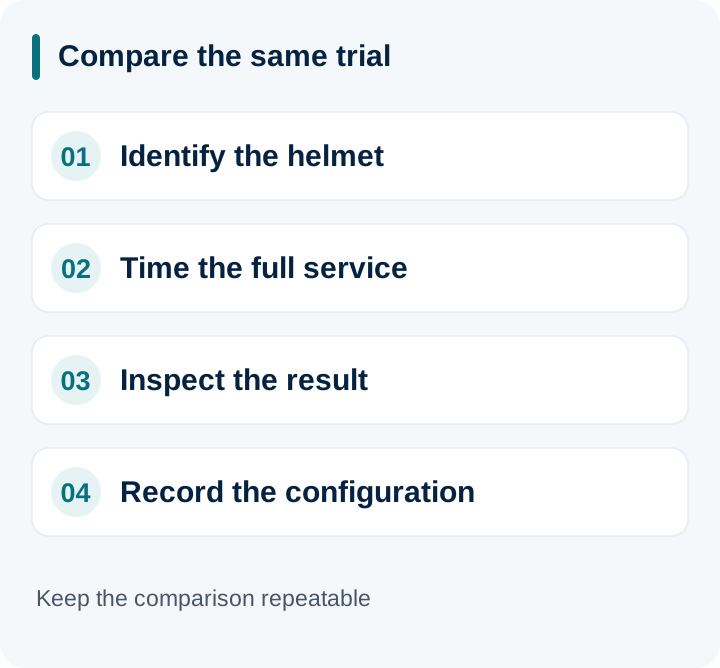
Use the following sequence:
- Identify the helmet and record its incoming condition.
- Record preparation outside the machine and operator time.
- Note the program, consumable and loading arrangement.
- Time the full service, including inspection and any repeat work.
- Compare the result against the agreed criteria.
- Match the demonstrated configuration to the quotation.
Keep failed or inconclusive observations in the record. They show where instructions, staffing or the equipment proposal need adjustment. The quote comparison worksheet can help keep commercial assumptions beside the technical comparison.
Use the SOP release checks to record the acceptance decision before measuring successful output.
Takeaway: Keep incomplete and failed observations in the demonstration record.
7. Compare operating cost and service responsibilities
Request a delivered cost with currency, destination, shipping scope and exclusions. Add installation, consumables, utilities, payment fees, cleaning labor, maintenance, planned parts and downtime. A self-service machine still needs somebody to inspect the site, replenish supplies and handle incidents.
Measure energy over a complete representative service when estimating electricity cost. Multiplying the maximum power rating by the cycle length can misrepresent a program whose heaters and other components switch on and off. State the method and assumptions beside any cost estimate.
Use the pricing checklist to organize the quotation. Warranty length, covered parts, exclusions, remote support and responsibility for return freight belong in the written order. Do not infer these terms from a generic website article.
For a temporary equipment arrangement, use the rental and purchase trial-terms checklist to compare ownership, maintenance and return responsibilities.
Takeaway: Include running costs and written service responsibilities in the decision.
8. Test the customer journey for self-service operation
For a self-service configuration, verify the chosen payment hardware, local provider, merchant account, network connection and settlement process. Agree what happens if payment succeeds but the machine does not start, or if a rider cannot complete the instructions.
Check interface language, placement of support details and the route for refund requests. Payment compatibility must be confirmed for the destination and integration; the presence of a card-reader space or QR graphic is not proof that every local payment service works.
Takeaway: Test failed-payment and recovery paths with the chosen integration.
Questions to settle before ordering
Can one machine accept every helmet? Establish an accepted list and exception procedure. Unfamiliar materials, accessories or damage require a decision under the relevant instructions.
Should I buy the largest cabinet available? Compare the actual bottleneck, service demand and cost of unused capacity. A larger cabinet may not improve a site limited by inspection or customer arrivals.
What makes a quotation reviewable? It identifies the configuration, included process, installation responsibilities, demonstration conditions, payment integration and after-sales terms. Send that brief through the equipment contact page so the discussion can resolve specific requirements.
Send the helmet range, observed demand, site power, demonstration criteria and payment requirements through the HCE contact page for a configuration and quotation discussion. We reply within 24 hours.
Takeaway: Settle the open requirements before confirming the order.
Buyer FAQ
How much does a helmet cleaning machine cost?
Request a quotation for the configuration, quantity and destination. Compare shipping, installation, consumables, utilities, payment fees, maintenance and labor on the same basis. A power rating is not energy per service, and website descriptions do not establish warranty or freight terms for an order.
Method and sources
This revision reorganizes the existing HCE guide; it does not add test results or equipment performance claims. The manufacturer references linked in the text retain their stated scope. Review date: October 8, 2026. For related operating or buying guidance, use the Equipment Guides archive.
Discuss your requirements
Contact us about the equipment question in this guide.
We reply within 24 hours.
What to send us
| Item | Why we need it | Example format |
|---|---|---|
| Application | Understand the intended use | Site type; operating arrangement |
| Question to resolve | Focus the configuration discussion | Question; relevant guide section |
| Configuration and quantity | Identify the proposed equipment scope | Model; number of units |
We reply within 24 hours.
Related articles
Helmet Cleaning Machine Supplier: Documents to Check Before a Sample or Deposit
Match the contracting party, quoted configuration, evidence and warranty duty to the actual files before you approve a sample or a deposit.
Read article
Helmet Cleaning Equipment Types Compared
Compare 4 commercial helmet cleaning equipment types: dry-mist + UV-C vending kiosks, multi-bay fleet lockers, countertop dryers, and wet-wash extractors.
Read article
How to Calculate Helmet Cleaning Throughput
Turn return volume, cycle time, labor, and drying capacity into a realistic equipment-capacity requirement.
Read article