How to Calculate Helmet Cleaning Throughput
Turn return volume, cycle time, labor, and drying capacity into a realistic equipment-capacity requirement.
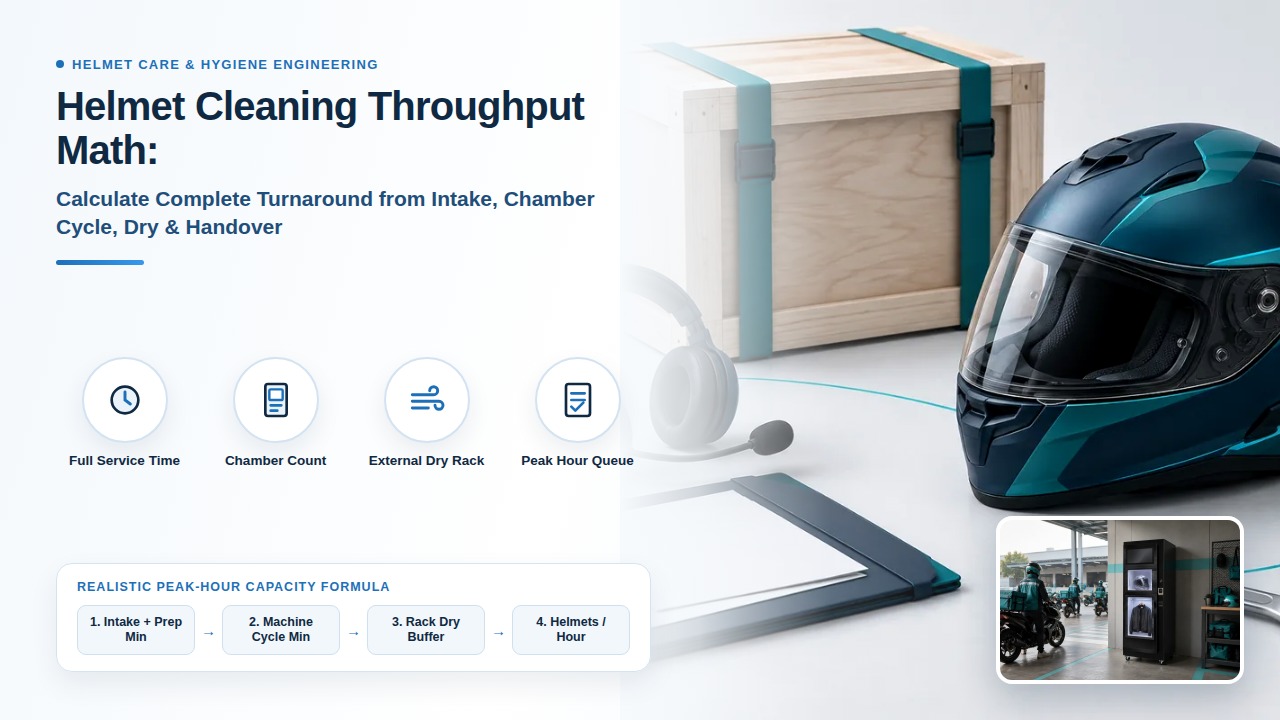
Sizing equipment from its automatic cycle alone can leave a peak-period queue. Helmet cleaning throughput counts acceptable helmets released by the complete service in a given period. It is different from the number of automatic cycles a cabinet can start. Loading, preparation, drying, inspection, interruptions and the arrival pattern all affect the result. Plan capacity around the busiest service window and verify it using a timed trial with representative helmets.
The calculations below are planning examples. They are not measured HCE machine outputs, quoted cycle durations or promises of customer demand. Replace every example input with observations from the configuration and site you intend to operate.
Planning formula — minutes per complete load; output in helmets per hour.
Theoretical output per hour = accepted helmets per load × 60 ÷ total minutes per load.
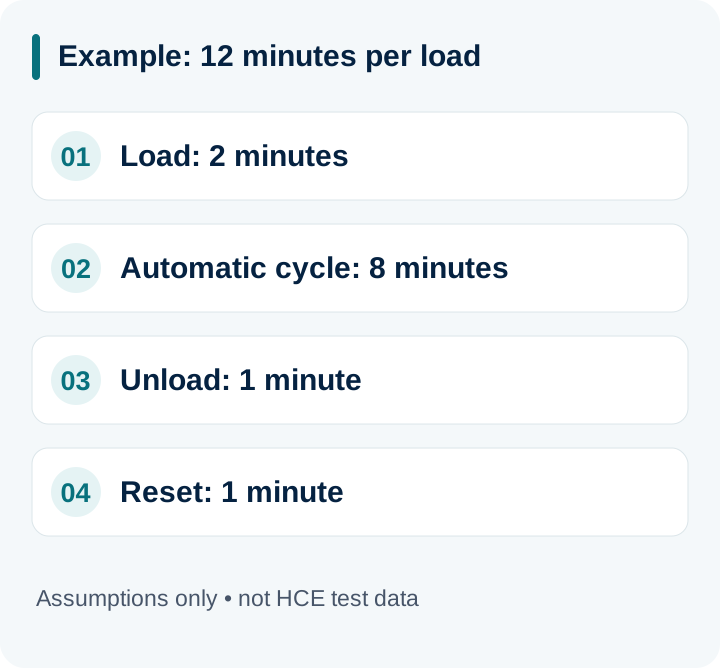
Suppose a hypothetical two-helmet load requires the following times:
| Activity | Assumed minutes | Your measured minutes | Why it belongs |
|---|---|---|---|
| Loading | 2 | ______ | The chamber cannot accept another load |
| Automatic program | 8 | ______ | The selected process occupies the equipment |
| Unloading | 1 | ______ | Staff remove and transfer the helmets |
| Required reset | 1 | ______ | The chamber becomes ready for the next load |
| Total | 12 | ______ | Complete occupancy for this example |
The ceiling is 2 × 60 ÷ 12 = 10 helmets per hour. Using only the eight-minute program would give 15, overstating this example’s chamber capacity by ignoring handling and reset. The difference is arithmetic, not a statement about any product.
This is not HCE performance data. The result is a chamber ceiling; the slowest effective preparation, drying or release stage can lower route output. Include each delay either in measured load time or in availability, never both.
Define the measurement before timing anything
Choose a clear start and finish. For customer turnaround, start when an accepted helmet arrives and finish when it is released. For chamber occupancy, start when loading prevents another load from entering and finish when the chamber is ready again. These measurements answer different questions and should have separate columns in the record.
Count only helmets that pass the documented release checks. A second attempt consumes time, but it should not create a second unit of output. If the site declines some helmets, record those separately so demand for an eligible service is not confused with all inquiries.

Takeaway: Choose timing boundaries and count each accepted helmet once.
Record the arrival pattern
Measure arrivals in short intervals over representative days. Include normal periods, known busy periods and conditions that change helmet mix or staffing. A daily total can look manageable while a short return wave creates an unacceptable queue.
Record the accepted helmet type, preparation needed, promised return window and whether spare helmets are available. A rental operator with spare stock may batch returns. A rider waiting at a public service point may need a different workflow even when both sites handle the same daily volume.
Use the site pilot log to organize observations. Document how the sample was collected, especially if a demonstration or event day differs from ordinary demand.
Takeaway: Use arrival observations from representative operating windows.
Calculate chamber capacity using the full load time
Use the full-load formula and assumed inputs above. Record the actual loading arrangement and replace every example time before comparing equipment.
For dual-chamber equipment, confirm independent operation for the ordered program. Two doors alone do not establish two simultaneous loads.
Common mistake: Multiplying output by two because the cabinet has two compartments, or counting a reworked helmet twice.
Takeaway: Include handling and reset in the full load time.
Find the lowest-capacity stage
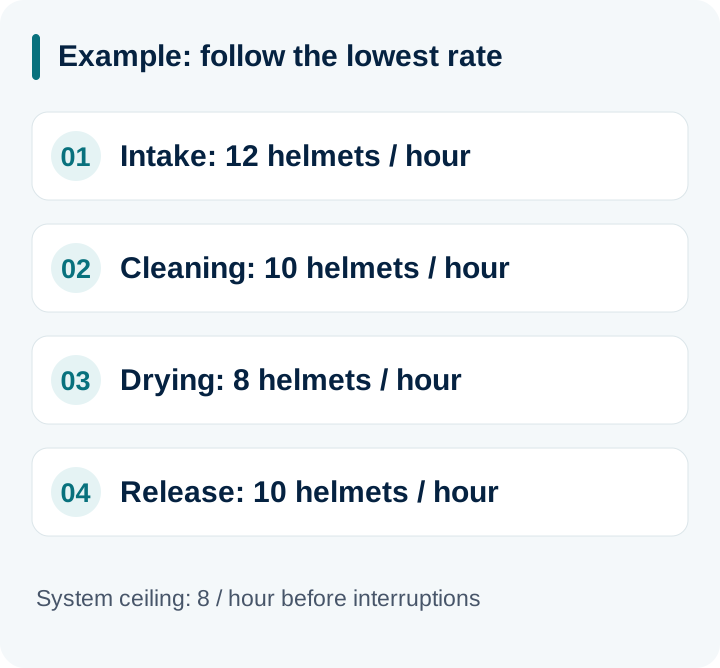
List the effective capacities of preparation, machine processing, drying and release. Where stages run separately, the slowest stage limits the sustained output of the combined route. Extra capacity elsewhere may provide flexibility, but it does not remove that bottleneck.
Consider another hypothetical observation: intake can handle 12 helmets per hour, cleaning 10, drying 8 and final release 10. The route cannot sustain more than 8 per hour without unfinished items accumulating before drying. It would be misleading to advertise the cleaning stage’s rate as the completed service rate.
Check whether steps can actually overlap. One operator cannot necessarily load a second station while inspecting the first helmet. Shared tools, narrow workspaces and customer questions can turn apparently parallel tasks into sequential work.
Use the equipment function comparison to distinguish integrated stages from separate drying and preparation resources.
Takeaway: The slowest effective stage limits the complete route.
Add interruptions without counting them twice
Consumable replenishment, cleaning, breaks and fault recovery reduce the time available for production. You can either include ordinary handling delays in the measured average load time or apply an explicitly defined availability factor. Explain which method you use so the same delay is not deducted twice.
For example, if the ten-helmet theoretical chamber rate above is available for 45 minutes of an hour, the time-adjusted rate is 10 × 45 ÷ 60 = 7.5 helmets per hour. That figure is an average planning rate, not permission to release half a helmet. Report completed whole items when reviewing a shift.
If a separate yield factor is needed, define it as the share of processed helmets accepted for release. Keep rejection and repeat processing visible. A faster rate achieved by omitting inspection is not comparable with a complete accepted service.
Takeaway: Deduct each interruption once and disclose the method.
Estimate queue growth during a peak
A simple planning check is whether arrivals exceed the route’s effective output. If accepted arrivals average ten per hour while the service releases eight, unfinished work grows by roughly two helmets per hour during that interval, assuming those rates remain steady.
Do not convert this difference directly into an exact customer waiting time. Burst arrivals, order of service, preparation differences and interrupted cycles change individual waits. Record arrival, start and release timestamps during a pilot to understand the actual distribution.
The response may be scheduled returns, more preparation capacity, additional drying, extra staff or a revised customer promise. Buying a second cleaning cabinet will not solve a drying constraint unless the surrounding process also changes.
Takeaway: Use timestamps, not a rate difference, to investigate waiting times.
Run a trial that reveals ordinary operating work
Use normal staffing and the accepted helmet range. Include setup, replenishment, inspection and end-of-session tasks. Keep a note of unusual events and whether they should be treated as typical operation or a separate fault scenario.
| Record field | What it helps explain |
|---|---|
| Arrival and acceptance | Demand for the actual service |
| Preparation start and finish | Manual work and variation by helmet |
| Machine start and completion | Occupancy and interrupted cycles |
| Drying and inspection completion | Delays after the automatic program |
| Release or hold decision | Acceptable output and unresolved work |
| Operator and configuration | Conditions needed to repeat the result |
The standard operating procedure guide provides a release and exception record. Use the same acceptance rules across trials so a capacity comparison does not hide changes in service quality.
Takeaway: Test with ordinary staff tasks and consistent acceptance rules.
Present the result with its conditions
Report the measured period, helmet mix, staffing, accepted program, load arrangement and count released. Give both the theoretical calculation and observed result when they differ. Explain how downtime, rework and unaccepted helmets were handled.
For a longer operating day, account for planned maintenance and changes in demand rather than multiplying the busiest hour by opening hours. The maintenance checklist helps identify recurring tasks that belong in the schedule.
When comparing equipment quotations, ask suppliers to demonstrate the assumptions behind their capacity statements. The useful question is which complete workflow can meet your measured peak while respecting the approved process. Capacity should never depend on changing helmet-care requirements merely to reach a target number. Refer to the actual helmet manual; SHOEI’s care guidance illustrates why those requirements vary by material.
Carry the observed conditions into the equipment selection brief. For a business pilot, keep accepted service output separate from paid demand; use observed sales in the ROI scenarios.
Send arrival and release times, helmets per load, handling times, staffing and acceptance records through the HCE contact page for a configuration and quotation discussion. We reply within 24 hours.
Takeaway: Report throughput with its load, program, staffing and time window.
Method and sources
This revision reorganizes the existing HCE guide; it does not add test results or equipment performance claims. The manufacturer references linked in the text retain their stated scope. Review date: October 8, 2026. All numerical examples above are assumed planning inputs, not measured machine output. For related operating or buying guidance, use the Equipment Guides archive.
Discuss your requirements
Contact us about the equipment question in this guide.
We reply within 24 hours.
What to send us
| Item | Why we need it | Example format |
|---|---|---|
| Application | Understand the intended use | Site type; operating arrangement |
| Question to resolve | Focus the configuration discussion | Question; relevant guide section |
| Configuration and quantity | Identify the proposed equipment scope | Model; number of units |
We reply within 24 hours.
Related articles

Helmet Cleaning Machine Supplier: Documents to Check Before a Sample or Deposit
Match the contracting party, quoted configuration, evidence and warranty duty to the actual files before you approve a sample or a deposit.
Read article
How to Choose a Commercial Helmet Cleaning Machine
A practical framework for comparing helmet cleaning systems by compatibility, process control, throughput, drying, and operating cost.
Read article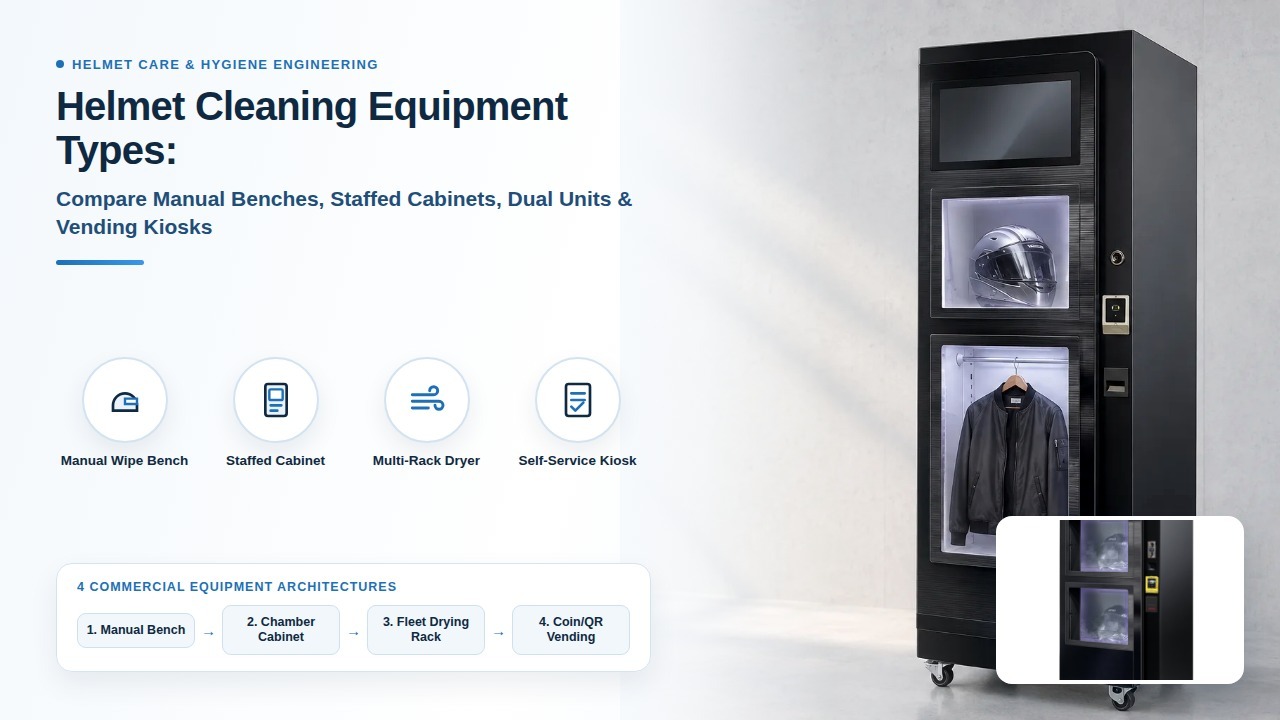
Helmet Cleaning Equipment Types Compared
Compare 4 commercial helmet cleaning equipment types: dry-mist + UV-C vending kiosks, multi-bay fleet lockers, countertop dryers, and wet-wash extractors.
Read article