Helmet Cleaning Equipment Types Compared
Compare 4 commercial helmet cleaning equipment types: dry-mist + UV-C vending kiosks, multi-bay fleet lockers, countertop dryers, and wet-wash extractors.
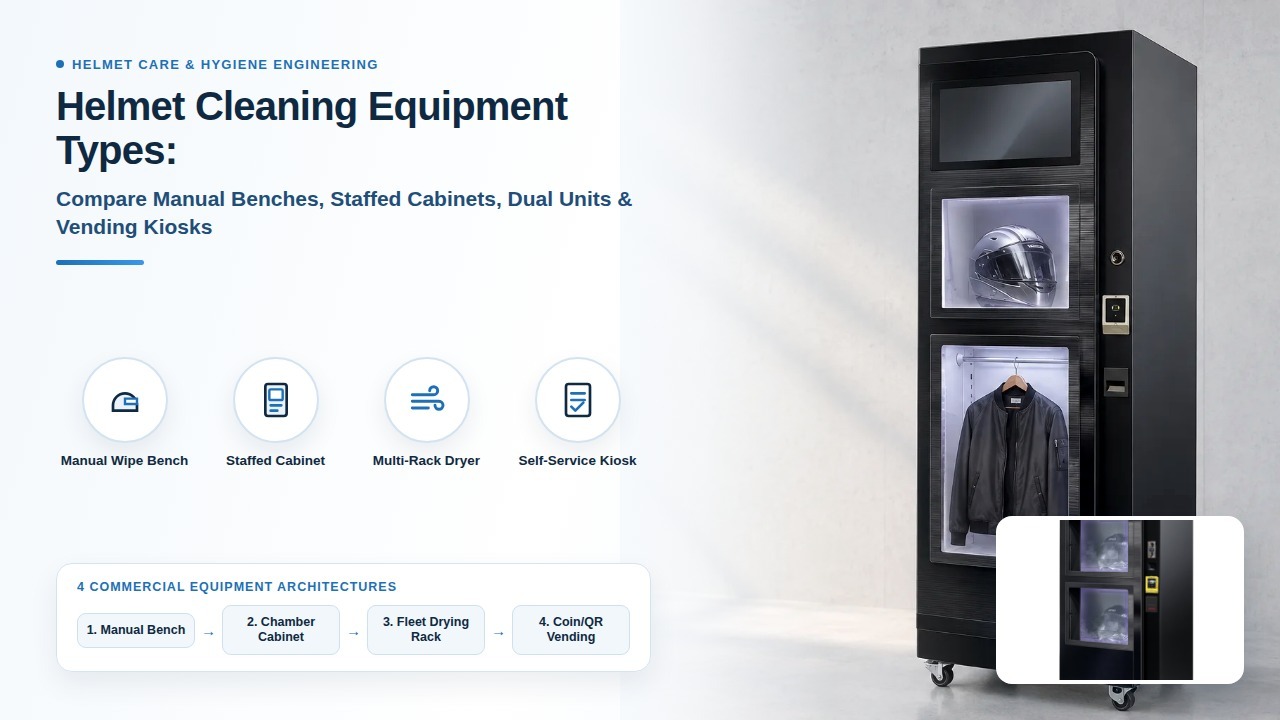
Installing a plumbing-connected wet-wash machine at a 5-minute self-service rider stop causes costly rework, rejected turnover, and damp cheek pads, while deploying a single-chamber kiosk at a 40-rider go-kart shift changeover creates two hours of queue downtime. Procurement teams and fleet engineers must compare commercial helmet cleaning equipment types by their moisture-injection physics, peak-wave chamber capacity ($N_{\text{chambers}}$), utility infrastructure, and payment/telemetry architecture before issuing a purchase order.
Commercial helmet hygiene hardware divides into four primary engineering architectures—plus manual intake pre-wash stations: (1) Standalone Dry-Mist + UV-C + PTC Forced-Air Vending Kiosks (HCE-K2, Dual-Slot A026, 3–8 min cycle, 110V/220V plug-and-play, no plumbing), (2) Multi-Bay Smart Sanitizing & Storage Lockers (4–16 RFID/QR bays for delivery and industrial PPE shift storage), (3) Countertop / Compact Single- and Dual-Chamber Dry-Mist, UV-C/Ozone & Rapid Air-Dry Stations (HCE-S1 and HCE-D2 for staffed rental desks and tracks), and (4) Plumbing-Connected Wet-Wash / Steam Extraction Machines (15–30 min deep wash + extraction drying). Because expanded polystyrene (EPS) impact liners soften above $50\text{ }^\circ\text{C}$ ($122\text{ }^\circ\text{F}$ per Snell M2020/M2025, DOT FMVSS 218, and UNECE R22.06) and $253.7\text{ nm}$ UV-C light penetrates $< 0.2\text{ mm}$ into porous 3D comfort foam (ISO 15858), rapid-turnaround machines must pair micronized ($\le 5\text{–}10\text{ }\mu\text{m}$) pH-neutral dry-mist atomization and catalytic-destruct ozone ($< 0.05\text{ ppm}$ release per FDA 21 CFR 801.415) with $\le 45\text{ }^\circ\text{C–}50\text{ }^\circ\text{C}$ PTC forced-air convection.
| Existing Operational Bottleneck | Equipment Architecture to Specify | Engineering Verification Question | HCE Catalog Entry Point |
|---|---|---|---|
| Unattended 24/7 rider monetization (gas stations, mall parking, dealerships) | Standalone Dry-Mist + UV-C + PTC Vending Kiosk (HCE-K2, 2 chambers, 25 L tank) | Does the VMC support local MDB cashless/QR/coin payment and 4G low-liquid telemetry without floor drains? | Self-service vending configurations |
| Continuous staffed counter turnaround (scooter rental desks, workshops, karting tracks) | Compact Single- or Dual-Chamber Automated Cabinet (HCE-S1 1-bay / HCE-D2 2-bay) | Can Chamber B load and start independently while Chamber A is mid-cycle during heat changeovers? | Commercial machine catalog |
| Simultaneous shift check-in wave + overnight custody (delivery hubs, industrial PPE) | Multi-Bay Smart Sanitizing & Storage Locker (4–16 RFID/QR compartments) or Dual-Cabinet + Buffer Rack | Does the bay count ($N_{\text{bays}}$) absorb the 15-minute shift arrival wave without queue abandonment? | OEM & custom fleet configurations |
| Caked off-road mud, heavy sebum, or end-of-season liner overhaul | Manual Intake Pre-Wash Bench ($\le 30\text{ }^\circ\text{C}$) + Dedicated Multi-Nozzle Air Dryer | Where do detached comfort pads dry for 15–30 minutes while keeping chamber air $\le 50\text{ }^\circ\text{C}$? | SOP intake & release framework |
How do the four commercial helmet cleaning equipment architectures compare in cycle physics and infrastructure?
The four commercial equipment architectures differ fundamentally in how much liquid water they introduce into the 3D polyurethane comfort liner ($3\text{–}5\text{ mL}$ micronized dry-mist vs. $15\text{–}40\text{ g}$ wet-wash saturation), whether they require pressurized water and floor drains, and how many helmets they process concurrently during peak arrival waves.
When evaluating a commercial helmet cleaning machine, buyers often mistake exterior cabinet styling for internal process capability. In practice, every machine in the industry is constrained by the same polymer and thermodynamic laws: removable comfort pads are rated for washing at $\le 30\text{ }^\circ\text{C}$ ($86\text{ }^\circ\text{F}$) per SHOEI USA’s Helmet Maintenance Guide (fetched October 18, 2026), and expanded polystyrene (EPS) impact crush liners cannot exceed $50\text{ }^\circ\text{C}$ ($122\text{ }^\circ\text{F}$) without risking bead softening and adhesive delamination (Snell M2020/M2025, U.S. DOT FMVSS 218, and UNECE Regulation 22.06). Because air temperature is capped at $\le 50\text{ }^\circ\text{C}$, the mass of liquid water injected during the cleaning stage directly dictates whether a helmet can be returned to a rider in 5 minutes or requires 30 minutes of forced-air extraction.
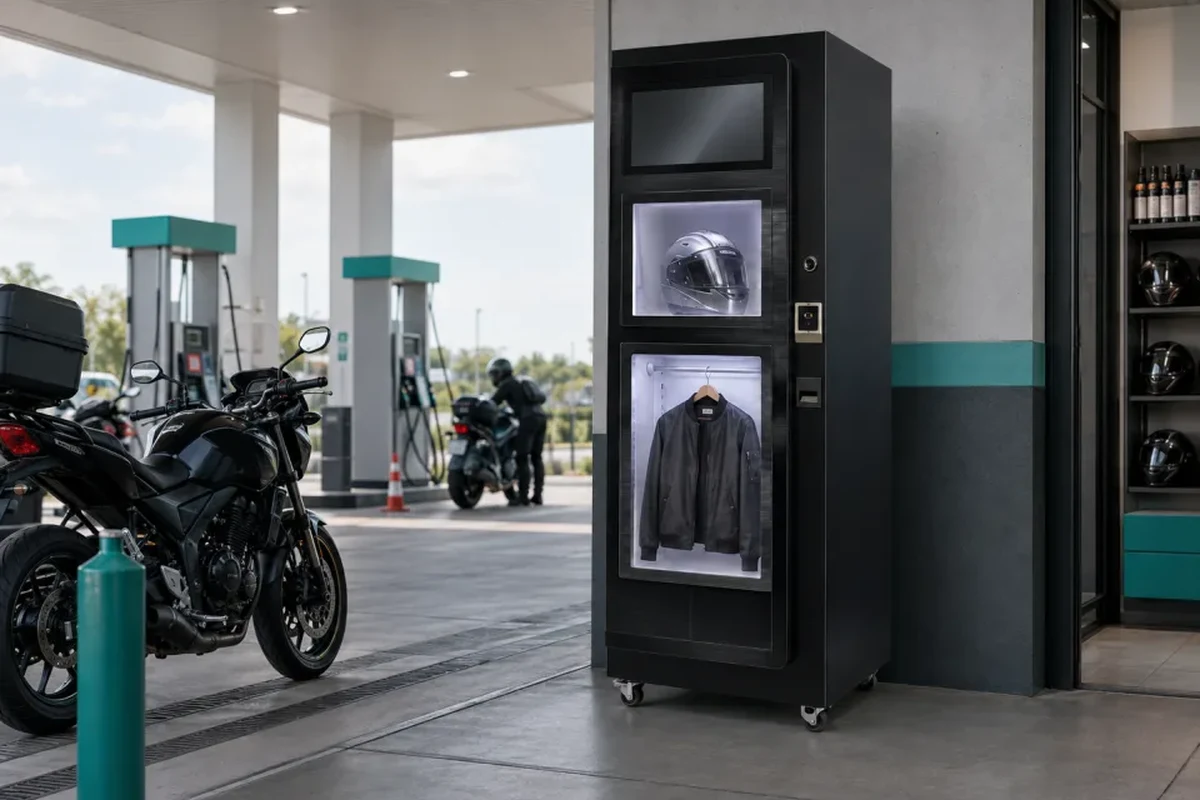
First-Screen 4-Architecture Engineering Comparison & Failure Prevention Matrix
The table below establishes the Standard Engineering Baseline under Reference Conditions across the four commercial equipment architectures (alongside manual pre-wash stations as an intake baseline), detailing utility hookups, moisture load, regulatory alignment, and the Dominant Failure Mode & Prevention for each machine type:
| Equipment Architecture | Target Deployment & Operating Mode | Cycle Time & Moisture / Thermal Baseline | Required Site Utilities & Payment / Control Stack | Dominant Failure Mode & Prevention |
|---|---|---|---|---|
1. Self-Service Dry-Mist + UV-C + PTC Vending Kiosk (HCE-K2, Dual-Slot Model A026, Homepage 2-Compartment Kiosk) | Unattended 24/7 gas stations, motorcycle dealerships, shopping mall parking, commuter transit hubs | $3\text{–}5\text{ min}$ (HCE-K2 baseline) to $5\text{–}8\text{ min}$ full 5-stage cycle; $3\text{–}5\text{ mL}$ micronized ($\le 5\text{–}10\text{ }\mu\text{m}$) mist; $\le 45\text{ }^\circ\text{C–}50\text{ }^\circ\text{C}$ PTC air | Plug-and-play 110V/60Hz or 220V–240V/50–60Hz (1800 W rated / 2650 W max); internal 25 L tank; no plumbing; MDB/Nayax/PAX card, QR, coin/bill + 4G/Wi-Fi telemetry | Empty biocide reservoir dry-firing & MDB payment timeout lockouts: Unattended kiosks that run out of fluid burn out ultrasonic piezo discs or charge riders for a dry cycle. Prevention: Specify a dual-level float switch wired to the VMC + 4G cloud telemetry that disables payment acceptance at $< 1.5\text{ L}$ reserve and auto-refunds interrupted cycles under IEC 60335-2-75 |
2. Multi-Bay Fleet Smart Sanitizing & Storage Locker (4–16 Compartment RFID/QR Cabinet) | Delivery courier depots, shared e-moped hubs, industrial hard-hat/PPE check-in rooms, ski rental storage | $15\text{–}60\text{ min}$ parallel batch or overnight storage cycle; passive/manifold dry-mist fogging + low-dose O3 + low-wattage $\le 45\text{ }^\circ\text{C}$ air | Hardwired or plug-in 110V/220V (800 W–2400 W across bank); no drain required; RFID badge, fleet app QR check-in, or PIN assignment | Uneven manifold distribution & fugitive ozone leakage across multi-door gaskets: Central mist/ozone blowers starve distant bays while leaking $> 0.10\text{ ppm}$ O3 into indoor locker rooms. Prevention: Use per-bay metering orifices or individual chamber fans, EPDM magnetic door seals, and catalytic carbon destruct cycles verified $< 0.05\text{ ppm}$ (FDA 21 CFR 801.415 / OSHA 29 CFR 1910.1000) |
3. Countertop / Compact Rapid Air-Dry & UV-C/Ozone Station (HCE-S1 Single-Chamber, HCE-D2 Dual-Chamber, Multi-Nozzle Dryer Rack) | Staffed go-kart tracks, scooter rental counters, bowling/recreation desks, fire/EMS stations, repair shops | $3\text{–}5\text{ min}$ (HCE-S1/HCE-D2 enclosed dry-mist + UV-C + PTC air) or $15\text{–}30\text{ min}$ on open multi-nozzle warm-air drying plenums | 110V/220V (1200 W peak on HCE-S1, 8 L tank; 2200 W dual peak on HCE-D2, 16 L tank); attended push-button/touch PLC control | Line-of-sight UV-C shadowing (< 0.2 mm foam depth) & unregulated heater runaway (> 60 °C): Lamp-only countertop boxes leave 97% of inner cheek-pad bacteria untouched, while cheap coil dryers melt EPS. Prevention: Pair 253.7 nm UV-C (ISO 15858) with 1–10 µm dry-mist or O3, and clamp self-regulating PTC heaters strictly $\le 50\text{ }^\circ\text{C}$ |
| 4. Plumbing-Connected Wet-Wash / Steam + Extraction Chamber (Automated Wet-Spray Washer or Manual Sink + Extractor) | Seasonal rental fleet overhaul depots, heavy off-road motocross mud recovery, industrial decontamination bays | $5\text{–}10\text{ min}$ liquid wash/steam + $15\text{–}30\text{ min}$ high-airflow extraction drying ($20\text{–}40\text{ min}$ total route); injects $15\text{–}40\text{ g}$ water into foam | Pressurized water supply ($\frac{1}{2}\text{ in}$ NPT), grease/sediment floor drain, 220V high-amp blower/extractor; requires removing Bluetooth intercoms | Residual deep-pad dampness (> 15% moisture) breeding mold & ruining Bluetooth electronics: Returning wet-washed helmets within 10 minutes leaves cold water trapped against the EPS liner and shorts intercom PCBs. Prevention: Restrict wet-washing to detached pads ($\le 30\text{ }^\circ\text{C}$ neutral wash per SHOEI) or enforce a 30-minute extraction + gravimetric dryness gate before release |
Scope Note: Published catalog specifications (HCE-S1, HCE-D2, HCE-K2, and the homepage 5-stage cabinet) represent Standard Engineering Baselines under Reference Conditions. Dedicated open-rack dryers and plumbed wet-wash sinks serve as industry comparison categories so buyers can map their complete end-to-end route before confirming order-specific hardware in Factory Acceptance Testing (FAT) and sample trials.
Takeaway: Match your equipment category to the physical state of the helmet at intake and the time available before the next rider wears it—never install a wet-wash process where riders expect a 5-minute dry turnaround.
Why do standalone dry-mist + UV-C vending kiosks dominate 5-to-8 minute unattended and retail deployments?
Standalone dry-mist + UV-C + PTC forced-air vending kiosks (HCE-K2 and dual-slot A026 architectures) dominate unattended rider stops because ultrasonic or pneumatic micronization ($\le 5\text{–}10\text{ }\mu\text{m}$ droplet diameter) delivers $\ge 3\text{-log}$ to $4\text{-log}$ surface and textile sanitization using only $3\text{–}5\text{ mL}$ of liquid per cycle—allowing a $\le 50\text{ }^\circ\text{C}$ PTC blower to return a completely dry helmet in $3\text{ to }8\text{ minutes}$ without water plumbing or Bluetooth removal.
In a self-service helmet cleaning vending machine installed at a fuel station, motorcycle dealership, or commuter parking deck, the rider remains standing beside the cabinet while their daily helmet—often fitted with a $$150\text{–}$350$ Bluetooth intercom, microphone boom, and Pinlock anti-fog visor—undergoes treatment. This operating context imposes four strict engineering requirements that only a waterless dry-mist + UV-C + ozone + PTC warm-air architecture satisfies:
- Zero External Plumbing & Closed-Loop Consumable Dosing: A commercial vending kiosk such as the
HCE-K2(1020 x 680 x 1850 mm,135 kgnet weight) houses an internal25 Lsolution reservoir and runs on a standard110V/60Hzor220V–240V/50–60Hzelectrical circuit (1800 Wrated /2650 Wmaximum power). At a metered ultrasonic atomization rate of $3\text{–}5\text{ mL/cycle}$, a single25 Lfill supports $5,000\text{ to }8,300\text{ cycles}$ with zero wastewater runoff, eliminating municipal drain permits and grease traps. - Five-Stage Integrated Hygiene Sequence: As documented on the HCE homepage 5-step deep cleaning configuration, an enclosed commercial vending chamber executes five coordinated stages inside a cold-rolled steel (
1.0–5.0 mm) enclosure behind UV-blocking Fuyao tempered safety glass:- Stage 1 — Warm-Air Preparation (Preheating): Gently conditions chamber air to expand comfort-liner fabric pores without approaching the $50\text{ }^\circ\text{C}$ EPS thermal limit.
- Stage 2 — Gaseous Ozone (
O3) Oxidation + Catalytic Destruct: Diffuses triatomic oxygen into deep open-cell polyurethane foam cells and EPS air channels to oxidize malodorous sweat volatile organic compounds (VOCs), followed by activated-carbon destruct so residual ozone drops strictly below $0.05\text{ ppm}$ (FDA 21 CFR 801.415 ceiling, half of the $0.10\text{ ppm}$ OSHA 29 CFR 1910.1000 8-hour TWA PEL) before door unlock. - Stage 3 — Germicidal UV-C Irradiation (
253.7 nm): Delivers line-of-sight optical fluence ($H_{\text{UVC}} = 10\text{–}30\text{ mJ/cm}^2$) across the hard outer shell, chin bar, and polycarbonate visor while dual-channel door interlock switches enforce ISO 15858 human exposure protection ($\le 6.0\text{ mJ/cm}^2$ 8-hour actinic limit). - Stage 4 — Micronized Dry-Mist Cleaning + Fragrance Spray: Atomizes an approved pH-neutral ($6.0\text{–}7.5$), alcohol-free biocide (
EPA OCSPP 810.2300/EN 1276/EN 13697/EN 14476compliant; see our cleaning, sanitizing, and disinfection evidence guide) into $\le 5\text{–}10\text{ }\mu\text{m}$ non-condensing aerosol droplets that penetrate 3D comfort padding without wetting intercom electronics. - Stage 5 — Low-Temperature PTC Forced-Air Drying (
40 °C–50 °C): High-volume centrifugal blowers sweep evaporated moisture out through the auto-exhaust duct so the liner is dry to the touch upon door release.
- Independent Dual-Chamber Mainboard & Shared Payment Architecture: On commercial dual-chamber kiosks (
HCE-K2and dual-slotModel A026vending architectures), a single Vending Machine Controller (VMC) mainboard and shared payment bezel (MDBcashless NFC/card reader, dynamic QR code generator on the21.5-inchcapacitive touchscreen, and optional bill/coin validator) control two physically isolated chambers with independent start relays. While Customer 1’s helmet is mid-cycle in the upper chamber, Customer 2 can pay, unlock, and start the lower chamber immediately.
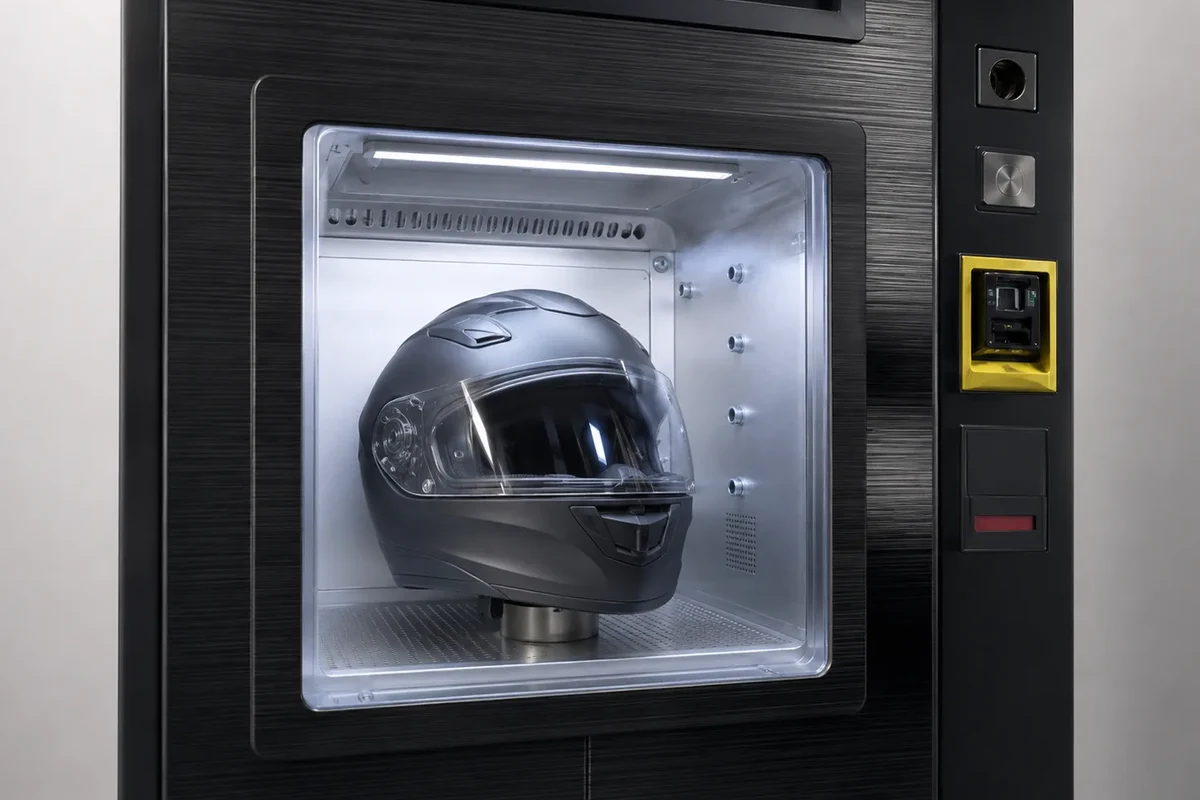
Takeaway: Specify a waterless dry-mist + UV-C + PTC vending kiosk whenever riders require a 3-to-8 minute dry turnaround with installed Bluetooth headsets and zero site plumbing.
How do multi-bay smart lockers, countertop dryers, and wet-wash extractors serve fleet depots and rental counters?
While self-service kiosks optimize rapid 1-to-2 helmet retail turnover, fleet depots and rental counters often require multi-bay smart sanitizing lockers (4–16 bays) for simultaneous shift check-ins, compact staffed cabinets (HCE-S1 / HCE-D2) for continuous counter service, or wet-wash + high-airflow drying benches for mud-caked liner refurbishment.
Selecting the wrong B2B fleet architecture creates immediate operational friction. Below is how the three non-kiosk equipment types solve distinct fleet bottlenecks:
1. Multi-Bay Fleet Smart Sanitizing & Storage Lockers (4–16 Compartments)
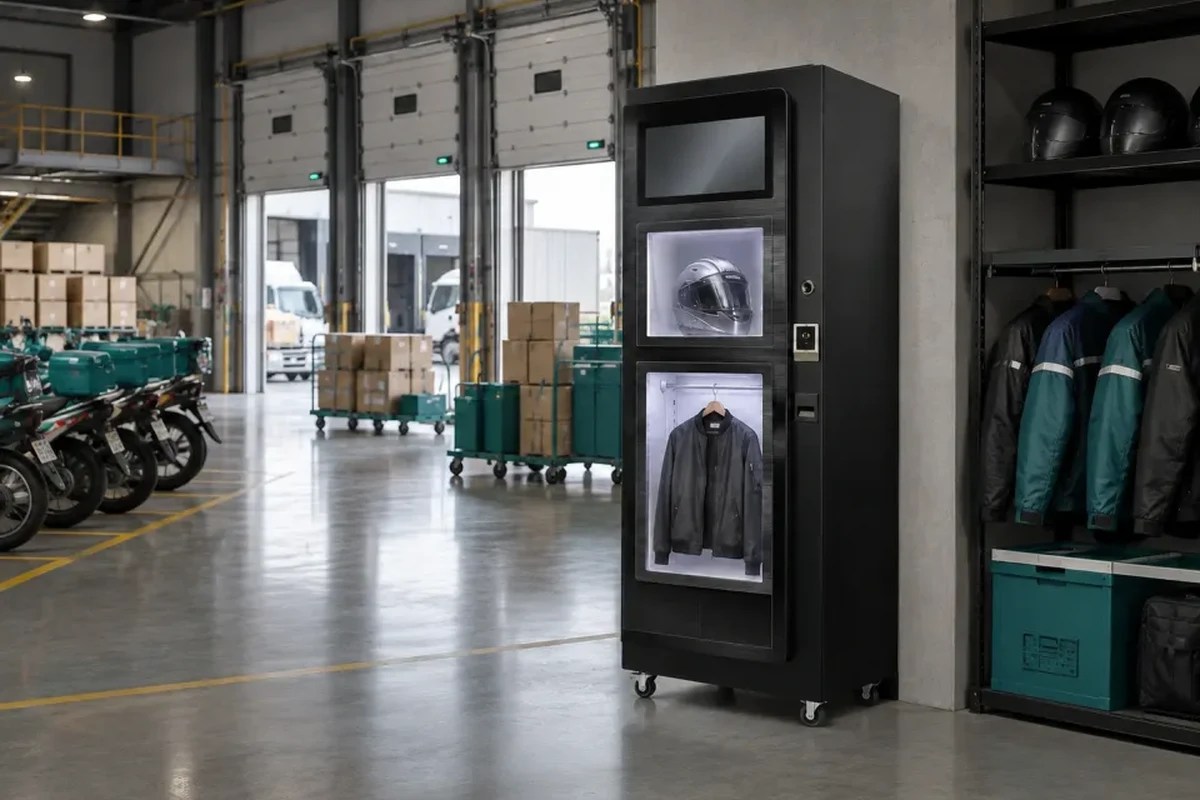
In food-delivery courier hubs, shared e-moped battery-swap stations, corporate commuter garages, and industrial hard-hat/tactical PPE rooms, riders do not trickle in one by one; instead, $15\text{ to }50\text{ riders}$ end their shift within the same $15\text{ to }30\text{ minute}$ window and leave their helmets stored until the next shift.
- Architectural Design: A multi-bay smart locker integrates $4, 8, 12,\text{ or }16$ electromagnetic locker compartments with RFID card readers, fleet-app QR scanners, or PIN pads. Because helmets remain locked inside for $30\text{ minutes to }8\text{ hours}$, the cabinet runs a lower-power ($15\text{–}60\text{ min}$) nano-mist fogging, ozone deodorization, and gentle $\le 45\text{ }^\circ\text{C}$ air circulation cycle across all bays simultaneously without exceeding standard branch-circuit amperage.
- Operational Boundary: Smart lockers excel at custody tracking and batch overnight sanitization, but they are unsuitable for walk-up retail customers who refuse to wait $30\text{–}60\text{ minutes}$ for a slow manifold cycle.
2. Countertop / Compact Staffed Cabinets (HCE-S1 & HCE-D2) and Dedicated Air-Dry Stations
At go-kart tracks, driving schools, motorcycle repair workshops, and scooter rental desks, staff inspect incoming helmets at a counter before handing them to the next customer or placing them on a ready rack (see our rental deployment evaluation guide).
- Compact Automated Counter Cabinets (
HCE-S1&HCE-D2): The single-chamberHCE-S1(520 x 580 x 980 mm,48 kg,1200 Wpeak heating,8 Ltank,20–45 helmets/daybaseline) and dual-chamberHCE-D2(960 x 620 x 1100 mm,85 kg,2200 Wdual peak heating,16 Ltank,40–120 helmets/daybaseline) use the same3–5 minmicro-atomized vapor + UV-C + $\le 50\text{ }^\circ\text{C}$ warm-air convection core as theHCE-K2, but omit the tall1850 mmvending kiosk chassis and payment validators to fit neatly behind a staffed counter or workshop bay. - Dedicated Multi-Nozzle Air Dryers & UV-C Boxes: Basic benchtop UV-C boxes or open warm-air drying trees perform only one stage of the hygiene route. A benchtop UV-C-only cabinet treats hard outer shells but fails to sanitize shaded 3D comfort foam ($< 0.2\text{ mm}$ penetration). Conversely, a dedicated warm-air drying rack evaporates moisture after manual pad washing, but provides zero validated microbial log reduction unless paired with an EPA/EN-listed disinfectant stage.
3. Plumbing-Connected Wet-Wash / Steam Chambers & Manual Intake Wash Sinks
When helmets return caked with off-road motocross mud, heavy hair pomade, or months of uncleaned sweat salts, micronized dry-mist alone cannot dissolve bulk particulate solids.
- Architectural Design: Wet-wash stations—ranging from staffed $\le 30\text{ }^\circ\text{C}$ neutral-detergent wash sinks to enclosed low-pressure spray/steam extraction machines—use bulk liquid water and mechanical wiping or extraction to flush suspended solids out of the open-cell polyurethane foam.
- Thermodynamic & Material Penalty: Wet-washing saturates comfort padding with $15\text{–}40\text{ g}$ of liquid water. Because forced-air drying must stay $\le 45\text{ }^\circ\text{C–}50\text{ }^\circ\text{C}$ (with removable comfort pads rated to $\le 30\text{ }^\circ\text{C}$ wash temperature under SHOEI guidelines), evaporating $25\text{ g}$ of trapped water at a safe $\le 50\text{ }^\circ\text{C}$ extraction rate of $0.8\text{–}1.2\text{ g/min}$ requires $20\text{ to }30\text{ minutes}$ of continuous high-airflow drying (or $60\text{–}90\text{ minutes}$ on an ambient shelf). All Bluetooth electronics must be stripped prior to wet-washing, and the facility must maintain pressurized water supply and sediment-trapped floor drainage. Use our helmet padding washability intake guide to separate removable-liner overhauls from daily dry-mist cabinet cycles.
Engineering Rules-of-Thumb for Commercial Equipment Selection
Apply these four physical-threshold rules when matching equipment types to your site’s turnaround window and helmet inventory:
Rule-of-Thumb 1 — Matching Cycle Moisture Load to Fleet Turnaround Interval: If required rider turnaround time is
<= 5–8 minutesat a self-service kiosk or rental desk (where drying air temperature is clamped <= 50 °C under Snell M2020/M2025 and UNECE R22.06) $\rightarrow$ specify micronized dry-mist atomization (<= 5–10 µmdroplet diameter dosing3–5 mL/cycle) rather than wet-wash or wet-steam chambers because wet-washing injects15–40 gof liquid water into open-cell cheek pads that cannot evaporate in5–8 minutesat<= 50 °C, leaving riders with damp helmets and shorting installed Bluetooth intercoms.
Rule-of-Thumb 2 — Sizing Bay Count ($N_{\text{bays}}$) to Peak Shift Check-In Surge Rather Than Daily Average: If a go-kart circuit, tour operator, or delivery hub receives a surge wave of
>= 20–40 helmets within a 15-minute window$\rightarrow$ size parallel active bays (multi-bay 8–16 compartment smart lockers, multiple dual-chamberHCE-D2/HCE-K2cabinets, or a pre-sanitized exchange buffer rack) to the15-minutesurge wave rather than the 24-hour daily average because a single-chamber6-minutemachine can complete at most2.5 cyclesin15 minutes, stranding90%+of the wave in a queue.
Rule-of-Thumb 3 — Verifying Payment & Telemetry Architecture for Unattended 24/7 Vending vs. Back-of-House Units: If the machine operates unattended in a 24/7 fuel station, mall parking garage, or transit terminal $\rightarrow$ specify an
IEC 60335-2-75commercial vending controller equipped withMDB (Multi-Drop Bus)cashless card/NFC/QR readers (Nayax / PAX), electromagnetic door locks, and4G/Wi-Fitelemetry (low-liquid float switch alert on the 25 L tank + door-interlock fault reporting) rather than deploying a manual push-button back-of-house cabinet (HCE-S1).
Rule-of-Thumb 4 — Clamping PTC Heater Cutout at
<= 50 °Cto Protect EPS Impact Liners & Visor Coatings: If forced-air drying temperature approaches50 °C (122 °F)inside any enclosed cabinet or dedicated dryer $\rightarrow$ require self-regulatingPTCceramic heating elements with dual bi-metallic thermal cutouts clamped strictly<= 45 °C–50 °Cand increase centrifugal blower airflow (m³/h) rather than raising temperature because heat above60 °C–65 °Csoftens expanded polystyrene (EPS) bead fusion, delaminates shell adhesives, and crazes Pinlock/anti-fog polycarbonate visor coatings.
Takeaway: Use dry-mist + UV-C + PTC cabinets (HCE-S1, HCE-D2, HCE-K2) for 3-to-8 minute daily turnaround, multi-bay lockers for shift-end batch storage, and $\le 30\text{ }^\circ\text{C}$ manual pad washing + air drying for heavy mud or end-of-season refurbishment.
How do you size peak-wave chamber capacity ($N_{\text{chambers}}$) and calculate unattended vending kiosk break-even ($n_{\text{BE,day}}$)?
Size commercial chamber or locker bay counts from the peak arrival wave volume, full validated cycle duration, and maximum allowable queue window ($N_{\text{chambers}} = \lceil (N_{\text{helmets,wave}} \cdot t_{\text{cycle,min}}) / T_{\text{window,min}} \rceil$), and calculate unattended vending break-even from monthly fixed overhead, target capital payback period, and net margin per paid cycle ($n_{\text{BE,day}} = [C_{\text{rent+power,mo}} + (C_{\text{capex}} / M_{\text{target}})] / [30 \cdot (P_{\text{vend}} - c_{\text{consumable}})]$).
A common procurement mistake is dividing a 24-hour day by a 5-minute cycle to claim a single chamber handles “288 helmets per day,” or multiplying gross vending price by theoretical capacity without deducting site rent, power, and consumable dosing. Use the two explicit engineering equations below—alongside our helmet cleaning throughput calculation guide and interactive HCE ROI Calculator—to size your deployment accurately.
Equation 1: Peak-Wave Chamber / Bay Capacity Sizing ($N_{\text{chambers}}$)
When a group of riders arrives simultaneously (such as a go-kart heat changeover, guided motorcycle tour return, or delivery shift check-in), the number of parallel active chambers or locker bays required to clear the wave within your target service window is:
$$N_{\text{chambers}} = \left\lceil \frac{N_{\text{helmets,wave}} \cdot t_{\text{cycle,min}}}{T_{\text{window,min}}} \right\rceil$$
Where:
- $N_{\text{chambers}}$ = Minimum number of parallel active treatment chambers or sanitizing locker compartments required (rounded up to the next whole integer).
- $N_{\text{helmets,wave}}$ = Number of helmets arriving in a single peak wave or shift changeover ($\text{helmets}$).
- $t_{\text{cycle,min}}$ = Complete turnaround time per helmet, including load/unload handling, dry-mist + UV-C + ozone treatment, catalytic destruct, and $\le 50\text{ }^\circ\text{C}$ PTC drying ($\text{min}$).
- $T_{\text{window,min}}$ = Maximum allowable turnaround window before the next heat or shift departs ($\text{min}$).
Worked Example (40-Rider Go-Kart Wave / Delivery Shift Check-In): Assume $N_{\text{helmets,wave}} = 40\text{ helmets}$ arrive at the end of a race heat or courier shift, each helmet requires $t_{\text{cycle,min}} = 6.0\text{ min}$ ($5.0\text{ min}$ validated cabinet program + $1.0\text{ min}$ load/pre-wipe/unload), and the wave must be turned around within $T_{\text{window,min}} = 15\text{ min}$. The required parallel chamber capacity is $N_{\text{chambers}} = \lceil (40 \times 6.0) / 15 \rceil = \lceil 240 / 15 \rceil = 16\text{ active bays}$—which an operator can satisfy either by installing one 16-bay fleet smart sanitizing locker for simultaneous batch processing, or by staging a 40-helmet pre-sanitized buffer rack and using two dual-chamber HCE-D2 cabinets ($4\text{ chambers} \times 10\text{ cycles/hr} = 40\text{ helmets/hr}$) to replenish the buffer continuously across the hour.
Equation 2: Unattended Vending Kiosk Break-Even Cycles per Day ($n_{\text{BE,day}}$)
For an unattended commercial helmet cleaning business operating a self-service HCE-K2 vending kiosk, the minimum number of paid cycles per day required to cover monthly site rent, electricity, connectivity, and full capital amortization within a target payback horizon $M_{\text{target}}$ is:
$$n_{\text{BE,day}} = \frac{C_{\text{rent+power,mo}} + \left(\frac{C_{\text{capex}}}{M_{\text{target}}}\right)}{30 \cdot \left(P_{\text{vend}} - c_{\text{consumable}}\right)}$$
Where:
- $n_{\text{BE,day}}$ = Break-even paid cycles per day ($\text{cycles/day}$).
- $C_{\text{rent+power,mo}}$ = Fixed monthly site overhead, including floor-space rent ($1.02\text{ m} \times 0.68\text{ m} \approx 0.70\text{ m}^2$ footprint), standby power, and 4G telemetry SIM ($$/\text{month}$).
- $C_{\text{capex}}$ = Delivered equipment and installation capital cost ($$$).
- $M_{\text{target}}$ = Target capital recovery / payback period ($\text{months}$).
- $P_{\text{vend}}$ = Retail price charged per self-service cleaning cycle ($$/\text{cycle}$).
- $c_{\text{consumable}}$ = Variable cost per cycle, combining $4\text{ mL}$ of dry-mist solution ($\approx $0.04$), $0.15\text{ kWh}$ active cycle electricity ($\approx $0.03$), and MDB cashless transaction fee ($\approx $0.05$) ($$/\text{cycle}$).
Worked Example (24/7 Fuel Station / Mall Parking HCE-K2 Kiosk): Assume a delivered kiosk capital cost of $C_{\text{capex}} = $3,600$ amortized over a target payback window of $M_{\text{target}} = 12\text{ months}$ ($$300/\text{mo}$), fixed site rent and 4G/standby power of $C_{\text{rent+power,mo}} = $132/\text{mo}$, a retail vend price of $P_{\text{vend}} = $3.00/\text{cycle}$, and a variable consumable + electricity + MDR fee of $c_{\text{consumable}} = $0.12/\text{cycle}$. The daily break-even volume is $n_{\text{BE,day}} = (132 + 300) / [30 \times (3.00 - 0.12)] = 432 / (30 \times 2.88) = 432 / 86.40 = 5.0\text{ paid cycles/day}$—meaning every cycle above $5\text{ vends/day}$ ($2.5\text{ cycles/day per chamber}$ on the dual-chamber HCE-K2) generates net positive profit ahead of the 12-month payback schedule.
Takeaway: Never assume two doors double your revenue without verifying independent chamber control and calculating both peak-wave queue capacity ($N_{\text{chambers}}$) and daily cash-flow break-even ($n_{\text{BE,day}}$).
What does a 5-year TCO comparison reveal about wet-wash liner dampness churn and single-bay queue abandonment?
Over a 5-year operating horizon, deploying a mismatched wet-wash process or an undersized single-bay unit costs $2.5\times\text{ to }3.8\times$ more than a matched commercial dry-mist + UV-C + PTC architecture once wet-liner customer churn, Bluetooth water-damage claims, queue abandonment, and manual drying labor are included in the ledger.
When comparing quotes on the helmet cleaning machine price page, hardware purchase price represents less than $25%$ of 5-year Total Cost of Ownership (TCO). In real fleet and vending operations, three hidden failure costs dominate the financial outcome:
- Wet-Wash Liner Dampness Churn & Mold Rework: When a rental desk or wash stall uses liquid water spray or wet steam without a 30-minute extraction drying cycle, open-cell polyurethane cheek pads retain $15\text{–}40\text{ g}$ of moisture. Handing a damp helmet to a rental customer triggers immediate complaints, forces staff to hold $30%\text{–}50%$ more spare buffer helmets, and breeds Staphylococcus aureus and Candida albicans odor biofilms inside the damp foam (see our recurring odor troubleshooting checklist).
- Single-Bay Queue Abandonment During Peak Waves: At a busy commuter fuel station or 25-rider karting heat changeover, riders will not wait more than $6\text{–}8\text{ minutes}$ for a occupied single-chamber machine. Deploying a 1-bay unit where a dual-chamber
HCE-D2/HCE-K2or multi-bay locker is needed forfeits $35%\text{–}50%$ of peak-hour paid transactions. - Unverified Chemical & Thermal Component Destruction: Using non-neutral detergents, alcohol wipes, or unregulated $> 60\text{ }^\circ\text{C}$ drying heaters degrades polycarbonate visor coatings (requiring replacement verified under our visor chemical check guide), ruins Pinlock inserts, and triggers early helmet retirement under our five-year rule and physical intake inspection SOP.
5-Year Commercial Equipment Architecture TCO Ledger (Assumed Baseline: 15,000 Cycles/Year, 75,000 Cycles over 5 Years)
Note: The comparative engineering ledger below models a high-traffic commercial site processing $15,000\text{ helmet cycles/year}$ ($\approx 41\text{ helmets/day}$) over 5 years under stated baseline assumptions:
| 5-Year TCO Cost / Revenue Category | Mismatched Wet-Wash Sink / Steam Unit + Undersized Single-Bay Dryer | Matched Dual-Chamber Dry-Mist + UV-C + $\le 50\text{ }^\circ\text{C}$ PTC Architecture (HCE-D2 / HCE-K2) | Engineering Root Cause & Prevention Reference |
|---|---|---|---|
| Equipment Capital & Installation Plumbing | $$2,200\text{–}$4,500$ hardware + $$1,800\text{–}$3,500$ water line, floor drain & grease trap plumbing ($\approx $4,000\text{–}$8,000$) | $$2,800\text{–}$5,200$ plug-and-play cabinet/kiosk + $$0$ plumbing ($\approx $2,800\text{–}$5,200$ delivered) | Closed-loop 16 L (HCE-D2) or 25 L (HCE-K2) dry-mist tank eliminates water supply and floor-drain construction |
| Consumable Liquid, Water & Drying Energy ($75,000\text{ cycles}$) | $1,500\text{–}3,000\text{ L}$ water/detergent + $20\text{ min/cycle}$ high-wattage extraction drying ($\approx $7,500\text{–}$12,000$) | $225\text{–}375\text{ L}$ metered dry-mist ($3\text{–}5\text{ mL/cycle}$) + $0.12\text{ kWh/cycle}$ PTC air ($\approx $3,150\text{–}$4,800$) | Ultrasonic $\le 5\text{–}10\text{ }\mu\text{m}$ atomization cuts liquid volume by $80%+$ and shortens drying to $2\text{–}4\text{ min}$ |
| Wet-Liner Buffer Inventory & Dampness Churn | $+25\text{ to }+40$ extra spare helmets ($\approx $3,750\text{–}$8,000$) to cover $30\text{–}60\text{ min}$ drying lag + repeat odor rework | Immediate $3\text{–}5\text{ min}$ dry handover requires minimal buffer stock ($\approx $0\text{–}$900$) | Clamped $\le 50\text{ }^\circ\text{C}$ PTC convection evaporates $3\text{–}5\text{ mL}$ mist completely before door unlock |
| Peak-Hour Queue Abandonment / Lost Turnaround | Single-chamber bottleneck forfeits $25%\text{–}40%$ of peak rush vends ($\approx $11,250\text{–}$18,000$ lost over 5 yr) | Dual independent chambers (HCE-D2 / HCE-K2) capture overlapping rider arrivals ($\approx $0$ dual-bay queue loss) | Independent upper/lower chamber start relays halve effective inter-arrival wait time |
| Bluetooth Intercom, Visor & EPS Damage Liability | $$4,500\text{–}$9,500$ in water-damaged rider intercoms, crazed visors, and heat-delaminated liners | Near-zero damage with waterless dry-mist, pH-neutral solution, and $\le 50\text{ }^\circ\text{C}$ thermal cutout ($\approx $400\text{–}$800$ routine gaskets/bulbs) | Verified via disinfectant spray label approval and preventive maintenance checklist |
| Attendant Labor ($75,000\text{ cycles}$) | $6,250\text{–}10,000\text{ labor hrs}$ ($5\text{–}8\text{ min}$ manual strip, wash, transfer & dry check $\approx $93,750\text{–}$150,000$) | $0\text{ attendant cycle hrs}$ on self-service HCE-K2 (or $625\text{ hrs}$ load/unload on HCE-D2 + weekly care $\approx $2,500\text{–}$9,375$) | Automated 5-stage PLC sequencing and MDB self-service payment remove manual stage transfers |
Takeaway: A lower-priced single-bay dryer or wet-wash sink rapidly becomes the most expensive asset on site once plumbing installation, 30-minute wet-liner lag, and peak-hour queue abandonment are totaled over five years.
How do you validate the complete operating route and supplier documentation before ordering?
Before signing a commercial equipment purchase order, time the complete 7-step physical route (intake, pre-wipe, loading, automated cycle, unloading, dryness/odor check, and release) and audit the supplier’s technical dossier for independent chamber wiring, EPA/EN biocide test alignment, ISO 15858 UV-C interlocks, and IEC 60335-1/2-75 electrical protection.
Do not evaluate a machine solely by its shortest advertised screen timer. Use our supplier document verification checklist to confirm four engineering deliverables during quotation and Factory Acceptance Testing (FAT):
- Independent vs. Shared Chamber Architecture: On any multi-door cabinet (
HCE-D2,HCE-K2, or multi-bay locker), request the electrical block diagram and PLC/VMC sequence table confirming whether each compartment has an independent ultrasonic mist manifold, UV-C ballast, PTC heater/blower, and door lock relay. - Microbial Test Report & Consumable Alignment: Cross-check the liquid consumable’s Safety Data Sheet (SDS) and third-party efficacy report (
U.S. EPA OCSPP 810.2300 / 810.2400,EN 1276,EN 13697, orEN 14476) against the machine’s actual misting and dwell timer. Ensure the formulation is pH-neutral ($6.0\text{–}7.5$) and free of petroleum solvents, alcohols, or ammonia that degrade EPS liners and polycarbonate visors. - Safety Interlocks & Ozone Destruct Verification: Confirm that opening any chamber door immediately cuts power to the $253.7\text{ nm}$ UV-C lamps (ISO 15858) and ozone generator via hardware microswitches, and that the catalytic carbon destruct cycle reduces residual ozone below $0.05\text{ ppm}$ (FDA 21 CFR 801.415) prior to electromagnetic lock release.
- Payment, Telemetry & Spare-Parts Kit (For Self-Service Kiosks): For unattended
HCE-K2deployments, confirm MDB cashless terminal compatibility (Nayax VPOS Touch,PAX, or local QR/coin/banknote modules), merchant settlement ownership, 4G/Wi-Fi cloud telemetry alerts (low-liquid float switchanddoor status), and a 12-month wear-parts package (ultrasonic piezo discs, UV-C lamps, door EPDM gaskets, and intake air filters).
Takeaway: Lock independent chamber control, biocide SDS compatibility, safety interlocks, and wear-parts supply into the written purchase order before scheduling Factory Acceptance Testing (FAT).
What to send us when comparing and quoting commercial helmet cleaning equipment
Whether you are equipping a staffed rental counter (HCE-S1 / HCE-D2), launching an unattended 24/7 vending network (HCE-K2), or scoping an OEM custom-branded cabinet or fleet locker, send us the five engineering inputs below so our team can size your chamber count and prepare an order-specific technical quotation:
| Item | Why we need it | Example format |
|---|---|---|
| 1. Primary operational bottleneck & deployment setting | Determines whether your workflow requires a 3–5 min staffed counter cabinet (HCE-S1/HCE-D2), a 24/7 unattended vending kiosk (HCE-K2), or a multi-bay shift storage locker | Setting type (e.g., unattended gas station forecourt, 30-kart indoor track counter, or 80-rider delivery hub) |
| 2. Accepted helmet types, sizes & installed electronics | Verifies chamber clearance (full-face, modular, motocross up to XXL), fixed vs removable 3D comfort padding, Pinlock visors, and Bluetooth intercom protection | Helmet mix (e.g., 70% full-face with Bluetooth headsets, 30% open-face rental helmets) |
| 3. Peak 15-minute arrival wave ($N_{\text{helmets,wave}}$) & turnaround window ($T_{\text{window,min}}$) | Calculates exact parallel chamber count ($N_{\text{chambers}}$) and buffer rack sizing without truncating the $\le 50\text{ }^\circ\text{C}$ drying stage | Peak wave volume and window (e.g., 24 helmets returning every 15 minutes between track heats, or 60 paid vends/day) |
| 4. Target hygiene standard & consumable preference | Matches the atomized dry-mist dosing program to routine odor refresh, $\ge 3\text{-log}$ sanitizing (EPA OCSPP 810.2300), or $\ge 4\text{-log}$ to $5\text{-log}$ disinfection (EN 1276 / EN 13697) | Required standard, local language label rules, or existing biocide SDS for compatibility verification |
| 5. Site power supply, weather protection & payment mode | Aligns voltage/frequency (110V/60Hz or 220V–240V/50–60Hz), peak circuit load (1200 W to 2650 W), indoor/canopy placement, and MDB card/QR/coin/bill hardware | Voltage/breaker rating, canopy/indoor dimensions, and attended push-button vs MDB cashless/QR payment list |
Send your bottleneck description, helmet mix, peak arrival wave, and payment requirements through the HCE contact page or review model-by-model commercial tiers on our helmet cleaning machine quotation page for a configuration, sample trial, and Factory Acceptance Testing (FAT) discussion. We reply within 24 hours.
Method and sources
Compiled and verified on October 18, 2026 from primary regulatory test guidelines, international appliance safety standards, helmet manufacturer polymer specifications, and commercial OEM engineering baselines:
- Commercial Helmet Cleaning Equipment & Vending Architectures: HCE published catalog baselines for
HCE-S1Single-Chamber Machine (1200 W,8 Ltank),HCE-D2Dual-Chamber Machine (2200 W,16 Ltank),HCE-K2Smart Self-Service Kiosk (1800 Wrated /2650 Wmax,25 Ltank,3–5 minbaseline cycle), and the 5-stage deep-cleaning cabinet (src/data/products.ts,src/data/home-machine.ts,src/data/home-cleaning-process.ts), cross-referenced with commercial dual-slot vending (Model A026) and multi-bay tactical PPE dry-mist fogging specifications (iHelmetSpa / FresHelmet Dual-Slot & Fighter Helmet Auto-Sanitizer Technical Documentation, fetched October 18, 2026). - Antimicrobial Efficacy & Carrier Substrate Standards: U.S. EPA — What are Antimicrobial Pesticides? (updated January 29, 2026; fetched October 18, 2026), U.S. EPA Series 810 — Product Performance Test Guidelines (
OCSPP 810.2200,810.2300,810.2400) (updated June 25, 2026; fetched October 18, 2026), and European EN 14885, EN 1276 ($\ge 5\text{-log}$ bactericidal suspension), EN 13697 ($\ge 4\text{-log}$ bactericidal and $\ge 3\text{-log}$ fungicidal surface), and EN 14476 ($\ge 4\text{-log}$ virucidal) standards. - Helmet EPS Liner, Comfort Pad & Polycarbonate Thermal/Chemical Limits: SHOEI USA Helmet Maintenance (fetched October 18, 2026), SHOEI Worldwide — How to Maintain Helmet (fetched October 18, 2026), Snell Memorial Foundation M2020/M2025 FAQ (fetched October 18, 2026), U.S. DOT FMVSS No. 218, and UNECE Regulation 22.06 ($50\text{ }^\circ\text{C} / 122\text{ }^\circ\text{F}$ high-temperature conditioning ceiling; $\le 30\text{ }^\circ\text{C} / 86\text{ }^\circ\text{F}$ removable comfort-pad washing baseline).
- UV-C, Ozone & Commercial Vending Appliance Safety Standards: ISO 15858 (UV-C Devices — Safety information — Permissible human exposure, $\le 6.0\text{ mJ/cm}^2$ 8-hour actinic dose limit at $253.7\text{ nm}$), U.S. EPA — Ozone Generators that are Sold as Air Cleaners (citing FDA 21 CFR 801.415 $\le 0.05\text{ ppm}$ indoor ozone output limit and OSHA 29 CFR 1910.1000 Table Z-1 $0.10\text{ ppm}$ 8-hour TWA PEL; fetched October 18, 2026), and IEC 60335-1 / IEC 60335-2-75 (Safety of commercial dispensing appliances and vending machines). Standard catalog figures reflect baseline reference conditions; buyers should verify cycle times, microbial outcomes, and helmet fitment via sample trials and Factory Acceptance Testing (FAT). For related guides, visit the Equipment Guides archive.
Frequently Asked Questions
What is the difference between a wet-wash helmet machine and a dry-mist + UV-C vending kiosk?
Does a dual-door or dual-chamber helmet cleaning cabinet always double hourly throughput?
When should a fleet choose a multi-bay smart sanitizing locker instead of a 5-minute counter cabinet?
Does an unattended self-service helmet cleaning vending kiosk eliminate staff maintenance?
Related articles
Helmet Cleaning Machine Supplier: Documents to Check Before a Sample or Deposit
Match the contracting party, quoted configuration, evidence and warranty duty to the actual files before you approve a sample or a deposit.
Read article
How to Choose a Commercial Helmet Cleaning Machine
A practical framework for comparing helmet cleaning systems by compatibility, process control, throughput, drying, and operating cost.
Read article
How to Calculate Helmet Cleaning Throughput
Turn return volume, cycle time, labor, and drying capacity into a realistic equipment-capacity requirement.
Read article