Helmet Disinfectant Spray: Check the Label and the Helmet Document
Hold a disinfectant spray until its container label and the exact helmet or component document both allow it on that surface for that use. Record the decision.
One motorcycle-helmet maker’s public maintenance page says an organic cleaning agent can crack plastic parts. A helmet disinfectant spray stays on hold until two documents agree: the label on the container, and the exact helmet or component document, both allowing that product on that surface for that use.
Missing either document is a hold. The container label tells you where that product may be used, which claim it makes, and the contact instruction printed for that claim. The helmet or component document tells you which chemicals that part may meet. Record both on the two-document approval worksheet. The worksheet is an operator record. It does not choose a product, supply a time, or approve any spray for helmets.
| Worksheet input | Where to copy it from | If it is missing |
|---|---|---|
| Exact product name | The printed container label | Hold. A marketing name is not the label. |
| Registration number, if shown | The container label | Record “not shown.” Do not borrow a number from another product. |
| Use site and directions | Directions for Use on that label | Hold. List membership is not a helmet use site. |
| Claim words and contact instruction | That label’s own wording for that claim | Write “not on this label.” Do not supply a time. |
| Chemical permission for the part | The exact helmet or component document | Write “not stated” and hold. |
| Rinse or drying step | Only one of the two documents | Write “not stated.” |
| Decision | Both documents compared | Hold is the default. |
Why a spray needs two documents
The container label describes the product: where it may be used, how it is applied, and what it claims to do. The helmet or component document describes the part: which cleaning materials it accepts and which it refuses. You need both before the spray leaves the shelf.
The site’s guide to cleaning, sanitizing, and disinfection already states the general rule. A spray description is not enough to select a process. Do not assume a product described as a sanitizer is suitable for the helmet or removes soil. Check the product label and the actual helmet instructions, including liners, adhesives, and accessories. This page turns that request into a record you can complete and file.
Takeaway: Approval needs the container label and the part document to agree. One document alone is a hold.
Read the container label, not the product name
Start with the physical container you intend to use. The label is the written, printed words or graphics on or attached to the product or its container. Read and understand the product label before use. A web listing or a distributor’s description is not that label.
Copy the product name exactly as printed on the container. If the label shows an EPA registration number, copy that too. The registration number is how to identify a registered product when the same product is sold under different names. A two-part number is a primary registration. A three-part number is a supplemental distributor product with the same composition and efficacy as that primary registration. Supplemental distributor products are not included on the lists. The number on the container in hand identifies the product. Do not copy a number from a different container or from a web page.
Disinfectants are pesticides and can be harmful. Read the precautionary language and safety information before use. That language is a handling instruction. It is not an efficacy result, and it is not permission from the helmet or component maker.
| Label element | What to record | What it does not establish |
|---|---|---|
| Product name as printed | Exact wording on the container | The product’s use sites or claims |
| Registration number, if shown | The number printed on that container | Permission from the helmet or component maker |
| Directions for Use | Use sites, application method, and the contact instruction for each claim | A result on a surface the label does not name |
| Precautionary statements | Handling and safety language | Material compatibility or an efficacy result |
Common mistake: Approving a spray from a supplier’s product page, then receiving a container whose wording or registration number differs. Record the label on the container that will actually be used.
Takeaway: The printed container label identifies the product. A name or a listing does not.
Match the use site and the claim words
A disinfectant is a substance, or mixture of substances, that destroys or irreversibly inactivates bacteria, fungi and viruses, but not necessarily bacterial spores, in the inanimate environment, such as on hard surfaces. That sentence describes a category of product. It does not say that any particular product is suitable for a helmet surface.
Directions for Use state where the product can be used, how it is applied, and the contact time. Contact time is the time the product must remain on the surface, and the surface should stay visibly wet for that entire time. Copy that instruction from the label in hand. This page gives no number.
Before applying an EPA-registered disinfectant, read the label to determine whether the product is approved for the intended-use site or pest. Inclusion on a list is not an endorsement. The opened page does not mention helmets, so a list entry cannot answer the helmet question. List membership is not a helmet use site.
Each registered product lists the microorganisms it is effective against. If the label has no disinfection directions for a pathogen, EPA has not reviewed data on whether the product is safe and effective when used that way. Copy only the organisms, directions, and contact instruction that appear on the label in hand, in the label’s own words. This page lists none of them.
Claim words matter as much as use sites. Deodorizing, sanitizing, and disinfecting are different claims. Odor reduction, soil removal, and a documented microbial outcome need separate evidence. Deodorizing concerns odor. A fresher smell does not establish cleaning, sanitizing, or disinfection. Sanitizing and disinfection are different microbial-control outcomes and need defined evidence and conditions. The definition guide covers that distinction. On the worksheet, write only the claim word the label uses.
| Label wording found | Worksheet entry | Decision effect |
|---|---|---|
| A use site that matches the helmet surface | Copy the use-site wording | Continue to the helmet document |
| No use site that matches the helmet surface | “Use site not on this label” | Hold |
| A claim word with its own contact instruction | Copy the claim word and the instruction as printed | Continue. Do not shorten the instruction. |
| A claim word with no contact instruction | “Not on this label” | Do not supply a time. Hold if the intended use needs one. |
| Odor or freshness wording only | Copy the wording | Record it as odor wording, not as a microbial claim |
Common mistake: Writing a contact instruction from memory, from another product, or from a general reference. If the label in hand does not print an instruction for that claim, the entry is “not on this label.”
Takeaway: Copy the use site, the claim word, and the contact instruction only from the label in hand.
Read the exact helmet or component document
The second document belongs to the part the spray will touch. That may be the whole helmet, or a shell, a removable interior, a fixed interior, an impact liner, a visor, or an accessory with its own instructions. Record the exact document, the model or component it covers, and the section where the chemical permission or prohibition appears.
Two public helmet-care documents restrict chemicals differently, and neither covers every helmet.
One motorcycle-helmet maker’s public maintenance page tells the reader to clean plastic parts with neutral detergent mixed with water, and not to use a petroleum agent, an acid or alkali detergent, or glass cleaner. It says an organic cleaning agent can crack plastic parts. The same page says the EPS liner is weak against solvent or heat, and to wipe it with a cloth soaked in neutral detergent mixed with water, without scratching or denting it. If the adhesive deteriorates and the liner moves, do not use the helmet. That page also gives separate care for the shell, removable interiors, and fixed interiors. Those instructions apply to that maker’s parts only. They are not a spray approval, and they do not transfer to other makers.
One hockey-helmet booklet’s maintenance section is stricter. It says not to use paint, adhesives, cleaners, anti-fog, or any other chemical unless that maker has approved and sold it for that helmet. It says to use only a damp cloth and mild soap, such as dishwashing soap, then wipe with a clean dry cloth, dry after each use, and keep the helmet out of direct sunlight. The same booklet says alteration, contact with contaminants, or improper use may reduce the protector’s performance and must be avoided.
Read side by side, the two documents give the operator different limits. One names a detergent for plastic parts and lists exclusions. The other excludes any chemical its maker has not approved and sold for that helmet. Neither mentions a disinfectant spray by product. A spray the exact part’s document does not cover stays on hold.
| Document found | Worksheet entry | Decision effect |
|---|---|---|
| Exact model or component document that permits the product or its chemical type on that surface | Copy the title, model or component, section, and permitted wording | Continue to the comparison |
| Exact document that prohibits the product, its chemical type, or any other chemical | Copy the prohibited wording | Hold |
| Exact document that is silent on chemicals for that part | “Not stated” | Hold |
| Document for a different model, generation, or component | Record which document it is | Hold. A restriction does not transfer between models. |
| No document available | “Document absent” | Hold |
Some parts have their own route before a spray is considered. For shields, coatings, and anti-fog inserts, use the visor chemical and insert checks. That guide does not cover a disinfection treatment, so a spray proposal for an optical part still needs both documents here. For comfort pads, fixed interiors, and impact liners, use the padding washability intake guide to identify the part and its wash route first.
Takeaway: Use only the document for the exact model or component. Silence is a hold.
Fill in the two-document approval worksheet
The two-document approval worksheet is an operator record. It is not a manufacturer form, an industry standard, or an HCE approval. Complete one worksheet for each combination of product, helmet model or component, surface, and use. A decision recorded for one shell does not carry to a liner, a pad, a visor, or another model.
| Row | What the operator copies | If the document is silent |
|---|---|---|
| Exact product and label | Name on the container, and the EPA registration number when the label shows one | Hold. A marketing name is not the label. |
| Intended surface and use | Use site and pest or organism directions from that label | Hold. List membership is not a helmet use site. |
| Claim and contact instruction | The label’s own words (deodorize, sanitize, disinfect, or another claim) and the contact instruction printed for that claim | Write “not on this label.” Do not supply a time. |
| Helmet or component permission | The exact document, model or component, and the permitted or prohibited chemical language | Write “not stated” and hold. |
| Rinse or drying | Only a rinse, wipe, or drying step written in one of those two documents | Write “not stated.” |
| Evidence missing | Which of the two documents is absent, conflicts, or covers a different surface | Hold. |
| Decision | Approve only when both documents allow the same product on the same surface for the same use. Otherwise hold. | Hold is the default. |
Fill the rows in order. The first three rows come only from the container label. The fourth row comes only from the helmet or component document. The fifth row may come from either document, and only when one of them writes a rinse, wipe, or drying step. Do not add a step that neither document states. The sixth row names the gap in plain words, such as “helmet booklet absent,” “label use site does not match the liner,” or “component document prohibits any other chemical.” The decision row says approve only when every earlier row supports the same product, surface, and use.

Common mistake: Marking approve because the label is complete and the helmet document is probably fine. An unread or missing helmet document belongs in the evidence-missing row, and the decision is hold.
Takeaway: One worksheet per product, part, surface, and use. Every silent row points toward hold.
Read the hold decisions correctly
Hold means the spray is not used on that helmet or part while the gap remains. It records that the two documents in front of you do not yet agree. It is not a finding that the product is ineffective in general.
| Situation | Why it is a hold | What could resolve it |
|---|---|---|
| Label has a matching use site; helmet document is absent | The part’s chemical permission is unknown | Obtain the exact helmet or component document |
| Helmet document permits mild soap only; the label is a disinfectant | The part document does not permit that product | A document in which the helmet or component maker permits that product |
| Helmet document excludes any chemical its maker has not approved | The spray falls inside the exclusion | A document showing that the maker approved that product for that helmet |
| Product appears on a list; the label use site does not match the surface | List membership is not a helmet use site | A label whose Directions for Use cover that surface |
| Label claim is deodorizing; the service promise is disinfection | The label claim and the intended use differ | A product whose label makes the intended claim, then a new worksheet |
| Document covers another model or another component | A restriction does not transfer between models or components | The document for the exact model or component |
A spot trial, a rule borrowed from a similar helmet, or a colleague’s memory does not add a line to either document. Write the open question in the evidence-missing row. The product supplier owns the label. The helmet or component maker owns the part document.
The worksheet does not replace the workplace safety rules that apply to the product. The definition guide sets the wider rule: follow the product label, the equipment instructions, the helmet guidance, and the workplace safety rules, and request evidence for the precise result being promised.
Takeaway: A hold records a documentation gap. Resolve it with a document.
Where an approved decision goes next
An approved worksheet is an input to the service procedure, not the procedure itself. The helmet cleaning SOP keeps an equipment-and-materials list that identifies approved helmet models, chemicals, concentrations, tools, machine programs, and drying settings, and it keeps the current manufacturer instructions attached. Attach the completed worksheet and copies of both documents to that list entry, so a later reader can see why the product was accepted for that model and surface.
The SOP stores a decision this worksheet has already recorded. It does not approve a spray by itself, and it does not turn one approval into a fleet-wide setting. Do not create one universal setting unless every helmet and accessory in the fleet has been checked. When a new helmet model enters service, it needs its own worksheet before the existing spray is used on it.
Keep a spray decision separate from any cabinet process. The published homepage configuration lists five stages: preheating, ozone, UV, spray cleaning plus fragrance, and drying. That list does not establish a universal cycle duration, material approval, or quantified microbiological result. A fragrance is not a measurement of soil removal. A cabinet stage does not approve a hand-applied spray, and an approved hand-applied spray does not approve a cabinet program. This page does not create a machine program.
Review the worksheet when either document changes. If a replacement container carries different label wording or a different registration number, or a helmet document is revised, the earlier comparison no longer describes the documents in front of staff. Re-read both documents and complete a new worksheet.
Takeaway: File an approval on the SOP materials list. Re-check when a label, a model, or a document changes.
When this guide does not apply
This page supports one decision: whether a specific spray may be used on a specific helmet or part for a specific use, based on two documents. It does not cover:
- Brand rankings, a best spray, prices, or a universal approved ingredient list.
- Homemade mixtures of any kind.
- Visor, coating, and anti-fog insert care, which belongs in the visor guide.
- Padding, fixed interiors, and impact-liner wash routes, which belong in the padding guide.
- The general meaning of cleaning, sanitizing, disinfection, and deodorizing, which belongs in the definition guide.
- Mildew removal, anti-fog sprays, spray products for sports pads, or spray-painting a helmet.
- Kill claims, contact times, concentrations, or approvals that are not printed in the two documents in front of the operator.
EPA terminology is a US reference, and the actual helmet manual controls material care. Neither source approves an HCE cycle. Nothing on this page approves a spray for helmets.
Takeaway: One product, one part, one use, two documents. Anything wider needs its own route.
Send the worksheet
If you want a reply about where this decision sits beside the equipment, send three items through the contact page:
| Item | What to include | Why we ask |
|---|---|---|
| Consumable model | Product name as printed on the container, plus the registration number if the label shows one | Identifies the actual container, not a category of spray |
| Maker’s document | Document title, the model or component it covers, and the page or section you used | Shows which helmet or component permission was checked |
| Two-document approval worksheet | The completed worksheet, including any blank or hold rows | Shows the approve or hold decision and where the gaps are |
We reply within 24 hours. The reply does not approve the spray, state a kill result, or supply a contact time. Those stay with the product label and the helmet or component maker.
Takeaway: Send the container identity, the part document, and the completed worksheet together.
FAQ
What is a good disinfectant spray for helmets?
This page names no product. Record approve on the two-document approval worksheet only when the container label and the exact helmet or component document both allow that product on that surface for that use. If either document is missing, the spray stays on hold.
Is a product on an EPA list approved for helmets?
No. Inclusion on a list is not an endorsement. Read the label to determine whether the product is approved for the intended-use site. The opened page does not mention helmets. You still need the helmet or component document.
Can I use a helmet cleaning spray that only says it deodorizes?
A deodorizing claim concerns odor. A fresher smell does not establish cleaning, sanitizing, or disinfection. Record the claim word the label uses, and do not describe the result as a microbial outcome. The helmet or component document must still permit the product.
What if the helmet manual only mentions mild soap and water?
Record the permitted wording exactly. If the document does not permit the spray you are considering, the decision is hold. One public hockey-helmet booklet excludes any chemical that its maker has not approved and sold for that helmet. Silence, or a narrow permission, is a hold.
Can I apply one helmet’s chemical rules to another model?
No. The two public helmet-care documents restrict chemicals differently, and one model’s restriction does not transfer to another model or component. Complete a worksheet with the document for the exact model or component.
Method and sources
The label-reading points come from the US EPA page on selected disinfectants and how to read a disinfectant label. That page shows a last-updated date of August 24, 2026, and it was read in October 2026. It does not mention helmets, and its example numbers are not reproduced here. The helmet examples come from one motorcycle-helmet maker’s public maintenance page and one hockey-helmet booklet’s maintenance section, both read in October 2026. Each applies only to its own parts. The definition, SOP, and stage-list points come from this site’s published pages. The two-document approval worksheet is an operator record. No spray trial, kill test, or contact-time measurement is reported here, and no spray is approved. For related operating guidance, use the Operations & Maintenance archive.
Last updated: October 2026.
Discuss your requirements
Contact us about the equipment question in this guide.
We reply within 24 hours.
What to send us
| Item | Why we need it | Example format |
|---|---|---|
| Application | Understand the intended use | Site type; operating arrangement |
| Question to resolve | Focus the configuration discussion | Question; relevant guide section |
| Configuration and quantity | Identify the proposed equipment scope | Model; number of units |
We reply within 24 hours.
Related articles
Helmet Visor Cleaning: Chemical and Insert Checks
Check the visor, coating and anti-fog insert separately before choosing a cleaner, and record what each instruction permits.
Read article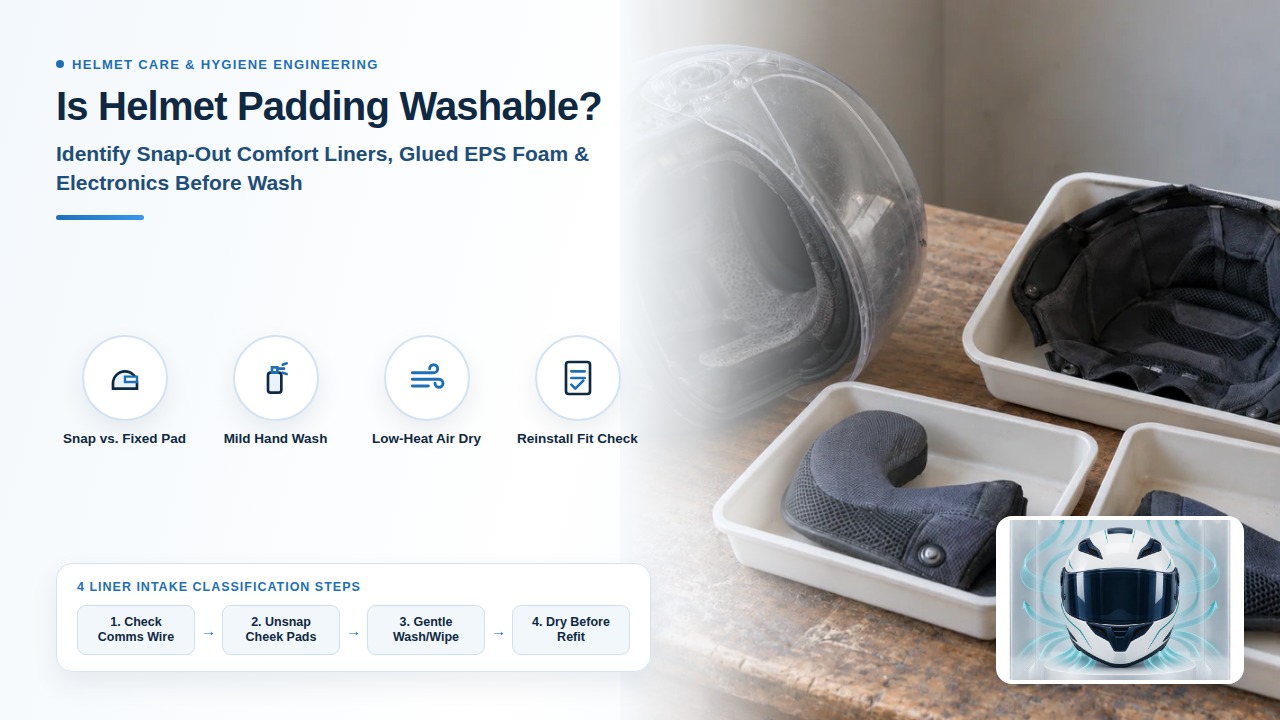
Is Helmet Padding Machine Washable? An Intake Guide for Cleaning Operators
Identify removable comfort padding, fixed interiors and impact liners before accepting a helmet. Check model-specific washing, drying and refitting guidance.
Read article
How to Clean a Football Helmet: Team Equipment-Room SOP
Run a football helmet cleaning and sanitizing SOP with component checks, disinfectant label decisions, batch planning and a downloadable team care log.
Read article